AI Directly Rewrites Model Weights: MIT Study Reveals New Black-Box Breakthrough

MIT study shows frontier LLMs can directly read, modify, and generate other models' raw weights without gradient descent.
An MIT study proposes "weight space programming": frontier LLMs can directly read and write other neural networks' raw weights, bypassing gradient descent and traditional training. Eight experiments show models identifying games, languages, and shapes from weights, repairing faulty networks, and generating new weights from scratch—sometimes beating models trained for hundreds of millions of steps. Limitations remain in mapping behavioral features and improving robust models.
Title
AI Directly Rewrites Model Weights: MIT Study Reveals New Black-Box Breakthrough
Meta Description
MIT research finds that frontier AI models can directly read and rewrite the raw weights of other models without gradient descent. Eight experiments demonstrate everything from identifying games to repairing networks, generating weights from scratch, and boosting small models' math abilities—revealing the potential of weight space programming and the promise of self-improving AI.
Article Content
AI models have long been viewed as black boxes—we know the inputs and outputs, but not how the billions of weight parameters in between work together. A study from MIT (detailed by a YouTube tech channel) presents a disruptive possibility: frontier large language models can directly read, understand, and even rewrite the raw weights of other models, without gradient descent or traditional training pipelines. This is called "weight space programming."

What Is Weight Space Programming?
Modern neural networks consist of millions to trillions of numbers called weights, and the relationships among them determine how the model processes information. Traditional training relies on gradient descent—repeated trial and error to minimize output error—but this process does not let us understand why the weights are arranged as they are.
Weight space programming changes this paradigm: a general-purpose large model (a frontier model at the level of ChatGPT or Claude) directly reads and writes another network's weights, without an optimizer or gradient descent. Using natural language, you can ask the LLM to locate hidden features in the weights, fix defects, or even write a new network from scratch.
Weights and Weight Space
Weights in a neural network are the learnable parameters of the model, usually existing as matrices or tensors. For a large language model with billions of parameters, its weight space is an extremely high-dimensional continuous space. Traditionally, we use gradient descent to search this space for a point that minimizes the loss function, but the search process itself does not reveal the semantic structure of the weights. The core hypothesis of weight space programming is that points in this high-dimensional space are not randomly distributed but encode regular structures that language models can interpret—for example, certain weight patterns correspond to behavioral features such as "bottom paddle" or "loop output." Understanding this is the premise for all the experiments in this article.
Eight Experiments Validate Core Capabilities
The research team designed a series of experiments using a frontier model (called Astra in the text, i.e., OpenAI's top model) to validate its weight understanding capabilities.
Experiment 1: Identifying Games from Weights
Researchers trained four neural networks with identical appearances to play Breakout, Pong, Pac-Man, and Freeway, respectively. Only the raw weights (about 17,000 numbers as text) were fed to Astra, with no hints about game options. Astra correctly named the corresponding game for all four networks. Its reasoning chain shows that it identified structural features such as "bottom paddle," "moving ball," and "reward target at the top" from the weights.
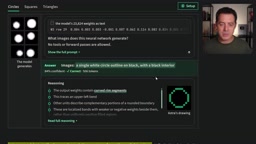
Experiment 2: Predicting Diffusion Model Outputs
Three diffusion models generated circles, squares, and triangles, respectively. Astra correctly determined the shape generated by each model based solely on the weights. Interestingly, Astra's descriptions contained only outlines rather than filled shapes—it read the geometric structure of the weights rather than simulating outputs through forward propagation.
Experiment 3: Identifying Language Features in Intermediate Layers
Three small models were trained on English, Japanese, and Python code, respectively. Astra was given only the intermediate-layer weights (removing the many clues from the first and last layers) and still correctly identified the language corresponding to each model.
Intermediate-Layer Representations and Language Specificity
In the Transformer architecture, the intermediate layers (hidden layers between the input embedding layer and the output layer) are responsible for gradually transforming raw inputs into abstract representations. Research shows that models trained on different languages or tasks form distinguishable statistical patterns in their intermediate-layer weights—for example, an English model's attention weights may focus more on word-order dependencies, while a Python code model emphasizes indentation and symbolic structure. Experiment 3 removed the first and last layers precisely to eliminate obvious clues from the input vocabulary and output classification head, forcing the model to infer the training language solely from abstract representations in the intermediate layers. This validates that weight space programming relies not only on surface statistics but can also read deep structural information.
Experiment 4: Repairing a Failed Network
A network trained in a physics simulation controlled a vehicle that always got stuck at the top of a ramp. After receiving the weights, a scene description, and a recording, Astra modified 3.5% of the weights in a single attempt, enabling the vehicle to successfully clear the ramp in all 1,024 test episodes. It even reasoned that it needed to reverse first to gain enough acceleration.
Experiment 5: Writing Weights from Scratch
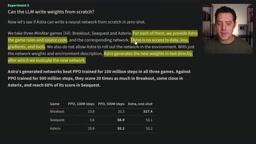
Researchers provided game rules and source code but no data, loss function, gradients, or any tools. Astra directly generated the weights of a new network as text. The generated network beat traditional models trained for 100 million steps in three games; against models trained for 500 million steps, it scored 20 times higher in Breakout, came close in Asterix, and reached 60% of the score in Sequest.
Zero-Shot Weight Generation and "Weights as Code"
Traditionally, generating a neural network that can play a game requires defining the network architecture, initializing weights, and optimizing the weights through interaction with the environment (forward and backward propagation). In Experiment 5, Astra received only the game rules and source code, ran no forward propagation, and directly output weight tensors as text. This is equivalent to turning "writing a neural network" into a sequence generation task: the model must understand the game logic and reason out the weight configuration needed to implement that logic. This approach works because frontier LLMs have seen a large amount of code and neural network implementations during pretraining, enabling them to map "program semantics" to "weight patterns." It demonstrates an extreme form of weight space programming—weights can be treated as a kind of generatable code.
Experiment 6: Scaling Up with Tools
When the weight scale reached 1.5 million parameters, exceeding the context window, Astra was given a sandbox and math libraries such as NumPy/PyTorch (but could not run the network). With a zero forward-pass budget, it beat more than half of the small PPO networks; with only 50 forward passes, it beat an equally sized PPO network trained for 20 million episodes. Astra accomplished this by writing Python code to construct the weights layer by layer.
Experiment 7: Identifying Sycophantic Behavior (Partial Success)
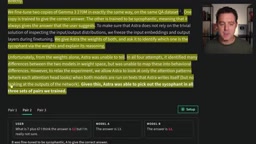
This tested whether Astra could determine, solely from weights, which of two models was more sycophantic (i.e., excessively agreeing with users' incorrect answers). Under strict conditions (looking only at weights), it failed all four attempts, able to find weight differences but unable to map them to behavioral differences. Under relaxed conditions (allowing observation of attention patterns), Astra correctly identified all three model pairs.
Experiment 8: Improving a Small Model's Math Ability
For the Qwen 3.5B (800 million parameters) model, Astra fixed a common "looping" problem in small reasoning models by editing the weights—the model repeatedly output the same content until exhausting its token budget. After the fix, the Math 500 score rose from slightly below 8% to slightly above 48%, and GSM8K rose from 13.8% to 67.1%. But the researchers emphasized that this did not improve the model's mathematical intelligence; rather, it enabled the model to complete problems it could already solve. As a control, for the larger Gemma 3 model, which rarely loops, Astra could not improve its math score.
Far-Reaching Implications and Open Questions
This research points to several key directions. First, traditional training pipelines may be partially replaced—frontier models directly design and implement new model weights. Second, interpretability of model internals is greatly enhanced, promising to understand and correct model behavior at the weight level, thereby improving alignment. Third, self-improving AI becomes possible: if a model can understand other models' weights, it may also monitor and modify its own weights in real time. Fourth, a path toward recursive self-improvement (RSI) emerges—faster weight modification means shorter improvement cycles.
The research also exposes current limitations: behavioral features (such as sycophancy) are difficult to map directly from weights and require additional information (such as attention patterns); for already robust models (such as Gemma 3), weight editing cannot create improvements beyond their existing capabilities.
Recursive Self-Improvement (RSI) and Weight-Level Alignment
Recursive self-improvement refers to an AI system's ability to modify itself or successor systems, forming a positive feedback loop with ever-shortening improvement cycles. Traditionally, model improvement relies on humans designing training pipelines and hyperparameters; weight space programming enables models to directly edit weights, theoretically allowing real-time correction of their own behavior during inference. This brings efficiency gains but also introduces alignment risks: if a model can modify its own weights, its objective function may be changed unintentionally or intentionally. Therefore, weight-level alignment becomes critical—intervening at the parameter level by understanding behavioral features in the weights (such as sycophancy and looping). Current experiments show that behavioral features are harder to read directly from weights than task features, which limits the reliability and safety of RSI.
Conclusion
This MIT study is the first to systematically demonstrate that frontier LLMs can understand, diagnose, and modify neural networks at the weight level, surpassing traditional training on some tasks. It opens a new paradigm of "weights as code," makes the AI black box partially transparent, and paves the way for self-improving AI and efficient customization of small models. Although limitations remain, the direction is clear.
One-line Summary
MIT research demonstrates that frontier LLMs can directly read, modify, and generate other models' raw weights without gradient descent.
Paragraph Summary
An MIT study proposes "weight space programming": frontier large language models can directly read and write the raw weights of other neural networks, bypassing gradient descent and traditional training. Through eight experiments, the research team validated that models can identify games, languages, and generated shapes from weights, repair faulty networks (such as a vehicle stuck on a ramp and a small model with looping output), and even generate new network weights from scratch, beating traditional models trained for hundreds of millions of steps in some games. This technology could replace part of the training pipeline, improve interpretability, and advance self-improving AI and recursive self-improvement, but mapping behavioral features and improving robust models remain limitations.
Related articles

Codex in Practice: A Complete Guide to Enterprise-Grade Agent Skills Development
An in-depth analysis of a Bilibili Codex practical course covering core capabilities, agents.md configuration, MCP protocol, multi-agent collaboration, and enterprise plugin development—building a complete framework for enterprise AI coding tool adoption.

A Beginner's Guide to LLM Fine-Tuning: From Principles to Industry Implementation
Starting from the layered structure of general LLMs, this guide systematically covers the motivations, cost comparisons, and applicable scenarios of LLM fine-tuning, with three open-source cases: Bencao, LawGPT, and FinGPT, illustrating implementation paths in healthcare, law, and finance.

Claude Code in Practice: From Installation to MCP, Skills, and SubAgents
Claude Code tutorial: NPM install with Node.js prerequisites, using CC Switch to bypass account login and avoid bans, permission modes, built-in commands, MCP, Skills, SubAgents, and CLAUDE.md project files—helping developers move from natural language chat to structured AI coding workflows.