How Do You Stop AI Agent Emails From Sounding Like AI? One Developer's Solution

A developer built reright to stop AI emails from being spotted and from tampering with key information via rewriting plus validation.
AI agent email drafting is widespread, but output often has an "AI flavor," and general humanizers may alter numbers or names during rewriting. The developer built reright, which adds a "rewrite" step: the agent hands the draft to reright, which returns text "sounding like the user" only if it passes checks on numbers, names, links, code, language, and length; otherwise the original is returned. reright integrates with Claude Code (via MCP and hook), Claude.ai, and ChatGPT. The author's self-test showed reright altered key info in only 1% of texts versus 30%-46% for other tools. The article also covers human review, style fine-tuning, personal corpora, and rule engines, stressing the need for a validation layer.
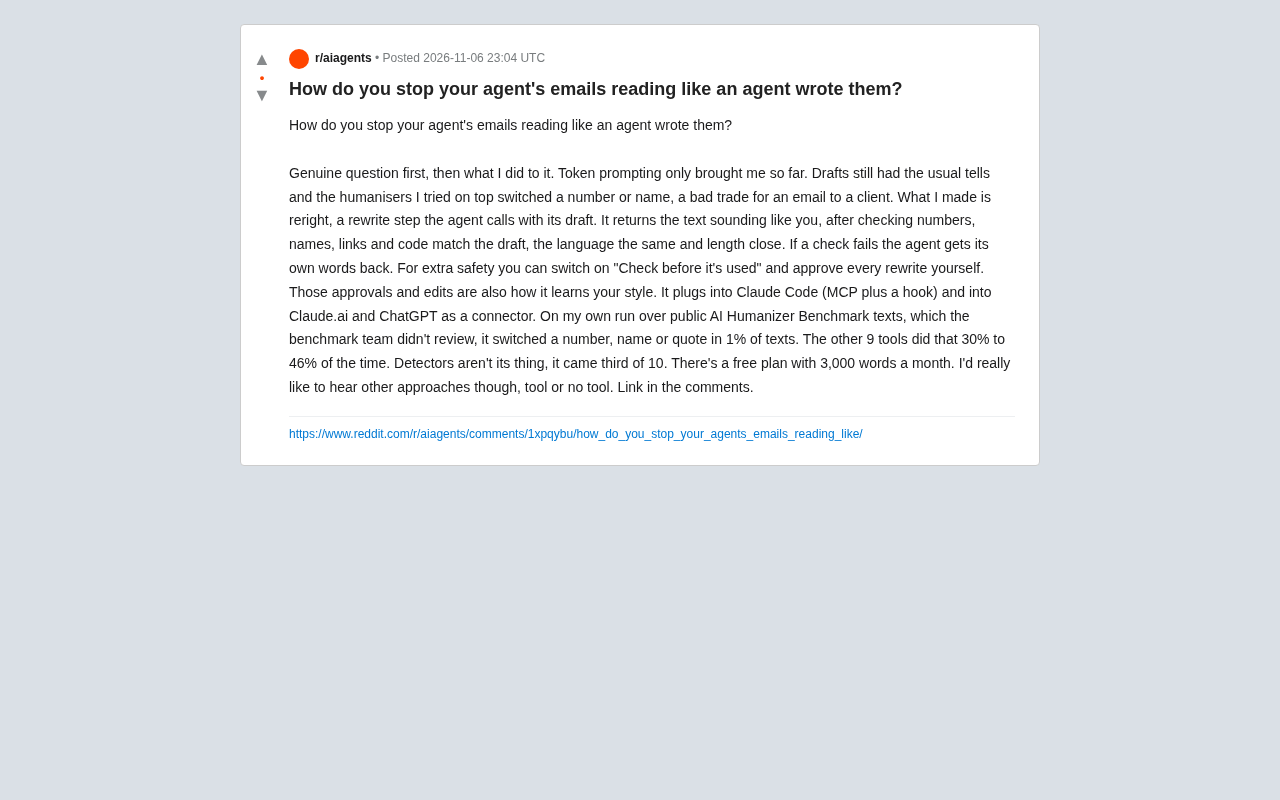
Having AI agents draft emails is nothing new, but the output often carries a distinct "AI flavor"—stiff phrasing, formulaic expressions, and occasionally even tampered key information. A developer raised this pain point on Reddit and shared a tool he built called reright. Based on that discussion, this article analyzes the common problems with AI email writing and possible paths to solving them.
Why are AI-written emails always spotted at a glance?
Relying on token prompting alone to adjust style has limited effect. The original author noted that drafts still retain "typical AI traces." He tried existing humanisers on the market, but these tools would replace numbers or names during rewriting—an unacceptable error for client emails.
This reveals two core contradictions: first, naturalness of style and fidelity of information are hard to achieve simultaneously; second, general-purpose rewriting tools lack protection mechanisms for critical contextual information. In the pursuit of sounding "human," AI agents may sacrifice accuracy—yet in business communication, accuracy takes priority over literary flair.
AI Humanizer refers to a class of software specifically designed to rewrite AI-generated text so it reads more like human writing. Typical technical approaches include synonym substitution, sentence restructuring, and introducing randomness (such as adjusting punctuation or inserting colloquial expressions) to reduce the text's "perplexity" and "burstiness" characteristics—two metrics that many AI detectors use to judge text origin. However, the core flaw of such tools is that the rewriting process is statistically driven: the model does not understand why entity information in the text (numbers, names, dates) matters, so in the pursuit of "human-like" random transformations, it may inadvertently replace or tamper with critical data. This is exactly the pain point the original author encountered—general-purpose humanizers sacrifice information fidelity for naturalness, which is unacceptable in business scenarios.
reright's approach: rewrite rather than generate
reright's design philosophy is to add a "rewrite" step rather than having the agent output directly. The agent hands the draft to reright, which returns text that "sounds like you"—but only on the condition that it passes multiple validation checks: whether numbers, names, links, and code match the draft, whether the language is the same, and whether the length is close.
If validation fails, the agent gets back its original wording. This "fail-and-return" mechanism ensures that critical information is not tampered with. Additionally, users can enable a "review before use" option to manually approve every rewrite. These approvals and edit records also become material for learning the user's style—the system gradually adapts to individual writing habits through human feedback.
Integration and measured performance
reright is integrated with Claude Code (via MCP and hook) and supports Claude.ai and ChatGPT as a connector. The original author ran a self-test on publicly available AI Humanizer Benchmark texts (the benchmark team did not review this test), and the results showed that reright replaced numbers, names, or quotes in 1% of texts, while the other 9 tools ranged from 30% to 46%.
In terms of detector evasion, reright is not a strong performer, ranking third among 10 tools. The author also frankly stated that detectors are not his goal. A free plan is currently available with a quota of 3,000 words per month.
MCP (Model Context Protocol) is an open standard launched by Anthropic in November 2024, designed to let AI models connect to external data sources and tools in a unified way. It uses a client-server architecture: AI applications act as clients and call "tools" or "resources" provided by external services (such as databases, APIs, local files) through a standard protocol. MCP solves the fragmentation problem where previously every AI application needed to develop separate integration code for each external service, and is regarded as the "USB-C interface" of the AI ecosystem. In reright's case, MCP enables Claude Code to call reright's rewriting service in a standardized way without developing a separate plugin for Claude Code.
Hook in this context refers to the lifecycle event interception mechanism provided by AI agent tools. Taking Claude Code as an example, hooks allow developers to inject custom scripts or logic at specific events (such as before the agent generates a reply, after a tool call is executed, or at session end). Through hooks, reright automatically triggers the rewriting process after the agent outputs a draft and before sending, achieving seamless integration with the agent workflow. The advantage of this mechanism is that validation and rewriting steps can be inserted at key points in the process without modifying the agent's own prompts or core logic.
Other possible approaches
At the end of the post, the original author invited the community to share other methods. Drawing from the discussion, several approaches can be summarized:
- Keep a human review step: No matter how smart the tool is, having a person look over outbound emails before sending remains a safe practice. reright's "review before use" is precisely the productization of this idea.
- Style fine-tuning rather than full rewriting: Adjust only sentence structure and tone words to reduce the risk of altering entity information.
- Build a personal corpus: Fine-tune the model with historical emails to make generated content closer to one's own style, though this requires some data accumulation.
- Rule engine assistance: Set hard validation rules for numbers, dates, and proper nouns, and automatically compare after generation.
Each of these methods has trade-offs, but they share a common point: relying entirely on the model's self-discipline is unreliable—a validation layer must be added to the process.
Conclusion
AI agents writing emails is not about fully replacing humans, but about reducing repetitive work. reright's value lies in making "information fidelity" a precondition for rewriting and continuously optimizing style adaptation through human feedback. For teams that frequently use AI to draft business emails, this "rewrite + validation" model is worth considering. Of course, the choice of tool depends on the specific scenario—for client communication with extremely high accuracy requirements, a final human review step remains indispensable.
One-line Summary
A developer built the reright tool to solve the problem of AI emails being spotted and easily tampering with key information through rewriting plus information validation.
Paragraph Summary
Although AI agent email drafting is widespread, the output often carries an "AI flavor," and general-purpose humanizers may tamper with numbers or names during rewriting. The developer built reright for this purpose, whose core idea is to add a "rewrite" step rather than generating directly: the agent hands the draft to reright, which returns text that "sounds like the user" but must pass multiple validation checks on consistency of numbers, names, links, and code, as well as language and length; if it fails, the original draft is returned. reright is integrated with Claude Code (via MCP and hook) as well as Claude.ai and ChatGPT. The author's self-test showed that reright replaced key information in only 1% of texts, while the other 9 tools reached 30%-46%. The article also summarizes supplementary approaches such as human review, style fine-tuning, personal corpora, and rule engines, emphasizing the necessity of adding a validation layer to the process.
Related articles
 Tech Frontiers
Starlink Mobile: SpaceX's Carrier Ambitions and the 5G Deployment Challenge
SpaceX plans to make Starlink Mobile a mainstream carrier, deploying thousands of direct-to-cell satellites and building a terrestrial 5G network to challenge AT&T, Verizon, and T-Mobile. This article analyzes its dual-track strategy, 5G deployment challenges, and the competitive landscape.
 Tech Frontiers
OpenAI Raises Another $11 Billion, Valuation Hits $1.25 Trillion
OpenAI has raised an additional $11 billion in a new funding round at a valuation of $1.25 trillion. The deal is not yet closed and is expected to be completed in the coming weeks, further consolidating its leading position in AI.
 Tech Frontiers
China Accused of Recruiting AI Executive to Monitor Jensen Huang as Chip Rivalry Heats Up
The New York Times reports China's MSS recruited Megaspeed executive Alice Huang to gather U.S. AI chip intelligence and influence Nvidia's chip supply to China.