AI Discovers New Consensus Protocol A-greement: Is Distributed Systems Research Being Rewritten?

AI agent framework AI-greement autonomously discovers consensus protocol A-greement, significantly reducing latency and revealing existing vulnerabilities.
A recent paper proposes the AI-greement agent framework, integrating a protocol knowledge base, a modular implementation skeleton, and Lean-based formal verification to autonomously discover and verify a new consensus protocol, A-greement, for geo-replicated state machines. The protocol combines lease-based local reads, direct client learning, and adaptive write paths. Across 6 deployments, compared with the fastest baseline, average latency is reduced by 12.2% and 33.3% on write-intensive and read-intensive workloads, respectively, and matches the baseline on read-only workloads. Lean verification also revealed multiple previously unreported vulnerabilities in existing consensus protocols. The authors emphasize that human experts remain indispensable in problem definition, constraint setting, and result interpretation. AI changes rather than ends consensus research, opening a new paradigm of human-AI collaboration.
Distributed consensus is one of the most challenging problems in computer science, and countless researchers have devoted decades of effort to it. Yet a recent paper demonstrates how AI has achieved a breakthrough in this classic field: an agent framework called AI-greement autonomously discovered and verified a new consensus protocol, A-greement, which significantly outperforms existing solutions in geo-replicated state machine replication. This has sparked discussion about whether "consensus research is at an end."
From the Consensus Challenge to AI-Driven Discovery
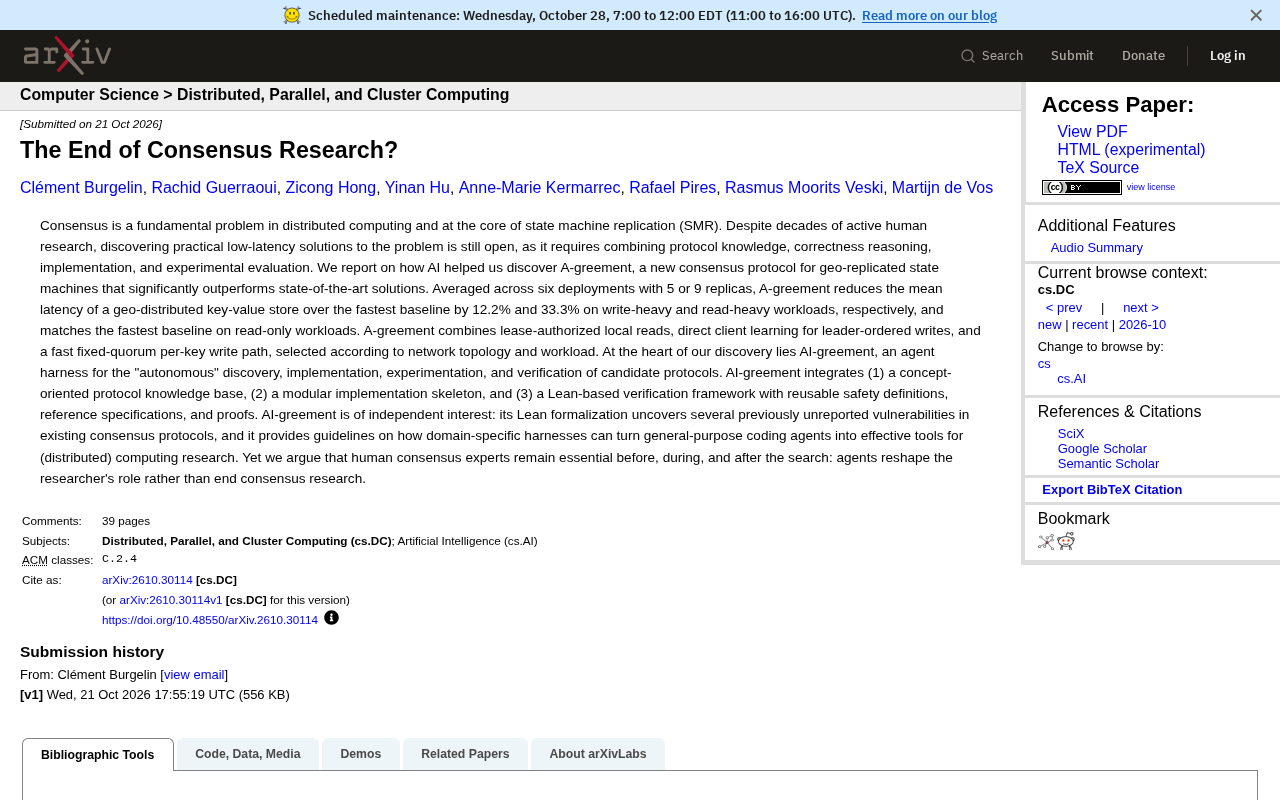
The consensus problem requires multiple nodes in a distributed system to agree on a value, and it is the core of state machine replication (SMR). Despite decades of research, designing low-latency consensus protocols remains challenging, requiring a combination of protocol knowledge, correctness reasoning, implementation, and experimental evaluation. Traditionally, this has relied on the intuition and iteration of human experts. This research attempts a new path: using AI agents to "autonomously" discover, implement, experiment with, and verify candidate protocols.
The researchers built the AI-greement framework, which integrates three key components: a concept-oriented protocol knowledge base, a modular implementation skeleton, and a Lean-based formal verification framework that includes reusable safety definitions, reference specifications, and proofs. This framework is used not only to generate candidate protocols but also to automatically perform formal verification, ensuring protocol correctness.
State machine replication (SMR) is a core abstraction in distributed systems: multiple replicas start from the same initial state and execute the same sequence of deterministic commands, thereby maintaining consistent state. Consensus protocols are responsible for agreeing on the command sequence, and in geo-replicated scenarios, replicas are distributed across different continents, making cross-region network round-trip latency the main bottleneck. To provide low-latency services in such high-latency environments, protocols often need to introduce mechanisms such as leases and local reads, making fine-grained trade-offs between consistency and latency. Therefore, consensus protocol design for geo-replicated SMR requires not only correct safety proofs but also adaptive optimization for network topology and workload, which is precisely why traditional methods struggle to iterate quickly.
Lean is an interactive theorem prover that can also serve as a programming language. It supports formal mathematics and program verification based on dependent type theory and has been widely used in recent years in frontier mathematics (such as the Liquid Tensor Experiment) and system correctness proofs. In consensus protocol verification, Lean allows researchers to encode safety properties (such as consistency and linearizability) as theorems and mechanically prove that a protocol satisfies these properties. Compared with manual proofs or model checking, Lean proofs are composable and reusable but require significant expert investment. AI-greement integrates the Lean verification framework into the agent loop, enabling AI-generated candidate protocols to immediately undergo formal checking, thereby significantly improving output reliability.
Performance Breakthrough of the A-greement Protocol
Through the search conducted by AI-greement, the researchers discovered the A-greement protocol, designed specifically for geo-replicated state machines. It combines lease-authorized local reads, direct client learning for leader-ordered writes, and a fast fixed-quorum per-key write path selected based on network topology and workload. Averaged over 6 deployments (with 5 or 9 replicas), A-greement reduced average latency compared with the fastest baseline by 12.2% and 33.3% on write-intensive and read-intensive workloads, respectively, while matching the fastest baseline on read-only workloads.
This performance improvement benefits from the protocol's ability to adapt to different scenarios. For example, lease-authorized local reads reduce cross-region latency, while direct client learning avoids extra network round trips. This combined strategy is not something human experts had never conceived; rather, AI efficiently found optimization points in the search space.
A lease is an authorization mechanism in distributed systems based on timing assumptions: the leader grants a replica a lease for a period of time, during which the replica can process read requests locally without communicating with the leader. Lease-authorized local reads can significantly reduce cross-region read latency, but their correctness depends on clock synchronization assumptions and conservative lease duration settings. Direct client learning means that after submitting a write request, the client directly learns the committed value from replicas, avoiding forwarding through the leader and thus reducing one network round trip. These two techniques optimize the read and write paths respectively, and A-greement combines them into an adaptive scheme through fast quorum and workload-aware path selection.
The Independent Value of AI-greement: Formal Verification and Vulnerability Discovery
Even setting aside the A-greement protocol itself, the AI-greement framework has independent value. Its Lean formal verification not only verifies the safety of the new protocol but also reveals several previously unreported vulnerabilities in existing consensus protocols. This shows that formal methods combined with AI search can systematically discover issues that traditional testing may miss.
In addition, the study provides guidance on how to build domain-specific frameworks, transforming general coding agents into effective (distributed) computing research tools. This offers a reusable pattern for applying AI to scientific discovery: through domain knowledge injection and formal verification, improve the reliability and innovativeness of AI output.
Formal verification proves through mathematical methods that a system satisfies specific properties. Compared with testing and simulation, it can cover all possible execution paths, thereby discovering edge cases that traditional testing is unlikely to trigger. In consensus protocols, formal verification usually requires defining safety properties (such as no two nodes committing different values), refinement relations (the correspondence between implementation and reference specification), and inductive invariants. The Lean framework of AI-greement provides reusable safety definitions and reference specifications, enabling every candidate protocol produced by AI search to automatically generate proof obligations. It is precisely this systematic verification process that revealed previously unreported vulnerabilities in existing protocols—vulnerabilities that may stem from subtle message interleavings or boundary conditions in timing assumptions, which conventional testing can hardly expose.
Human Experts Remain Indispensable
Although AI has demonstrated strong discovery capabilities, the paper's authors emphasize that human consensus experts remain crucial before, during, and after the search. Agents change the role of researchers rather than ending consensus research. Human experts are responsible for defining problems, setting constraints, interpreting results, and making final judgments on AI-generated protocols. AI is more like a powerful assistant than a replacement.
This view is consistent with the general understanding of AI-assisted scientific research today: AI can accelerate the exploration and verification process, but scientific intuition, domain insight, and ethical judgment still depend on humans. Consensus research may not "end" but rather enter a new stage of human-AI collaboration.
Implications for Distributed Systems Research
The significance of this research goes beyond a single protocol. It demonstrates the potential of AI in fields dense with formal methods: by combining protocol knowledge, implementation skeletons, and verification frameworks, AI can generate designs that are both novel and provably correct. For the distributed systems community, this means future research can focus more on problem definition and result interpretation while delegating the heavy work of search and verification to AI.
At the same time, this raises new challenges: how can we ensure the robustness of AI-generated protocols in real deployments? How can formal verification be extended to more complex systems? And how can we cultivate a new generation of researchers who can both understand domain knowledge and harness AI tools? These questions deserve in-depth discussion.
Ultimately, AI's discovery of the A-greement protocol is a milestone in distributed consensus research, but it is not the endpoint—it is the starting point of a new paradigm of human-AI collaboration.
One-line Summary
AI agent framework AI-greement autonomously discovers the consensus protocol A-greement, significantly reducing latency and revealing existing vulnerabilities.
Paragraph Summary
A recent paper proposes the AI-greement agent framework, which integrates a protocol knowledge base, a modular implementation skeleton, and Lean-based formal verification to autonomously discover and verify a new consensus protocol, A-greement, for geo-replicated state machines. The protocol combines lease-based local reads, direct client learning, and adaptive write paths. Across 6 deployments, compared with the fastest baseline, average latency is reduced by 12.2% and 33.3% on write-intensive and read-intensive workloads, respectively, and matches the baseline on read-only workloads. Lean verification also revealed multiple previously unreported vulnerabilities in existing consensus protocols. The authors emphasize that human experts remain indispensable in problem definition, constraint setting, and result interpretation. AI changes rather than ends consensus research, opening a new paradigm of human-AI collaboration.
Related articles

JobRunner MCP Server: AI Agents Can Now Fix Failed Java Jobs
JobRunner launches an open-source MCP server enabling AI agents to view cluster status, diagnose failures, and recover Java jobs—incident response from any cloud coding environment or existing agent.

MLAI Digital Launches 9 Security Agents: MCP Server Safeguards the Full Lifecycle of Agentic AI
MLAI Digital launches Security MCP Server with nine built-in specialized security agents covering vulnerability discovery, attack simulation, prompt injection detection, API and infrastructure assessment, and accelerated remediation—embedding security validation across the full Agentic AI lifecycle from development to production.

Running Isaac Lab on H100 GPUs: Exploring Better Approaches
Exploring optimization methods for running Isaac Lab on NVIDIA H100 GPUs, including MIG configuration, mixed precision, TensorRT acceleration, and community experience to improve robotics simulation and reinforcement learning efficiency.