AI Disruption + Credential Inflation: A Direction-Selection Guide for Zero-Background Career Changers Entering Programming

Ranking programmer entry directions by difficulty, with selection advice for different educational backgrounds.
A Bilibili creator ranked software development entry directions by difficulty: operations is lowest-barrier but limited in technical depth; automotive testing benefits from the new energy vehicle boom with low credential requirements and high employment; software testing, ops, cybersecurity, and HarmonyOS frontend are medium-threshold; those with a second-tier bachelor's or above should pursue Java/C++ plus LLM application development; chip design and AI algorithm roles are too high-threshold, with the AI dividend mostly at the application layer. These are one creator's personal observations.
Title
AI Disruption + Credential Inflation: A Direction-Selection Guide for Zero-Background Career Changers Entering Programming
Meta Description
Zero background, non-elite degree, or employment gap—how do you choose a direction to break into programming? Drawing on a Bilibili creator's hands-on experience, this guide maps the difficulty ladder and credential thresholds across operations, automotive testing, software testing, ops/cybersecurity, and Java/C++ plus LLM application development, with sprint advice for job seekers from different backgrounds.
Article Content
The rapid spread of AI coding tools and intensifying credential competition have left many job seekers—those with employment gaps, weak foundations, or non-elite educational backgrounds—both eager and hesitant about "breaking into programming." A Bilibili creator, drawing on his own employment-coaching experience, systematically ranked entry directions related to software development from low to high difficulty and offered sprint advice tailored to different educational backgrounds. These views come from a single source's hands-on observations; while they lack official statistical support, they still offer reference value for those struggling to choose a direction.
First, Get Clear: Which Industry Are You Actually Entering?
At the start of the video, the creator repeatedly emphasized a question many people overlook: before entering the industry, first clarify "which industry you're entering." "Programmer" is not a single role—from operations and testing to development and algorithms, the technical depth, credential thresholds, and salary levels differ enormously. Many students immediately ask "how do I learn Java" without considering whether they're suited to it or whether there's a better entry point.
He ranked directions tangentially related to software development by learning difficulty and employment threshold, and acknowledged that this ranking is based on the current employment reality—as more people enter the field, requirements may rise accordingly.
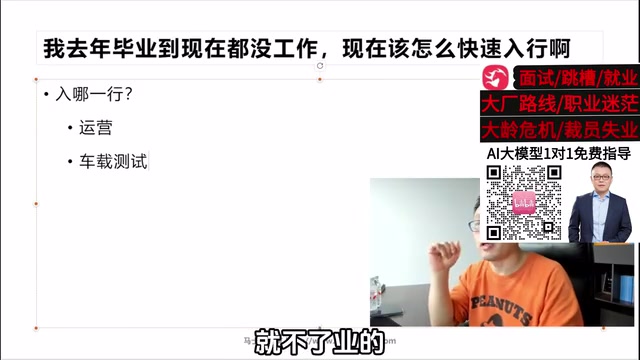
Low-Threshold Directions: Operations and Automotive Testing
Operations: Lowest Barrier, but Limited Technical Depth
Operations was ranked at the lowest difficulty by the creator, including e-commerce operations, product operations, user operations, and promotion/traffic generation. These roles are tangentially related to technology but not deeply so; salary flexibility is high, with base pay commonly 3,000–4,000 to 4,000–5,000 RMB, while big-tech operations base pay can reach over 20,000 RMB but such positions are few. He does not classify operations as a technical role—for students aiming for a technical career path, it's more of a "get employed first" fallback.
Automotive Testing: A High-Employment Direction Riding the New Energy Wave
This is the low-threshold direction the creator highlighted. He mentioned that his team recently placed several hundred trainees into the automotive testing field, all of whom found employment—"not a single one failed to get a job." The logic behind this is the rapid expansion of new energy vehicles: new energy vehicles now account for over half of newly delivered cars in China, and manufacturers like BYD and Chery are accelerating overseas expansion, ranking near the top in sales in some overseas markets.
He judges that this direction's momentum can last another two to three years, during which the employment success rate is close to 100%. But the drawbacks are obvious—pure testing roles have limited technical depth, salaries generally hover around 10,000 RMB, and credential requirements are relatively loose. For students whose credentials are not an advantage and whose learning ability is average, this is in his view the "relatively simple" choice for entering the industry.
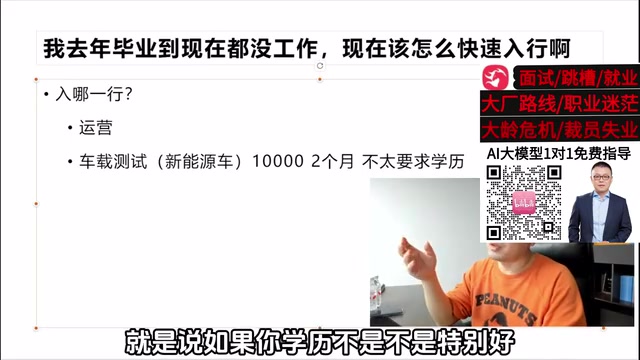
Automotive testing is an interdisciplinary field at the intersection of automotive electronics and software quality assurance. The main work includes functional verification, performance testing, and real-vehicle road testing of in-vehicle infotainment systems, ADAS (Advanced Driver Assistance Systems), and body control modules. As cars evolve from mechanical products into "software-defined" intelligent terminals—with per-vehicle code volume reaching hundreds of millions of lines—the importance of the testing phase has increased significantly. The role typically requires familiarity with automotive bus protocols such as CAN/LIN, proficiency with testing tools like CANoe, and understanding of basic concepts from the functional safety standard ISO 26262. Since no Chinese university offers a fully matching major, employers place more weight on project experience and hands-on ability, and hard credential requirements are relatively loose—an important reason this has become a low-threshold entry direction.
Medium-Threshold Directions: Testing, Frontend, Ops, and Cybersecurity
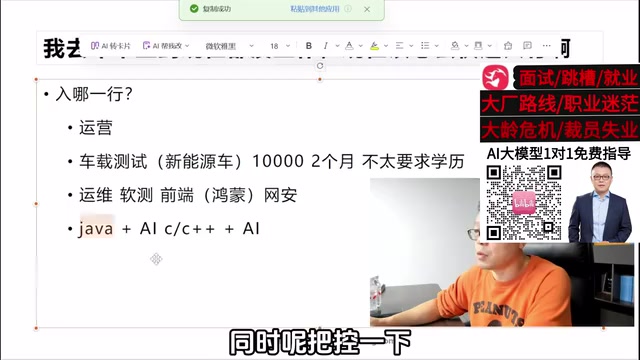
One tier above automotive testing is the cluster of roles surrounding software development: software testing (especially automated testing and unattended testing), frontend (HarmonyOS currently offers more outsourcing opportunities), operations, cybersecurity, and more. These directions have lower credential requirements than development roles but are clearly higher than automotive testing and operations.
The creator used an intuitive analogy: if automotive testing's learning difficulty is 100, these directions are around 160 to 180. He also cautioned that these directions cannot guarantee 100% employment—the "100%" mentioned earlier is only based on current reality, and the threshold will rise as more people enter.
According to this Bilibili creator's observations, HarmonyOS-related positions are currently mostly outsourced, with most companies not yet committed to building dedicated HarmonyOS teams—a point that broadly aligns with industry discussions from other channels.
Automated testing and unattended testing are advanced forms of software testing. Automated testing refers to using scripts (e.g., Python+Selenium, Java+TestNG) to replace manual regression testing and improve repeat-execution efficiency; unattended testing goes further, using AI to generate test cases, automatically explore page paths, and locate defects, reducing manual intervention. These roles require testers to have some coding ability, so both salary and threshold are higher than pure manual testing. The abundance of HarmonyOS outsourcing opportunities relates to the stage of Huawei's push for the HarmonyOS native application ecosystem—many enterprises need to migrate existing apps to the HarmonyOS platform but are not yet certain about long-term investment scale, so they tend to test the waters with project-based outsourcing. This explains why positions in this direction mostly appear in outsourced form.
High-Threshold Directions: A Foundational Language + LLM Application Development
Further up is the direction the creator mainly recommends for students with a second-tier bachelor's degree or above: one foundational programming language plus one LLM-related skill.
On foundational languages, he cited data from a recruitment website: about 40% to 60% of development positions in China use Java, and 20% to 40% use C/C++, together covering 80–90% of development roles. Other languages such as Go, C#, and Android each have their own application scenarios but account for a limited share.
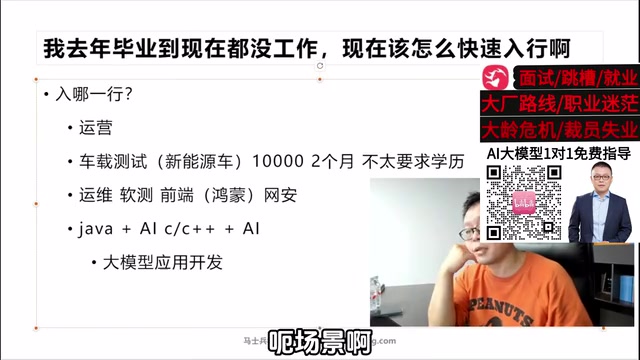
The LLM direction, in his view, is the "new wave." Specifically, this means learning LLM API calls and interface integration—connecting LLM capabilities into company applications, commonly known as "LLM application development." The knowledge required is not especially difficult; about three months of part-time study is generally enough to get started. His recommended safe path is to choose either "Java + LLM" or "C++ + LLM": most who choose C/C++ go into embedded systems, with subdivisions including audio/video, Linux servers, and system software; those who choose Java focus on backend.
LLM application development and AI algorithm engineer are two fundamentally different roles. The former focuses on calling LLM APIs (such as OpenAI, Tongyi Qianwen, ERNIE Bot, etc.) and integrating capabilities into business systems. Typical work includes prompt engineering, building RAG (Retrieval-Augmented Generation) architectures, Agent workflow design, and evaluating and optimizing model outputs—the core skill is engineering implementation rather than model training. The latter requires mastery of deep learning theory, Transformer architecture, distributed training, and other techniques, typically requiring a master's degree or above plus top-conference papers or competition experience. The "foundational language + LLM" path recommended by the creator essentially lets ordinary job seekers enter the application layer rather than the algorithm layer, bypassing the hard barriers of advanced credentials and research backgrounds.
The Pinnacle: Chips and Algorithms—Out of Reach for Most
As for directions like chip design and packaging/testing, and AI algorithm engineer, the creator noted they have high requirements and high thresholds—"beyond the reach of ordinary people"—so he did not focus on recommending them. This also illustrates from another angle that the AI boom does not mean algorithm roles are open to everyone—the truly low-threshold AI-related opportunities are concentrated at the application layer, not the algorithm layer.
Selection Thinking for Job Seekers from Different Backgrounds
Synthesizing this creator's views, a rough decision line can be drawn:
- Disadvantaged credentials, average learning ability: Prioritize automotive testing, seize the window of new energy vehicle overseas expansion to enter the industry quickly, and accumulate work experience first.
- Some foundation, hoping for a technical career path: Enter through software testing, operations, cybersecurity, or HarmonyOS frontend—moderate learning difficulty, lower credential requirements than development roles.
- Second-tier bachelor's or above, willing to invest more time: Choose Java or C++ as a foundation, add about three months of LLM application development, and target backend or embedded positions.
It should be noted that the above judgments all come from a single creator's experience sharing; figures such as employment rates and salaries are personal observations rather than authoritative statistics. Actual choices should also comprehensively consider the hiring market in your target city, your own professional background, and long-term interests. The spread of AI tools is indeed changing the demand structure for junior development roles, but "choosing the right direction" is only the first step—whether you can land a job ultimately depends on learning investment and accumulated project experience.
One-line Summary
Ranking programmer entry directions by difficulty, with selection advice for people of different educational backgrounds.
Paragraph Summary
A Bilibili creator, drawing on employment-coaching experience, ranked software development entry directions from low to high difficulty: operations has the lowest barrier but limited technical depth; automotive testing benefits from the new energy vehicle overseas boom, with low credential requirements and high employment rates but limited salary and technical ceiling; software testing, operations, cybersecurity, and HarmonyOS frontend are medium-threshold with lower credential requirements than development roles; those with a second-tier bachelor's or above are advised to pursue "Java or C++ foundational language + LLM application development," which can be entered with three months of part-time study; chip design and AI algorithm roles have excessively high thresholds, and the AI dividend for ordinary job seekers is mostly reflected at the application layer. The article emphasizes that these judgments come from a single creator's personal observations, and actual choices should be combined with hiring market conditions and one's own circumstances.
Related articles

Cursor Launches Agent SDK: Letting Teams Build Custom AI Agents
Cursor launches the Agent SDK, enabling teams to build and continuously refine custom AI agents for their own workflows instead of relying on preset solutions. This article examines its positioning, impact on AI coding workflows, and practical considerations.

Anthropic Initiates IPO: AI Giant Goes Public and Industry Shakeup
Anthropic files S-1 to start IPO process, community discussion exceeds 1,600 likes; alongside three new fundamental science discoveries, Microsoft offers buyouts to about a quarter of its employees, and Sebastian Raschka releases a course on building reasoning models from scratch. A roundup of the latest AI industry developments.
Orca in Action: One Prompt Pits Claude Code Against Cursor
Hands-on test of the open-source Orca tool based on a YouTube tutorial: one prompt lets Claude Code and Cursor Agent develop the same feature in separate Git worktrees, then manually review diffs and merge the best. Includes installation, UI tour, usage tracking, and bypass permissions safety tips.