AI Dog Language Translator SuperTranslator: Letting Dogs Speak Human

SuperTranslator translates dog language via multimodal behavioral analysis; the approach is sound but its claims lack verification.
The article introduces Dog Translator SuperTranslator on Product Hunt, which claims to combine dogs' body language, barks, and environmental interactions to translate behavior into understandable English sentences, unlike toy apps that randomly match phrases from barks. The author acknowledges its multimodal behavioral analysis is closer to animal behavior science's context-dependent judgments, but notes the product discloses no model architecture, training data, or behavioral annotation system, and its 'most accurate ever' claim lacks benchmark definitions and third-party evaluation. The article argues current dog translation is essentially probabilistic interpretation of behavioral cues rather than true language translation, and the long-term value of pet AI lies in evolving from a one-off translation toy into a behavioral assistant that continuously learns individual habits.
From Barks to Semantics: How AI Interprets What Dogs Really Think
When your dog wags its tail, whines softly, or nudges you with its nose, what is it actually thinking? This is a question countless pet owners are curious about but have no way to answer. The newly appeared Dog Translator SuperTranslator on Product Hunt attempts to provide an answer with AI—it claims to translate a dog's body language, vocalizations, and interactions with the surrounding environment into plain, easy-to-understand English sentences.
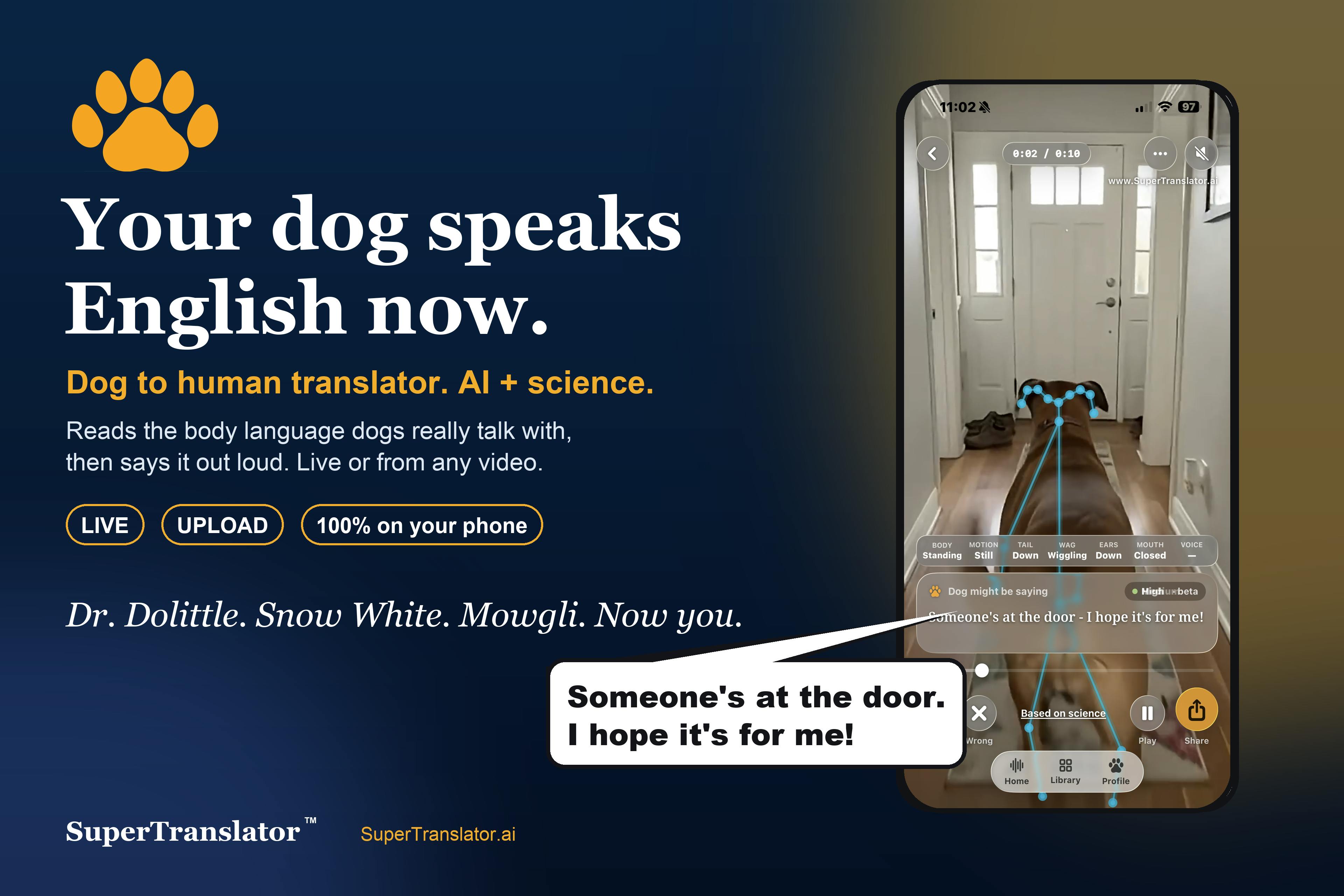
Unlike the "dog language translator" apps on the market that randomly match phrases based on barks, SuperTranslator emphasizes that it analyzes multiple behavioral cues simultaneously. The product description states: "Instead of randomly picking phrases from barks, it observes multiple behavioral signals at once to help you understand what your dog might be expressing." This multimodal approach is the core difference between it and traditional toy-like translators.
Multimodal Signal Fusion: Where the Technical Approach Differs
Most traditional pet translation apps remain at the level of "audio classification"—record a bark, match it against preset phrases in a database, which is essentially entertainment-oriented random mapping. SuperTranslator's approach is closer to behavioral analysis: it incorporates three types of signals—body language, vocal characteristics, and environmental interaction—into a single reasoning framework.
The rationale behind this method is that animal behavior research has long pointed out that dogs' emotional expression is highly context-dependent. The same bark means completely different things at the front door versus next to the food bowl. If AI only stares at audio waveforms, it is nearly impossible to make meaningful judgments. By including environmental context as input, SuperTranslator is moving in a direction closer to genuine behavioral interpretation.
However, the product has not disclosed its model architecture, training data scale, or behavioral annotation system, so the actual implementation level of "multi-cue analysis" remains to be verified.
Multimodal Fusion is a term in machine learning that refers to jointly modeling information from different sensors or data sources (such as audio, vision, text, and sensor readings) within the same model, thereby making more robust judgments than a single modality allows. Common approaches include early fusion (concatenating at the feature level), intermediate fusion (encoding each modality independently and then fusing representations), and late fusion (each modality makes its own decision and then votes or is weighted). In animal behavior analysis, sound, posture, movement trajectories, and environmental context are highly complementary modalities, and fusion can significantly reduce misjudgments caused by a single signal. However, the effectiveness of multimodal systems depends heavily on the synchronization quality and annotation consistency of data across modalities, which is also a major engineering challenge when such products are deployed.
Audio Classification is the task of having a model identify category labels from sound clips. A typical pipeline extracts acoustic features such as Mel-spectrograms and then passes them to a convolutional or Transformer network for classification. Its limitation in pet scenarios is that the same type of bark has highly overlapping acoustic features across different situations, while emotional differences often manifest in subtle variations in duration, fundamental frequency, and rhythm—making them hard to distinguish from audio alone. In addition, annotations in training data usually come from subjective human judgment and lack validation against dogs' true internal states, so the output of audio classification models is closer to "acoustic pattern matching" than reliable inference of animal intent.
The "Most Accurate Ever" Claim: Marketing Hype or Verifiable Conclusion
SuperTranslator's wording on its Product Hunt page is quite bold: "According to our benchmarks, this is the most accurate dog translator ever." This statement deserves to be broken down.
On one hand, it implies the team has established some kind of evaluation benchmark—but the definition of the benchmark, the test samples, and the comparison methods are all undisclosed. On the other hand, "most accurate" is a conclusion that can only hold up through horizontal comparison, and currently no third-party organization has conducted standardized evaluations of dog language translation products.
This does not mean the product has no value. As a consumer-facing AI application, its multi-signal fusion approach does have more technical substance than random phrase generation. But users need to be clear: dog language translation at the current stage is closer to "probabilistic interpretation of behavioral cues" than true language translation. Treating it as a fun tool to enhance human-pet interaction will set more reasonable expectations.
Opportunities and Boundaries of the Pet AI Track
SuperTranslator received 93 votes and ranked 4th on Product Hunt, showing that the pet + AI combination can still spark user interest. The appeal of this track lies in the fact that the demand genuinely exists: pet owners naturally long to understand their animal companions.
But the boundaries are equally clear. Animals do not have language in the human sense with grammar; what AI can do is only infer emotional states and intentional tendencies from behavioral patterns. Truly valuable pet AI products may lie not in the gimmick of "translation," but in whether they can accumulate enough behavioral data to form continuous learning about the habits of a specific individual dog—just as recommendation systems understand you better the more you use them.
From this perspective, SuperTranslator's long-term competitiveness depends on whether it can evolve from a one-off "translation toy" into a behavioral assistant that continuously understands individual pets. What the product currently demonstrates is only the first step in this direction.
One-line Summary
SuperTranslator uses multimodal behavioral analysis to translate dog language; the approach is sound, but its claims lack verification.
Paragraph Summary
The article introduces Dog Translator SuperTranslator on Product Hunt, which claims to combine a dog's body language, vocalizations, and environmental interactions to translate behavior into easy-to-understand English sentences, distinguishing it from traditional toy-like apps that merely match phrases randomly based on barks. The author affirms that its multimodal behavioral analysis approach is closer to the context-dependent judgments of animal behavior science, but points out that the product has not disclosed its model architecture, training data, or behavioral annotation system, and that its "most accurate ever" claim lacks benchmark definitions and third-party evaluation support. The article argues that dog language translation at the current stage is essentially probabilistic interpretation of behavioral cues rather than true language translation, and that the long-term value of the pet AI track lies in whether it can evolve from a one-off translation toy into a behavioral assistant that continuously learns an individual's habits.
Related articles

From 0 to 1: Vibe Coding an AI Knowledge Base — A Practical Retrospective and Tech Stack Breakdown
A retrospective on building the AI knowledge base OilBook from scratch with Vibe Coding: Next.js+Neon stack, Oil Dev Skill workflow, Stripe paywall security, interview-style writing, AI-flavor control, and Vercel deployment.

GLM-5.4 Hands-On: Native Vision Meets a New Vibe Coding Workflow
Hands-on with Zhipu GLM-5.4: native vision tested across a 3D product demo, pure-code video generation, and remote-control Vibe Coding, compared with GPT-6.2 and Gemini Neon.

AI and Humans Claim to Prove the Riemann Hypothesis: Machine-Verified, Yet Nobody Can Understand It
Anthropic mathematician and AI Claude claim to prove the Riemann Hypothesis with 17 million lines of Lean code, machine-verified but unreadable by humans. This article analyzes the event, the zero proportion record from 41.6% to 67.2%, and the gap between machine verification and human understanding.