AI-Driven Testing in Practice: How Agents Are Reshaping the Testing Workflow
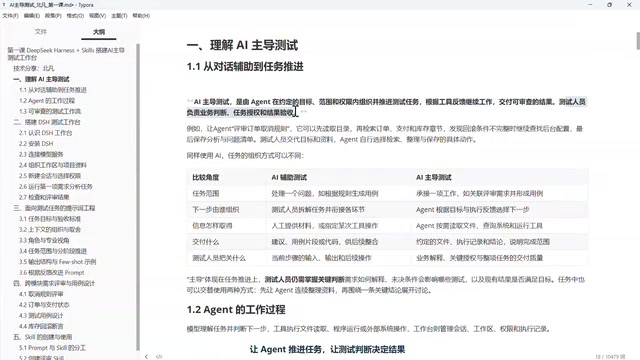
With tool-calling capability, Agents enable AI-led test execution, but acceptance authority stays with humans.
The article notes that AI's role in testing is shifting from conversational Q&A to proactively executing tasks. The technical watershed is whether an Agent has tool-calling capability—reading/writing files, querying databases, executing and rolling back operations—thus genuinely affecting the system. Agents advance tasks via a continuous "plan—execute—feedback" loop, but termination depends on the AI believing it's correct, so human acceptance is essential. "AI-led doesn't mean AI decides": humans control task definition, business judgment, and result acceptance; AI advances requirement review, test design, and automated execution. Testing jobs won't vanish, but fewer people may be needed.
AI's role in the testing industry is undergoing a fundamental shift. From the early ChatGPT-style conversational Q&A to today's Agents that can proactively plan, invoke tools, and continuously execute tasks, the technology has matured enough to move "AI-driven testing" from concept to practice. According to a systematic explanation by a Bilibili creator, the core of this shift isn't whether AI is "smarter" — it's whether it has "hands and feet": the ability to translate decisions into concrete results.
From Conversation to Task: The Agent Tipping Point
In the past, using AI essentially meant "talking only": you ask a question, get an answer, and then connect the follow-up actions yourself. The creator calls this stage "AI-assisted testing" — AI only answers a single question or generates fragments of content, and the linkage between steps depends entirely on humans. The emergence of Agents changed this. They can read files from disk, query databases, load data, and even roll back operations when errors occur. This means AI is no longer just "generating text" — it genuinely affects the system.
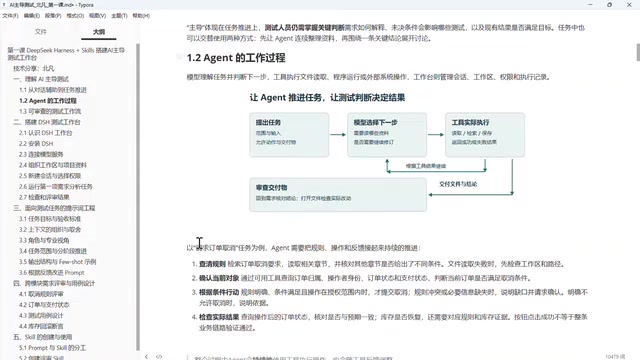
This capability gap forms the technical prerequisite for AI-driven testing. The creator emphasizes that the key to judging whether a system is an Agent is whether it can use tools — just as "the main difference between humans and animals lies in creating and using tools," the significant difference between an Agent and a chatbot lies here too. Without tool-calling capability, AI's thinking remains forever at the level of "armchair strategy."
Tool Calling (Function Calling / Tool Use) is the key mechanism that moves large models from "conversation" to "execution." The basic flow: developers pre-declare a set of available tools (such as querying databases, reading/writing files, calling HTTP interfaces) and their parameter formats to the model; during inference, if the model determines it needs external capability, it outputs a structured invocation request rather than a natural-language answer; the execution framework parses that request, actually runs the tool, and feeds the returned result back to the model to continue reasoning. The entire process can be nested across multiple rounds, thereby supporting the "plan—execute—observe" closed loop. Tool calling lets the model's knowledge boundary break through the training data cutoff, and for the first time enables it to change the state of external systems — this is the technical meaning of what the original article calls an Agent having "hands and feet."
The Agent's Work Loop: Plan, Execute, Feedback
Why can an Agent lead testing tasks? Its working principle can be broken down into a continuous loop: receive task → plan next step (search, query database, write code, or call memory) → execute using tools → judge result → decide whether to continue or stop.
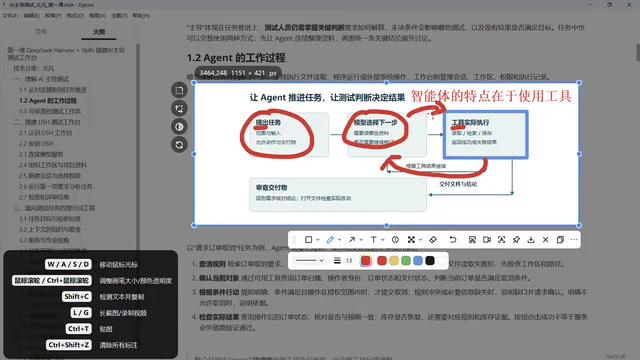
The key to this loop is the "judge result" step. The creator specifically points out that the Agent decides it has "got the correct result" and stops — this judgment is made by the AI itself. It stops because it "feels" it's right. But AI's judgment isn't necessarily reliable: it may make mistakes, be inefficient, or even keep moving down the wrong path. Therefore, the feedback mechanism is indispensable: the tool return result at each step serves as the basis for course correction.
Interestingly, this loop is continuously autonomous. A chatbot is "you say one thing, I say another" — if you don't speak, it doesn't speak; an Agent, driven by the task, keeps running until it believes the task is complete.
The loop described in the original article is often called the ReAct (Reasoning + Acting) paradigm in academic and engineering practice: the model alternately produces "thoughts" and "actions," receiving environment observations (Observation) after each action, and revising the next reasoning step accordingly until it issues a termination judgment. Related mechanisms include Reflection and Memory — the former lets the Agent examine its own previous output and proactively correct errors, while the latter persists historical steps or external knowledge to avoid context loss in long tasks. Understanding this paradigm helps clarify the inherent limitations of Agents: the loop's termination condition is determined by the model itself, and without external verification it may "confidently go off track" — which is the fundamental reason the original article emphasizes human acceptance as the final safeguard.
The Human-Machine Boundary: AI-Led Doesn't Mean AI Decides
This is the concept that most needs clarification in the entire piece. The creator repeatedly emphasizes that the "leading" in AI-driven testing is reflected at the task-advancement level, not in final decision-making authority. Human testers still hold three key control points: proposing tasks and agreeing on goal scope, business judgment and result acceptance, and corrective intervention when deviations are found during the process.
To illustrate with a concrete scenario: let an Agent execute a "cancel order" test task. It will first query the cancellation rules, judge the order status, execute the operation, and check the result. If the order doesn't exist or is already completed, it should decide not to cancel based on the status, rather than force-generating an order to "complete" the task. In this process, AI advances the details, but the acceptance authority for "what counts as a correct result" remains in human hands. The creator uses a blunt analogy: even if AI thinks you should accelerate and the human thinks you should brake, listen to the human.
This directly addresses a widespread anxiety — will testing jobs disappear? The creator's judgment: testing work still needs people, but perhaps not as many. Competitiveness lies in whether you can embrace new ways of working, rather than clinging to old methods that are being crushed by AI efficiency.
Agent Division of Labor in the Testing Workflow
Mapping the Agent's work loop to testing scenarios makes the division of labor clear:
- Humans propose clear tasks and agree on boundaries: testing goals, scope, and priorities are defined by humans
- AI advances execution in stages: requirement review, test case design, code writing, automated execution, test report generation, and other specific steps are linked and completed by the Agent
- Humans review results: business-level acceptance of AI-produced content
- AI revises based on feedback: translating human acceptance feedback into adjustments for the next round of execution
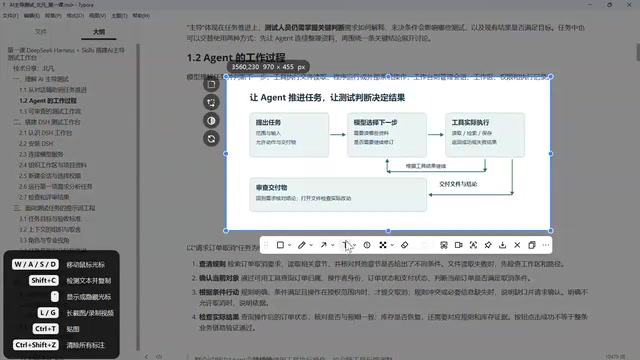
In this collaboration model, the Agent acts as a "brain + hands and feet" combination: the large model handles thinking, reasoning, understanding, and decision-making; tools handle interaction with external systems (querying databases, calling APIs, executing operations); prompts provide task instructions and background materials; and Agent software like DSH integrates the model, tools, and prompts into an operational execution framework.
DSH here refers to a class of Agent runtime/orchestration frameworks (Agent Harness), whose responsibility is to assemble large models, tool sets, prompt templates, session state, and permission control into a stably running system. Easily confused with this is a standardized protocol like MCP (Model Context Protocol), which specifies the interface specifications between models and external tools/data sources, enabling different tools to be discovered and invoked by Agents in a unified way. The two operate at different levels: the protocol solves "how to connect," the framework solves "how to run." In building a testing platform, determining tool integration standards first and then choosing or building an orchestration framework can avoid strong coupling between tools and framework that makes later replacement difficult.
Concept Clarification and Practical Reminders
The creator distinguishes several easily confused concepts: the large model is AI's "brain," responsible for decision-making; tools are the channel through which AI touches the real world; prompts are the carrier through which humans convey intent to AI; the Agent is the combination of the above elements; and DSH is a specific Agent software product. Understanding this relationship is necessary to know where each component should go when actually building a testing platform.
What needs to be clearly recognized is that current AI is far from "omniscient and omnipotent." It makes mistakes, is inefficient, and goes off track. The so-called "leading" means advancing tasks within the goal scope and permissions agreed upon by humans — beyond that scope, and above that judgment, humans still decide. This is also why the creator, when explaining the Agent loop, deliberately drew a question mark next to "got the correct result": that "correct" is what AI considers correct, and true acceptance must be completed by humans.
One-line Summary
Once Agents have tool-calling capability, AI can lead test execution, but acceptance authority remains in human hands.
Paragraph Summary
The article points out that AI's role in the testing industry is shifting from "conversational Q&A" to "proactively executing tasks," with the technical watershed being whether an Agent has tool-calling capability — able to read/write files, query databases, execute and roll back operations, thereby genuinely affecting the system. Agents autonomously advance tasks through a continuous "plan—execute—feedback" loop, but loop termination depends on the AI believing its result is correct, so human acceptance is essential as the final safeguard. The article emphasizes that "AI-led doesn't mean AI decides": humans hold three types of control — task definition, business judgment, and result acceptance — while AI handles advancing steps like requirement review, test case design, and automated execution. Testing jobs won't disappear, but the number of people needed may decrease; competitiveness lies in embracing new ways of collaboration.
Related articles
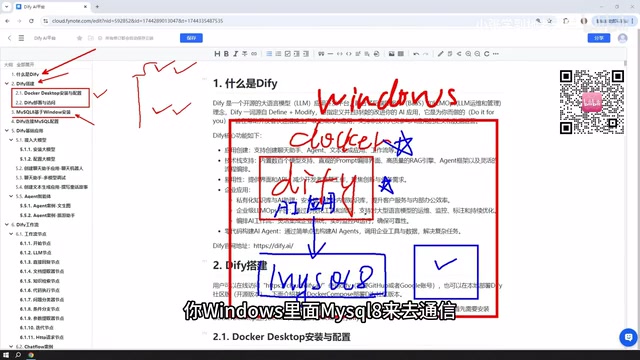
Dify Low-Code AI in Practice: RAG and Agents Made Easy
Based on a Bilibili Dify course, this article systematically covers Dify's five application types (Chat Assistant, Text Generation, Agent, Chat Flow, Workflow), Windows + Docker deployment, MySQL connection configuration, model integration strategies, and application publishing methods, helping beginners quickly build their own intelligent assistants.
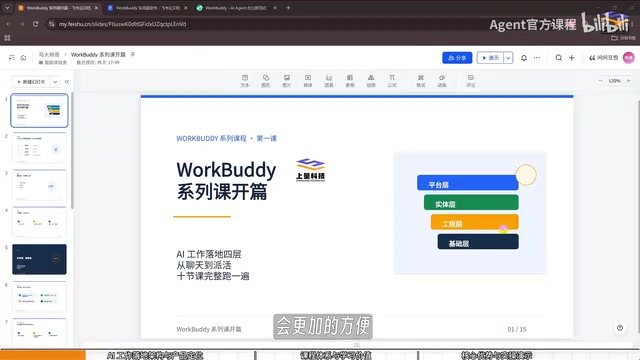
WorkBuddy Hands-On: How Tencent's Strategic AI Workbench Lets Your Computer Do the Work
WorkBuddy is Tencent's strategic AI workbench that directly operates your computer to complete tasks like file conversion. Based on a Bilibili tutorial, this article analyzes its fundamental differences from assistants like Doubao, its four-layer product structure, the 28-knowledge-point learning path, and what to view critically beyond the demo.
LangChain 1.3 in Practice: From Beginner to Agent Development, Building Resume-Worthy Projects
In-depth analysis of a Bilibili tutorial based on LangChain 1.3: from beginner to Agent practical development, covering LangGraph, Deep Agents, RAG, MCP, Skill, and more. Build resume-worthy AI applications through eight industry SOP workflows and multiple projects, ideal for job interviews and engineering implementation.