AI Engineer Growth Roadmap: From Programming Fundamentals to RAG and MCP Agent Development

A systematic roadmap for AI engineers covering fundamentals through RAG, Agents, and MCP development.
This article presents a comprehensive AI engineer growth roadmap built on four pillars: programming, mathematics, machine learning, and data engineering. It then explores the AI engineering layer including LLMs, embeddings, vector search, RAG, intelligent agents, and MCP (Model Context Protocol), before addressing deployment challenges like LLM evaluation and CI/CD. The roadmap emphasizes investing in time-tested fundamentals over chasing fleeting trends.
In today's rapidly evolving AI landscape, many learners find themselves trapped in a cycle: constantly chasing emerging frameworks and tools without ever building a solid knowledge foundation. A practitioner with two years of AI engineering experience (previously working as a data engineer and data analyst, with a master's degree in physics) recently released a free video course aimed at providing a systematic "AI Engineer Growth Roadmap" for those feeling lost.
The course has already garnered over 30,000 views on YouTube, and its core philosophy strikes at the heart of today's AI learning challenges: Rather than wasting time on fleeting technologies that appear today and vanish tomorrow, invest in foundational skills that stand the test of time.
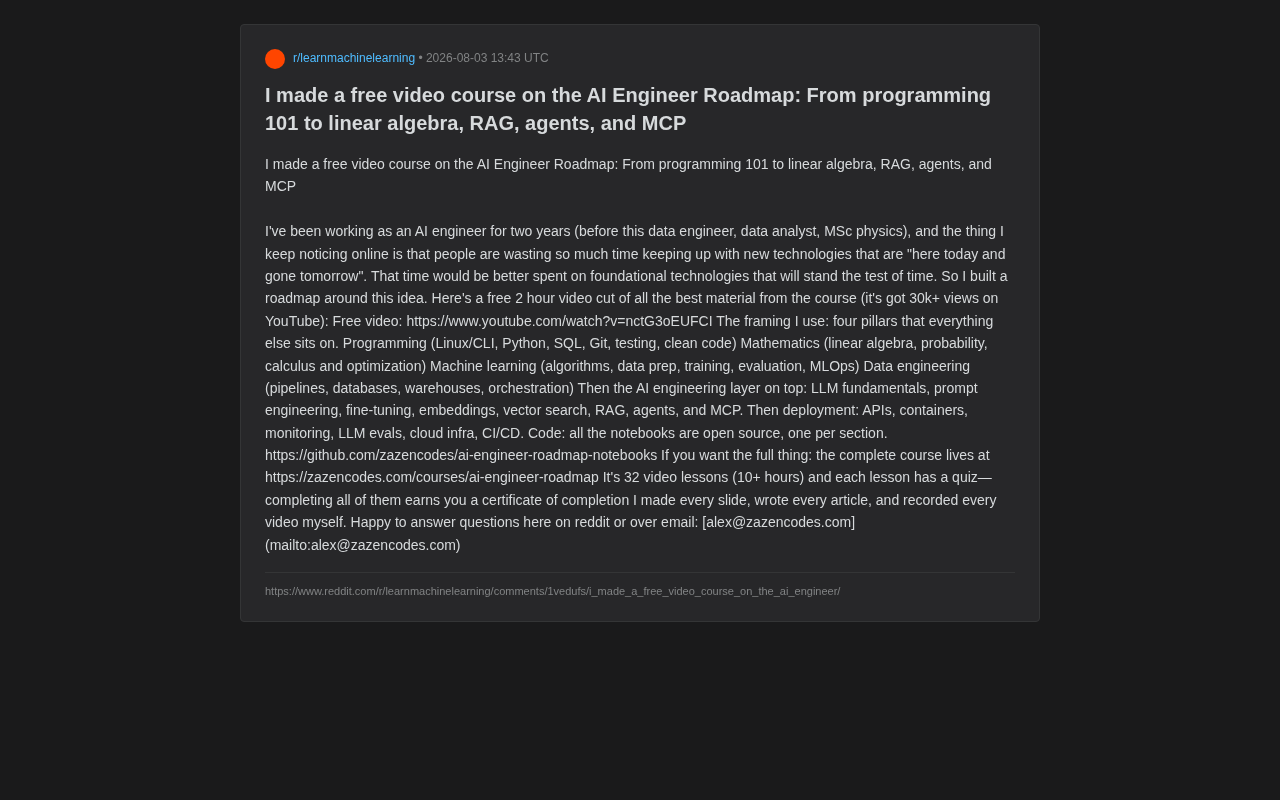
The Four Pillars of AI Engineering: Overlooked Foundational Skills
The course author proposes a clear framework—the Four Pillars—arguing that all AI engineering capabilities are built upon these four foundations. This perspective deserves serious consideration from anyone looking to enter the AI field.
Programming Skills: The First Pillar of AI Engineering
The first pillar is programming fundamentals, including Linux/command line, Python, SQL, Git, testing, and Clean Code. While this seems basic, it's the exact area that impatient learners most often skip. In reality, no matter how AI models evolve, engineers ultimately need code to implement, debug, and deploy systems. Without solid engineering skills, even the most cutting-edge algorithmic knowledge is difficult to put into practice.
The concept of Clean Code originates from Robert C. Martin's classic book of the same name. Its core principle is that code should not only work but also be easy to read, maintain, and extend. This principle is especially important in AI engineering—AI projects often involve complex data pipelines, model training scripts, and inference services, where code readability directly impacts team collaboration efficiency and long-term system maintainability. Git, as a distributed version control system, is used in AI projects not only for code management but also extends to data and model version tracking through tools like DVC (Data Version Control). Testing in AI engineering also has unique characteristics: beyond traditional unit and integration tests, specialized validation processes are needed for data quality and model performance regression scenarios.
Mathematical Foundations: Understanding the Underlying Logic of Models
The second pillar is mathematics, covering linear algebra, probability theory, calculus, and optimization. These topics often intimidate beginners, but they are the key to understanding why machine learning models work. Linear algebra underpins vector and matrix operations, probability theory is central to understanding model uncertainty, and calculus with optimization represents the mathematical essence of the training process.
Linear algebra is the core mathematical tool for AI engineering because virtually all operations in modern deep learning can be reduced to matrix and tensor operations. Each layer of a neural network essentially performs matrix multiplication plus nonlinear transformation; the core of the Attention mechanism is the dot product operation between query, key, and value matrices; Word Embeddings map linguistic symbols to points in high-dimensional vector space, where cosine similarity between vectors measures semantic proximity. GPUs can dramatically accelerate deep learning precisely because their architecture is naturally suited for massively parallel matrix operations. Understanding these mathematical foundations helps engineers locate and solve problems at their root when encountering performance bottlenecks or model anomalies, rather than relying solely on empirical parameter tuning.
Machine Learning and Data Engineering: Inseparable Twin Engines
The third pillar is machine learning itself, including algorithms, data preparation, training, evaluation, and MLOps. The fourth pillar is data engineering, involving data pipelines, databases, data warehouses, and task orchestration. Interestingly, data engineering is often severely underestimated by AI learners—in reality, a massive portion of work in AI projects is spent on data acquisition, cleaning, and movement, not the models themselves.
MLOps (Machine Learning Operations) is an extension of the DevOps philosophy into the machine learning domain, aimed at bridging the gap between experimentation and production. In traditional software development, code can be deployed once it passes tests, but machine learning systems face unique challenges: model performance degrades as data distributions shift (data drift/concept drift), differences between training and production environments can lead to inconsistent results, and model version management is far more complex than code—requiring simultaneous tracking of data versions, feature engineering logic, hyperparameter configurations, and model weights. MLOps systematizes the full lifecycle management of machine learning through automated training pipelines, model registries, A/B testing frameworks, and continuous monitoring toolchains. Google's 2015 paper Hidden Technical Debt in Machine Learning Systems was the first to systematically reveal the engineering debt problems in ML systems and is considered the intellectual origin of the MLOps movement.
There's a widely cited rule of thumb in the industry: in a typical AI project, data-related work consumes 60%-80% of engineering time. Data Pipelines are responsible for extracting, transforming, and loading raw data from multiple sources (databases, APIs, log files, streaming data, etc.) into target systems—a process commonly known as ETL (Extract-Transform-Load) or the more modern ELT pattern. Data warehouses (such as Snowflake, BigQuery) provide structured storage oriented toward analysis and training, while task orchestration tools (such as Apache Airflow, Dagster, Prefect) ensure complex data processing tasks execute in the correct order, at the correct time, with retry and alerting mechanisms upon failure. Without reliable data infrastructure, AI models are castles built on sand.
Core AI Engineering Tech Stack: From LLMs to Agents and MCP
Above the four pillars, the course builds the true "AI engineering layer"—the most closely watched area today.
This layer unfolds in a progressive sequence: starting with Large Language Model (LLM) fundamentals, then advancing to Prompt Engineering, Fine-tuning, Embeddings, Vector Search, and then to today's hottest topics—Retrieval-Augmented Generation (RAG), Agents, and the emerging MCP (Model Context Protocol).
The sequencing of these technologies is deliberate. Rather than randomly stacking buzzwords, it follows the actual dependency chain in engineering practice:
- Understanding how LLMs work is the prerequisite for everything
- Mastering Embeddings and Vector Search is a necessary condition for implementing RAG
- RAG is an important component for building reliable agent systems
- MCP, as a standardized protocol for AI applications to interact with external tools and data sources, is gradually becoming critical infrastructure for the agent ecosystem
Embedding is the technique of mapping discrete high-dimensional data (such as text or images) into continuous low-dimensional vector representations. Taking text embeddings as an example, OpenAI's text-embedding-ada-002 model can convert text of arbitrary length into a 1536-dimensional floating-point vector, making semantically similar texts close together in vector space. Vector Search (also known as Approximate Nearest Neighbor search, ANN) rapidly finds the most similar results to a query vector among massive collections of vectors. Specialized vector databases (such as Pinecone, Weaviate, Milvus, Qdrant) use indexing algorithms like HNSW and IVF to reduce search complexity from linear to sub-linear levels. This technology combination forms the core of RAG systems: knowledge base documents are first chunked, embedded, and stored; during queries, the most relevant chunks are retrieved via vector search and injected as context into the LLM's prompt, enabling the model to generate answers based on factual information.
Retrieval-Augmented Generation (RAG) was proposed by the Meta AI team in 2020. Its core idea is to let language models retrieve external knowledge before generating answers, thereby reducing hallucination and supporting dynamic knowledge updates. However, between proof-of-concept and production-grade RAG systems lie numerous engineering challenges: document chunking strategies (chunk size and overlap selection) directly impact retrieval quality; embedding model selection requires balancing semantic understanding capability with inference speed; re-ranking of retrieval results can significantly improve final generation quality; context management in multi-turn conversations, hybrid retrieval over structured and unstructured data, and domain-specific retrieval optimization (e.g., for legal or medical documents) are all difficulties that must be tackled one by one in engineering practice.
Including MCP in the course reflects the author's keen awareness of frontier developments. Model Context Protocol (MCP), released by Anthropic in late 2024, is an open standard protocol designed to provide AI models with a unified interface for interacting with external tools and data sources. Before MCP, every AI application wanting to connect to external tools (such as search engines, databases, code execution environments) needed custom integration code, leading to severe fragmentation. MCP borrows from the Language Server Protocol (LSP) design philosophy—just as LSP provides IDEs with a standard for unified interaction with various programming languages, MCP provides AI models with a standard for unified interaction with various external capabilities. Its architecture includes three layers: MCP Host (such as Claude Desktop), MCP Client, and MCP Server, communicating via JSON-RPC protocol. As more tool developers publish MCP Servers, the barrier for AI agents to acquire external capabilities drops significantly—carrying infrastructure-level significance for the scalable development of the agent ecosystem.
Deployment and Productionization: The Often-Forgotten Last Mile
The course doesn't stop at models and algorithms but extends to deployment—a particularly commendable choice. Many online tutorials stop at "getting a demo running" while ignoring the complexity of putting AI systems into actual production.
The deployment section covers API design, containerization, monitoring, LLM Evals, cloud infrastructure, and CI/CD (Continuous Integration and Delivery). Among these, LLM evaluation is a topic that deserves special emphasis. Unlike traditional software, large model outputs are inherently uncertain. How to systematically measure their quality and detect regressions is one of the core challenges in production environments. Including evaluation as a standalone module in the roadmap reflects the author's real-world experience.
Traditional software quality assessment is relatively straightforward—deterministic inputs produce deterministic outputs that can be verified through assertions. But LLM outputs are stochastic and open-ended; the same question may have multiple valid answers, making automated evaluation extremely challenging. Current mainstream LLM evaluation methods include: reference-based metrics (such as BLEU, ROUGE for summarization and translation tasks), model-based evaluation (using another LLM as a judge to score, i.e., LLM-as-a-Judge), human preference-based evaluation (such as Chatbot Arena's ELO rating system), and dimension-specific evaluation frameworks (such as RAGAs for evaluating RAG system faithfulness and relevance). In production environments, continuous evaluation pipelines must also be established to monitor model performance degradation in real user interactions, with effective regression tests designed to ensure model updates don't introduce new problems.
CI/CD (Continuous Integration/Continuous Delivery) implementation in AI systems is more complex than in traditional software. Beyond code-level building and testing, AI system CI/CD pipelines also need to handle: training data validation (detecting data quality issues and distribution anomalies), automated training triggers (when new data arrives or performance metrics decline), versioned storage of model artifacts, pre-deployment performance benchmarking (ensuring new models don't fall below current production versions on key metrics), and canary release strategies (gradually shifting traffic to new models while monitoring online metrics). Tool-wise, beyond traditional Jenkins and GitHub Actions, platforms like MLflow, Kubeflow Pipelines, and Weights & Biases provide specialized support for ML workflows.
Open-Source Learning Resources and Course Structure
A major highlight of this course is its openness. The author has open-sourced all accompanying Jupyter Notebook code, with one Notebook per chapter hosted on GitHub, allowing learners to practice hands-on.
The course structure is as follows:
- Free highlights version: A 2-hour highlight video compiling core content from the course
- Full course: 32 video lessons (over 10 hours), each with quizzes
- Completion certification: A certificate upon finishing all content
- Independently produced: All slides, articles, and videos created solely by the author
Practical Advice for AI Learners
Beyond the course itself, the methodology conveyed by this roadmap may be even more valuable. In an era where anxiety pervades the AI field, the author's advice serves as a dose of clarity: Technology trends will keep changing, but underlying principles remain relatively stable. Rather than being pulled around by every "must-learn" new tool, build a strong foundation in programming, mathematics, machine learning, and data engineering.
Of course, this perspective may spark debate. For those with clear goals who want to quickly enter a specific role, overemphasizing fundamentals might mean a longer preparation period. The ideal strategy is perhaps to strengthen foundations while simultaneously pursuing targeted learning around specific goals—the two are not mutually exclusive.
For learners hoping to systematically enter AI engineering, this clearly structured, free, and open-source roadmap undoubtedly provides an excellent reference framework. Its value lies not only in the content itself but also in offering a panoramic map that helps learners find their own path amid the overwhelming flood of technical information.
Key Takeaways
Related articles

Alguard: Building a Dual-Layer Trust Defense for AI Agent Shopping
Alguard, an Amazon Developer Hackathon project, designs a dual-layer trust architecture for Alexa+ agent shopping. Through physical isolation between an MCP server and a human approval channel, it replaces prompt defenses with structural constraints to block unauthorized purchases caused by prompt injection.

Food Poisoning: Causes, Symptoms, Treatment, and Prevention Explained
Food poisoning is caused by bacteria, viruses, parasites, or toxins contaminating food, with common symptoms including vomiting, diarrhea, and dehydration. This article explains the causes, symptoms, treatment, and prevention of food poisoning to help you safeguard food safety.

Meta Uses LLMs to Make Facebook Feed Customizable
Meta launches LLM-powered algorithm personalization for Facebook and Reels, letting users manage interests via menu and customize feed with a text box.