AI Engineering from Scratch: 523 Free AI Engineering Lessons Take GitHub by Storm

GitHub's free open-source course AI Engineering from Scratch has 63,000+ stars, with 523 lessons covering the full AI engineering path from math foundations to agents and MCP.
AI Engineering from Scratch is a free, MIT-licensed open-source course on GitHub with over 63,000 stars and roughly 5,000 new stars per week. It spans 523 lessons across 20 phases — an estimated 342 hours — starting from environment setup and math foundations and extending through language model usage to agents and MCP. It supports four languages (Python, TypeScript, Rust, Julia), isn't locked to a single stack, and delivers a reusable prompt, skill, agent, or MCP server in every lesson. Learners can jump to phases based on goals rather than going linear. The recommender hasn't finished the course themselves, so trying the first few lessons before committing hundreds of hours is advised.
An Open-Source Course That's Exploding in Popularity
An open-source course called AI Engineering from Scratch is rapidly gaining attention on GitHub — surpassing 63,000 stars and adding roughly 5,000 stars per week. Its pitch is straightforward: teach people to do AI engineering from scratch, completely free, under the MIT license.
The course targets a real gap: plenty of people use AI tools daily, but far fewer feel truly "ready to build with AI." The course aims to bridge exactly this distance — between "using" and "building."

523 Lessons, 20 Phases, About 342 Hours
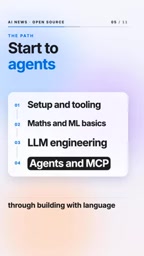
The scope is substantial: 523 lessons spread across 20 phases. Content starts with environment setup and math foundations, moves through practical use of language models, and extends all the way to agents and MCP.
By the source's estimate, completing the full course takes roughly 342 hours of material. This isn't a tutorial you can binge over a weekend — it's a curriculum approaching the scale of systematic training. The source also candidly notes that they haven't completed the course themselves, and recommends that anyone interested should try the first few lessons before deciding. This is worth noting — whether a recommender has personally finished a course directly affects how credible their endorsement is.
MCP (Model Context Protocol) is a standardized protocol released and open-sourced by Anthropic in late 2024, designed to establish unified connections between large language models and external tools and data sources. Before this, every model integration with databases, APIs, or local file systems required custom adapter code, resulting in a severely fragmented ecosystem. MCP functions like "USB-C for the AI world": developers only need to implement an MCP server once, and any MCP-compatible model client (such as Claude Desktop, IDE plugins, etc.) can call it directly. The protocol was quickly adopted across the industry, becoming an important foundational layer connecting models to the real world in AI engineering — which explains why the course lists it as a key topic in its advanced phases.
Not Locked to a Single Language: Python, TypeScript, Rust, Julia
The course covers Python, TypeScript, Rust, and Julia. This combination reveals a certain orientation: it doesn't intend to lock learners into one ecosystem, but rather aims to cover different needs from rapid prototyping to performance-sensitive scenarios.
For AI engineering, this multi-language perspective has practical significance. Python is the default choice for model and data ecosystems, TypeScript is close to application and frontend integration, Rust is increasingly common in high-performance inference and server-side work, and Julia has its place in numerical computing. The course lays out all these threads, letting learners choose based on their own goals.
Julia is a dynamic programming language designed for high-performance numerical computing, first released in 2012. Its syntax is close to Python and MATLAB, but it compiles and executes via LLVM, achieving performance close to C. Its core advantages lie in multiple dispatch and native parallel computing. It has a stable user base in scientific computing, differential equation solving, and machine learning research, and is especially suited to scenarios requiring large amounts of matrix operations and custom gradients. Compared to Python's reliance on C extension libraries like NumPy, Julia lets you write high-performance code in pure Julia, avoiding the development friction of "two-layer languages." In recent years it has been increasingly adopted in AI research involving automatic differentiation, probabilistic programming, and physics simulation — which is why the course includes it among its four languages.
Every Lesson Delivers Something Reusable
The most interesting aspect of the course design is this: every lesson produces a reusable artifact — whether a prompt, a skill, an agent, or an MCP server.
This means the learning process isn't "watch a video and hit like" — it's continuous accumulation of takeaway assets. By the end, you'll have a set of components you can directly use in projects, rather than a pile of notes. For engineering learning aimed at "being able to build," this design is closer to real working practices than pure theoretical instruction.
Prompt, in the context of AI engineering, typically refers to a carefully designed, repeatedly callable structured instruction template, containing role settings, task descriptions, output format constraints, and a few examples. It's not a one-off input, but an engineering artifact that can be version-managed, tested, and composed. Mature AI engineering projects often maintain a prompt library for reuse and iteration across different tasks. Skill is a concept one level above prompt, typically referring to a callable unit that encapsulates a specific capability (such as web retrieval, code execution, chart generation), combining multiple prompts, tool calls, and post-processing logic. The two form the basic building blocks for AI applications moving from "conversation" to "construction" — which is precisely why the course emphasizes producing a reusable artifact in every lesson.
Choose a Path by Goal, No Need to Start from Lesson One
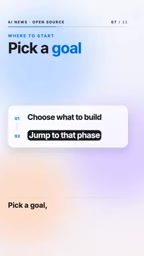
If 523 lessons had to be learned linearly, the dropout rate would be very high. The course's approach to this: you don't have to start from lesson one. You can first determine your goal, and the course will point you to the corresponding phase.
This is especially friendly to experienced learners. Those already familiar with Python and basic model calling can jump directly to agents or MCP-related phases; complete beginners start with setup and math. The course structure itself acknowledges differences in learners' starting points, rather than assuming everyone begins from the same line.
Who It's For, and Who Should Be Cautious
The group best suited to this course is probably people who already use AI tools but lack systematic building experience. Its breadth (20 phases, 4 languages, all the way to agents and MCP) provides a complete path from zero to independent building.
But it's worth being realistic. 342 hours is a number requiring long-term commitment, and the actual quality of the first few lessons needs to be verified yourself. The source themselves admits not having completed it, so signals like "63,000 stars" reflect community popularity, not personal experience endorsement.
Fortunately, the barrier is low enough: free, MIT license, open-sourced on GitHub. Trying it out first, then deciding whether to invest several hundred hours, is the more prudent approach.
If you opened it right now, what would you build first?
Frequently Asked Questions
Is the course really free? Yes, free and under the MIT license, hosted on GitHub.
What background is needed? The course starts from setup and math, so theoretically zero-background entry is possible, but it involves four languages — Python, TypeScript, Rust, Julia — so some programming experience will make it much smoother.
Must it be learned in order? No. You can first set a goal, and the course will point you to the corresponding phase.
How long does it take? The source estimates about 342 hours — a long-term commitment type of course.
What does each lesson produce? Each lesson delivers a reusable prompt, skill, agent, or MCP server.
MIT License is one of the most permissive open-source licenses, requiring only that the copyright notice and license text be retained. Users can freely modify, commercialize, distribute in closed-source form, and even use it in proprietary products. For learning resources like courses, the MIT license means learners can not only use the course content but also integrate it into their own commercial projects, internal training materials, or derivative courses without paying fees or disclosing source code. This licensing choice significantly lowers the adoption barrier, and is one of the factors behind the course's rapid accumulation of attention. However, note that the MIT license provides no warranty, and learners must judge the accuracy and timeliness of course content for themselves.
Related articles

Chain of Thought Isn't Just for AI: How Humans Can Use CoT to Improve Thinking Quality
Chain of Thought isn't just a prompt trick for large models. Starting from a Hacker News discussion, this article analyzes why CoT works for human thinking too, breaks down actionable ways to transfer it, and highlights the key differences between human CoT and machine CoT.
Cloudflare Teams Up with OpenAI: Closi…
Cloudflare Teams Up with OpenAI: Closing the Loop from Vulnerability Discovery to Defense with AI
Cloudflare uses OpenAI Daybreak to investigate security vulnerabilities and generate reviewable remediation plans, while developers use Codex to boost coding efficiency and quality.

Orca Multi-Agent Orchestration in Practice: A Guide to Parallel Collaboration with Claude and Codex
Orca is Stable AI's free open-source agent workbench supporting 34 agents like Claude Code and Codex in parallel. Learn its Git worktree isolation, multi-model orchestration, and mobile management.