AI Entry Point Expansion and Governance Catch-Up: Triple Signals from Anthropic, OpenAI, and Supply Chain Security

AI entry point expansion forces governance catch-up, making controllability the industry's core issue
From May 14–16, 2025, the AI industry revealed a parallel theme of 'entry point expansion and governance catch-up.' Anthropic is driving service-oriented enterprise AI delivery (including compliance, auditing, and operations) through its PwC partnership, while exploring constraint design for high-risk scenarios with the Gates Foundation. OpenAI Codex has evolved into a cross-device, interruptible-and-resumable workbench with stateful task management. Together, these moves answer one core question: as AI entry points multiply, how do you ensure permissions are controllable, processes are traceable, and incidents are reversible?
Over the past three days (May 14–16, 2025), the most noteworthy shift in the AI industry wasn't yet another new model launch. Instead, a deeper throughline is emerging: entry points are multiplying, and governance is playing catch-up. Anthropic is expanding enterprise and philanthropic partnerships, OpenAI is pushing Codex toward an "always takeover-ready" design, and supply chain security incidents are forcing engineered responses. These seemingly unrelated updates are all answering the same question: As AI entry points multiply, who's responsible for controllability?
The Real Watershed for Entry Point Expansion
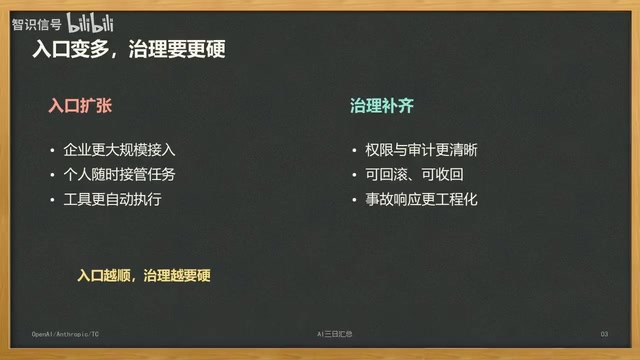
The true watershed isn't whether AI can be used — it's whether you dare hand over your work to it. When AI entry points expand from demo showcases into real business workflows, three practical questions immediately surface:
- How do you constrain permissions? Who can access what data, and can permissions be revoked at any time?
- How do you trace execution? What decisions did the AI make, and is there an auditable record?
- How do you roll back after an incident? If something goes wrong, can you quickly restore to a safe state?
The industry moves from these three days are essentially "catch-up work" around these three questions — transforming AI entry points from flashy demos into controllable workflow components.
Anthropic's Two-Track Strategy: Enterprise Compliance and Philanthropic Governance
Expanded PwC Partnership: From Buying a Tool to Buying a Service
Anthropic's expanded partnership with PwC isn't simply "the collaboration is deepening." The signal it sends is: model providers increasingly need to bundle delivery, compliance, and process integration together.
For enterprise customers, the barrier is no longer whether a model can answer questions — it's whether it can operate reliably within audit frameworks, permission systems, and data boundaries. The essence of such partnerships is pushing AI from "buying a tool" to "buying a complete service" — one that includes compliance guarantees, workflow adaptation, and ongoing operations.
Behind this shift is a fundamental change in enterprise AI procurement logic. In traditional software procurement, companies buy tools with deterministic functionality. But AI systems' inherent uncertainty, data sensitivity, and regulatory complexity make the pure "tool procurement" model unsustainable. In finance and healthcare, for example, regulations like GDPR and HIPAA require enterprises to take responsibility for the entire data processing chain. There's a natural tension between AI models' "black box" characteristics and audit requirements. The involvement of consulting giants like PwC essentially provides a complete package of "compliance endorsement + workflow adaptation + ongoing auditing," helping enterprises embed AI systems into existing risk management frameworks. This model has precedent from the cloud computing era — AWS and Azure's enterprise compliance certification systems (SOC2, ISO27001) are products of the same logic. For enterprises currently evaluating AI deployment strategies, this "service-oriented delivery" model is becoming the mainstream choice.
Gates Foundation Partnership: Constraint Design for High-Risk Scenarios
On the same day, Anthropic also updated its collaboration progress with the Gates Foundation. Viewed through this issue's main theme, this represents another AI entry point governance track.
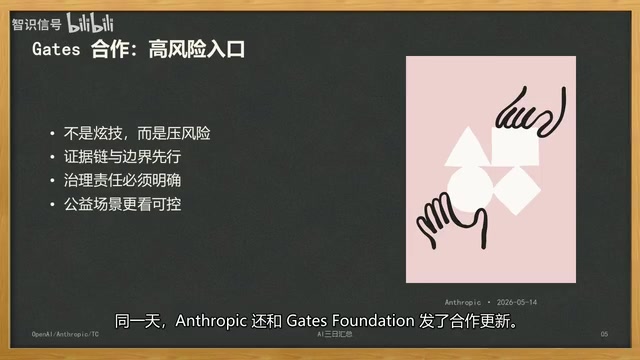
When AI enters high-risk scenarios like philanthropy, health, or social programs, the focus shifts away from "more impressive capabilities" to: How do you compress risk boundaries? How do you build evidence chains? Who bears governance responsibility?
This touches on a core issue in AI ethics: "value alignment" and "embedded constraints" in high-risk scenarios. In public health, poverty alleviation, and similar domains, erroneous AI decisions can directly affect resource allocation for vulnerable populations — consequences far more severe than in commercial settings. Academia calls these "High-Stakes AI" applications, and the EU AI Act specifically establishes the strictest regulatory tier for them. Core principles of constraint design include: explainability (decision processes can be understood by humans), accountability (clear assignment of responsibility), and correctability (errors can be promptly detected and fixed). This aligns closely with Anthropic's own "Constitutional AI" research direction — embedding value constraints during training rather than relying on post-hoc filtering. This reminds us of an important principle: once an AI entry point enters a high-risk scenario, the product form must inherently carry constraints rather than patching them in after the fact.
OpenAI Codex: From Tool to Always Takeover-Ready Workbench
OpenAI has expanded Codex's usage scenario from "sitting at your computer" to "From Anywhere." On the surface, it's more convenient. At a deeper level, it pushes AI coding from a tool toward an always takeover-ready workbench.

You no longer need to be on the same machine or in the same session to continue a task. Instead, long-running tasks become workflows that can be interrupted, resumed, and handed off.
At the engineering level, this corresponds to a "Stateful Task Management" architecture. Traditional command-line tools or IDE plugins are stateless — closing the window means losing context. Codex's new design requires persisting task state (current progress, completed actions, pending steps) and supporting state recovery across devices and sessions. Technically, this resembles "Process Migration" in operating systems or "Checkpoint" mechanisms in cloud-native architectures. For AI Agents, takeover-readiness also means structured logging of execution — every operation, every tool call needs to be saved in an auditable format, which is precisely the foundation for enterprise compliance auditing.
For people already using AI to get work done, this kind of entry point evolution often matters more than model benchmarks — it determines whether you can truly hand off a portion of your work to AI, then pick up the results at a different time, on a different device. This "takeover-readiness" is the real dividing line between AI as a toy and AI as infrastructure.
Related articles
Meta Muse Hits 900K Downloads in Six D…
Meta Muse Hits 900K Downloads in Six Days: The AI Agent Era Has Officially Arrived
Meta's AI agent Muse hit 902K downloads in 6 days, topping US App Store and Google Play charts above ChatGPT and Claude. A deep dive into Muse's capabilities and the AI Agent race.
 Industry Insights
IRS Fully Embraces Claude AI, Accelerating Federal Government's AI Adoption
The IRS is recruiting staff with 24/7 Claude AI access, marking Anthropic's breakthrough into the federal government. Explore the strategic implications and tax use cases.
 Industry Insights
The IRS Mobile App Debate: A Trust Crisis in Government Digital Transformation
The IRS's proposed mobile app has sparked heated debate. This article analyzes the core arguments, exploring data security, privacy, and the trust crisis in government digital transformation.