OpenAI's Internal Codex Usage Surges 56x — AI Coding Is Eating Everything

OpenAI's internal Codex usage has surged up to 56x across all departments, signaling a major AI adoption inflection point.
OpenAI disclosed that internal Codex output tokens have grown 56x in Research, 32x in Customer Support, 27x in Engineering, and 13x in Legal since November 2025. Driven by Codex's new Agentic Mode and its Plan-Execute-Reflect Loop, even non-technical departments are deeply integrating AI coding tools — marking a pivotal moment in enterprise AI adoption.
Core Data: The Explosive Growth in Codex Output Tokens
OpenAI recently disclosed a striking set of internal metrics: since November 2025, the median output token count from internal Codex (its code-generation AI) usage has grown at a staggering pace. The breakdown by department:
- Research: 56x growth
- Customer Support: 32x growth
- Engineering: 27x growth
- Legal: 13x growth
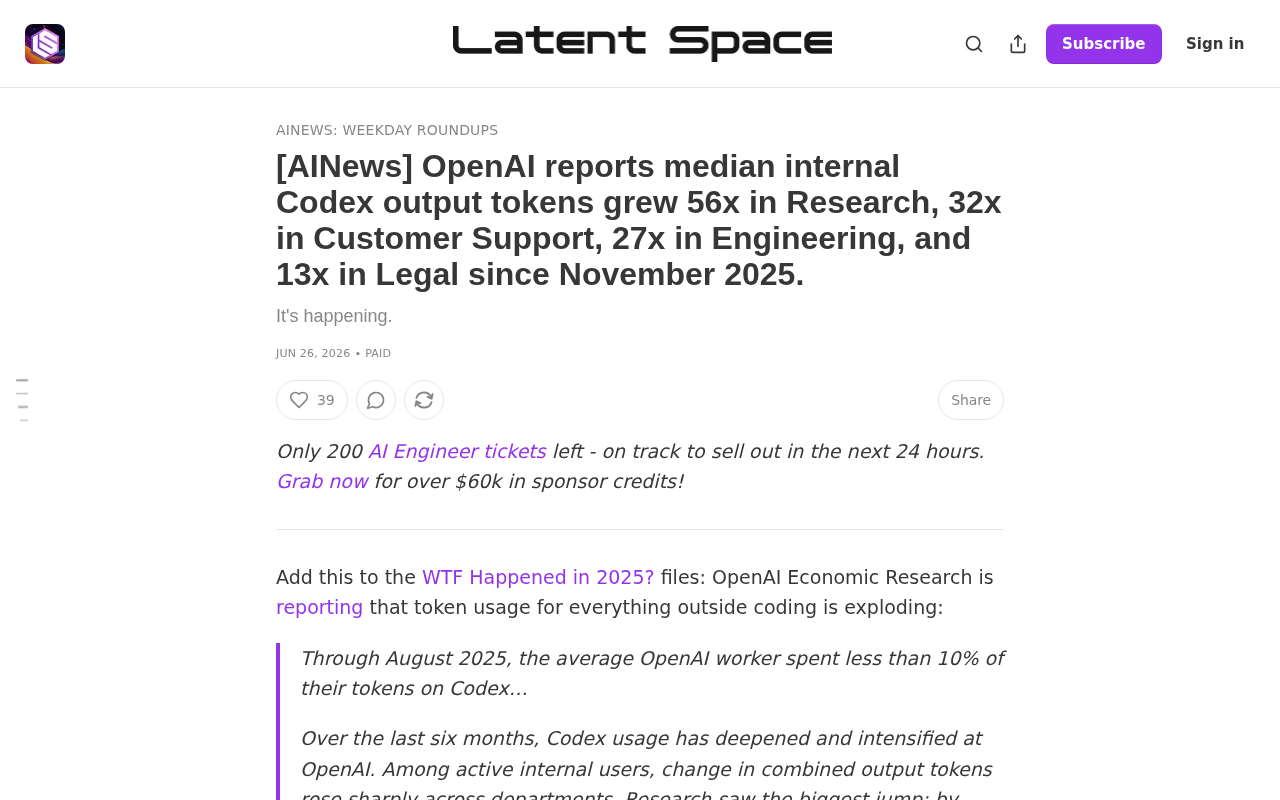
These aren't external user numbers — they reflect how deeply OpenAI's own employees have come to rely on AI coding tools in their daily work. When an AI company itself is embracing AI-assisted workflows at this pace, the signal carries far more weight than the numbers alone.
Understanding Codex: More Than Just Code Completion
OpenAI Codex is a large language model fine-tuned specifically for code generation tasks on top of the GPT architecture. It was originally released in 2021 as the underlying engine powering GitHub Copilot. Trained on billions of lines of public code, Codex can interpret natural language descriptions and translate them into executable code across dozens of programming languages, including Python, JavaScript, TypeScript, Go, and Ruby.
In 2025, OpenAI launched a new generation of Codex, integrating it into the ChatGPT ecosystem and API platform while introducing Agentic Mode — a fundamental shift in how large language models are applied. Traditional code completion models operate on a single-turn inference architecture: receive a prompt, output a snippet, done. Agentic Mode introduces a Plan-Execute-Reflect Loop: the model first decomposes a complex task into a sequence of subtasks, executes them step by step, evaluates output quality at each node, self-corrects when necessary, and continues forward. This architecture relies on the coordinated use of Tool Use, Code Interpreter, and Long Context Window capabilities.
Consider a typical research task: a traditional Codex might output a 50-token function snippet, while the same task in Agentic Mode could trigger multiple iterations, cumulatively producing tens of thousands of tokens — a complete data processing pipeline, unit tests, and documentation included. This is the underlying technical reason behind the orders-of-magnitude growth in output tokens.
Why Measure Usage Depth in Output Tokens?
Tokens are the basic units that large language models use to process text — they don't map strictly to words or characters. In English, one token corresponds to roughly 4 characters or 0.75 words; in code, a function definition, a comment, or a line of logic may each be split into multiple tokens. AI companies widely use output token count as a core usage metric because it directly reflects the model's computational load and is the primary basis for API billing.
Growth in output tokens means users are no longer satisfied with having AI generate short code snippets — they're now delegating complete modules, systems, or documentation to AI. This is a qualitative shift in usage depth, not merely an increase in frequency. Viewed through this lens, the tens-of-times growth reveals a fundamental transformation in how employees collaborate with AI.
Why Did the Research Department Grow the Fastest?
Research leading the pack at 56x isn't surprising. AI research is inherently code-intensive — from model training scripts and data processing pipelines to experiment automation, nearly every step can be accelerated with Codex.
The deeper reason is that researchers need to rapidly prototype and validate ideas. Traditionally, turning a hypothesis into working code could take hours or even days. With Codex, researchers can focus more on ideation and analysis while letting AI handle the tedious coding work. The 56x growth signals that researchers are increasingly offloading the "heavy lifting" to Codex, generating longer and more complex code outputs.
The Penetration of Non-Technical Departments Is Equally Striking
Perhaps the most noteworthy figures aren't from Engineering or Research, but from Customer Support (32x) and Legal (13x) — departments traditionally considered "non-technical." This reflects a broader industry trend: the AI-powered upgrade of the Citizen Developer movement.
The citizen developer concept was formally defined by Gartner in 2009, describing non-IT employees who build business applications using IT-approved tools. The movement has gone through three distinct technology waves:
- First Wave (2010–2015): Excel macros and Access databases
- Second Wave (2015–2022): Low-code/no-code platforms like Salesforce, Power Apps, and Airtable, where drag-and-drop interfaces dramatically lowered the barrier to building applications
- Third Wave (2023–present): Natural language-driven AI coding tools that eliminate the final technical barrier — the need to understand code logic at all
Compared to the first two waves, the AI-driven citizen developer movement has one critical distinction: users no longer need to learn platform-specific operational logic. Natural language itself is the only interface, which theoretically enables technology diffusion at an unprecedented scale. The data from OpenAI's Legal and Customer Support departments are early empirical evidence of this third wave — blurring the line between technical and non-technical roles.
Customer Support: What's Behind the 32x Growth?
A 32x increase in Codex output tokens from Customer Support suggests that AI coding tools are being deeply integrated into customer service workflows. This likely includes: auto-generating technical documentation, writing automated response scripts, building internal tools to track and analyze customer issues, and even using code to reproduce bugs reported by customers. Customer support is shifting from purely human communication toward code-driven problem resolution.
Legal: What Does 13x Growth Mean?
Legal's 13x growth is the lowest among the four departments, but given the nature of legal work, it's still impressive. Legal teams are likely using Codex for contract analysis automation, compliance check scripting, and data extraction and organization. Gartner predicts that by 2026, over 80% of low-code/no-code application development will come from non-IT departments — and AI coding tools are accelerating that shift. Legal's numbers are an early confirmation of this trend.
The Deeper Implications of This Data
The "Dogfooding" Effect
OpenAI's decision to publicly share this internal data is itself a powerful product endorsement — "we are our own heaviest users." The term "dogfooding" originated at Microsoft in the 1980s, when management required employees to use unreleased software products in their daily work to surface real-world issues. The practice later became a standard part of Silicon Valley culture.
For an AI company, dogfooding carries a dual significance: internally, it rapidly exposes model limitations and creates a high-quality feedback loop; externally, publishing internal usage data sends a market signal — "we have enough confidence in our own product." A 56x growth figure makes that endorsement quite compelling.
The Compounding Effect of AI Usage
In just a few months since November 2025, output token volumes have grown by tens of times. This suggests a clear compounding effect in AI tool adoption — one that closely mirrors the Diffusion of Innovations curve from technology adoption theory.
Everett Rogers' 1962 theory divides technology adopters into five groups: Innovators (2.5%), Early Adopters (13.5%), Early Majority (34%), Late Majority (34%), and Laggards (16%). The core insight is that once adoption crosses roughly the 16% threshold, technology tends to enter an explosive phase, with the growth curve shifting from linear to exponential.
The multi-fold growth shown in OpenAI's internal data aligns closely with this theory in terms of timing — AI coding tools completed their Early Adopter phase accumulation in 2023–2024 and began penetrating the Early Majority in 2025. It's worth noting that technology diffusion within organizations tends to be faster than in the broader market, due to mandatory knowledge-sharing mechanisms and management-driven adoption.
In the AI coding tools space, this compounding effect has its own specific mechanism: employees who have a positive experience in one context actively bring the tool into adjacent contexts; success stories spread by word of mouth within teams, lowering the barrier for others to try; and as experience accumulates, prompt quality improves, AI output quality improves in turn, further reinforcing usage intent. Once this self-reinforcing positive feedback loop is activated, the growth curve stays steep.
Implications for the Industry
If even OpenAI internally is increasing its use of AI coding tools at this pace, the broader industry's AI adoption rate is likely at an inflection point. For enterprise decision-makers, the question is no longer "whether to adopt AI coding tools" but "how to roll them out comprehensively, and fast."
Questions Worth Considering
That said, we should remain measured. Growth in output token count does not directly translate to proportional gains in productivity. In software engineering, Lines of Code (LoC) was long used as a productivity metric, but its limitations were thoroughly debated as far back as the 1980s — more lines of code can mean less efficient implementation, not higher output value.
The "output token count" metric of the AI era faces a similar measurement challenge: there is no linear relationship between token count and code quality. The Acceptance Rate of AI-generated code is a far more meaningful proxy for productivity — GitHub Copilot once disclosed that its code suggestion acceptance rate averaged around 26–35%, though this varies significantly across task types.
Furthermore, the value of AI-assisted coding also manifests in cognitive load transfer: even if the final code is heavily modified, an AI-generated first draft may have significantly reduced the engineer's cognitive startup cost. Evaluating the true ROI of AI coding tools therefore requires a multi-dimensional framework — including code acceptance rate, defect rate, iteration cycle time, and engineer satisfaction — rather than relying solely on token counts.
Additionally, this data comes from inside OpenAI — an organization that is inherently AI-friendly and has an exceptionally high level of technical literacy. Whether other industries and companies can replicate this growth trajectory remains to be seen.
But regardless, when an AI company's own internal usage data is growing exponentially, the brief comment "It's happening" may be the most accurate summary of the current AI coding wave.
Key Takeaways
- Since November 2025, OpenAI's internal Codex output tokens have grown 56x in Research, 32x in Customer Support, 27x in Engineering, and 13x in Legal
- Codex's new Agentic Mode introduces a Plan-Execute-Reflect Loop, expanding single-task output from dozens of tokens to tens of thousands — the technical root of this growth
- High growth in non-technical departments (Customer Support, Legal) marks the citizen developer movement's entry into its third wave: natural language as the sole interface, technical barriers approaching zero
- AI tool adoption follows the Diffusion of Innovations curve; the current moment may be the exponential inflection point of Early Majority penetration
- Output token growth does not directly equal proportional productivity gains; code acceptance rate, defect rate, and other multi-dimensional metrics are key to evaluating true ROI
- OpenAI's disclosure of internal data is a powerful product endorsement, but whether its growth trajectory can be replicated in other industries — given its uniquely high-tech culture — remains an open question
Related articles
Meta Muse Hits 900K Downloads in Six D…
Meta Muse Hits 900K Downloads in Six Days: The AI Agent Era Has Officially Arrived
Meta's AI agent Muse hit 902K downloads in 6 days, topping US App Store and Google Play charts above ChatGPT and Claude. A deep dive into Muse's capabilities and the AI Agent race.
 Industry Insights
IRS Fully Embraces Claude AI, Accelerating Federal Government's AI Adoption
The IRS is recruiting staff with 24/7 Claude AI access, marking Anthropic's breakthrough into the federal government. Explore the strategic implications and tax use cases.
 Industry Insights
The IRS Mobile App Debate: A Trust Crisis in Government Digital Transformation
The IRS's proposed mobile app has sparked heated debate. This article analyzes the core arguments, exploring data security, privacy, and the trust crisis in government digital transformation.