AI Expert Network SuperMe Raises $20M to Build AI Avatars from Real Human Expertise

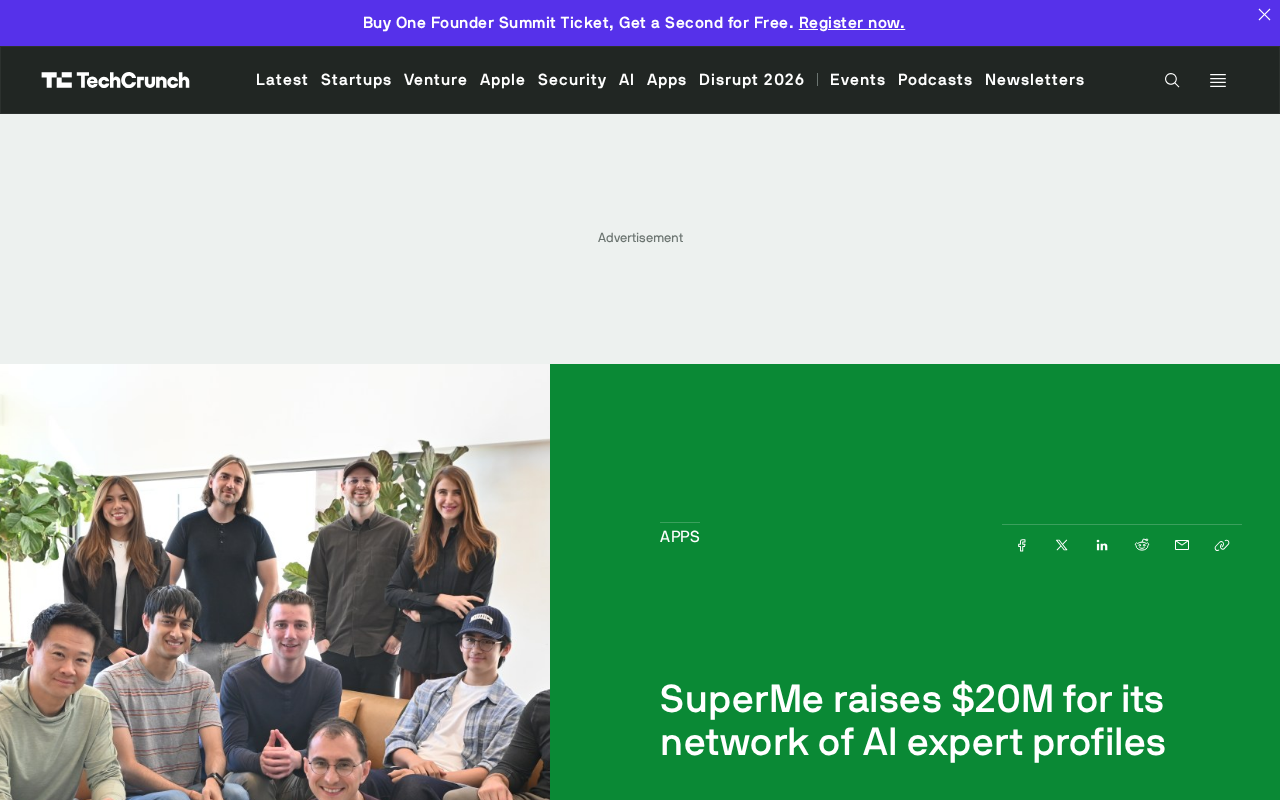
SuperMe raises $20M to turn real experts into AI avatars that team up in group chats.
SuperMe is a startup that builds real experts' knowledge into AI profiles and has raised $20 million. When a user asks a question, the platform automatically matches the best expert AI avatars and creates a group chat with multiple avatars for collaborative answering. The article analyzes this model's value—expert knowledge as a differentiator in vertical scenarios—and open questions around multi-avatar coordination, matching accuracy, and knowledge updates.
From Real Experts to AI Avatars: SuperMe Wants You to "Pull Together a Group Chat" with Experts Anytime
When you run into a professional question, you typically post on social media, ask a friend for a recommendation, or search through scattered information and piece together an answer yourself. A startup called SuperMe is trying to solve this problem differently: it turns real experts' knowledge into AI profiles, and when you ask a question, the platform automatically determines which experts are best suited to answer and pulls their AI avatars into a group chat.
According to RSS sources, SuperMe has raised $20 million for this model. The number itself isn't staggering, but the direction it points to is worth watching—not another general-purpose chatbot, but a combination of "expert knowledge + multi-agent collaboration."
SuperMe's Product Logic: Not Search, but Convening
SuperMe's core mechanism can be broken into three steps: the user asks a question, the platform matches the most suitable expert AI profiles, and then creates a group chat containing multiple AI avatars. What's interesting about this design is that it simulates the real-world scenario of "finding a few people who know their stuff and chatting together," rather than having the user face an isolated Q&A box.
From a product-form perspective, SuperMe is more of an entry point to an expert network than a single tool. Behind each AI profile is the accumulated knowledge of a real expert, which means the differentiation and credibility of answers may come from the expert's professional background rather than the generalization capabilities of a general-purpose model.
Why "Expert AI Avatars" Are Worth Watching
The capability boundaries of general large models are being repeatedly debated, and one obvious trend is that in vertical, professional, high-value scenarios, users don't need a model that "knows a little about everything"—they need answers that are "genuinely reliable in a specific domain." SuperMe's approach is to treat expert knowledge as a differentiating asset and productize experts' experience in the form of AI profiles.
If this model works, it will bring two changes. For users, the path to obtaining professional opinions is greatly shortened; for experts, their knowledge can continuously provide services in the form of AI avatars without having to personally respond to every question.
An AI profile (AI avatar / agent persona) refers to a personalized AI agent built on the knowledge, experience, and communication style of a specific expert. Unlike general large models, AI profiles typically inject expert knowledge through retrieval-augmented generation (RAG), fine-tuning, or prompt engineering. The RAG approach uses the expert's documents, case studies, Q&A records, and so on as an external knowledge base, retrieving relevant content at inference time; the fine-tuning approach adjusts model parameters with expert data so that outputs more closely match the expert's style. The quality of an AI profile's construction depends on the completeness and structuredness of the accumulated knowledge, which is also the core engineering challenge for platforms like SuperMe—how to transform experts' tacit experience into explicit knowledge that AI can call upon.
Group-Chat-Style Multi-Agent: Collaboration or Gimmick?
Putting multiple AI profiles into the same group chat sounds like a lightweight implementation of multi-agent collaboration. In reality, complex problems often require cross-validation from different perspectives, and a single expert may also have blind spots. In theory, the group chat mechanism allows the AI avatars of different experts to complement each other and even form a discussion.
But there are also things to watch here: when multiple AI avatars speak at the same time, how do you ensure information isn't redundant or conflicting? How does the platform determine which expert is "most suitable" to answer? These questions determine whether the group chat genuinely improves answer quality or merely adds interaction complexity. The original article does not disclose specific technical implementation details, which is also a direction worth tracking going forward.
A multi-agent system is an important concept in the AI field, referring to multiple agents solving problems that a single agent struggles to handle through collaboration, negotiation, or competition. In the LLM era, multi-agent collaboration typically manifests as multiple AI instances with different role settings interacting through message-passing mechanisms. Common architectures include debate-style (letting different agents propose viewpoints and challenge each other), pipeline-style (tasks decomposed and processed sequentially by different agents), and group-chat-style (all agents speak freely in a shared context). The core challenges facing group-chat-style multi-agent systems include: speaker scheduling (who speaks when), information redundancy (multiple agents repeating the same content), conflict resolution (how to adjudicate differing viewpoints), and context window limitations (context bloat after multiple rounds of dialogue leading to performance degradation). SuperMe's design needs to solve these problems for the group chat to genuinely improve answer quality.
Industry Signals Behind the Funding
The $20 million funding scale shows that capital markets remain interested in the "expert knowledge + AI" path. For a while now, innovation in the AI application layer has been heavily concentrated in general assistants and productivity tools, while SuperMe represents a heavier model: one that requires accumulating an expert network, maintaining knowledge quality, and designing matching mechanisms.
The barrier for such projects isn't the model itself, but the ability to organize expert resources and the quality of knowledge transformation. Funding itself is a starting point; the real test is whether the platform can make users feel a clear difference between "asking an expert" and "asking a general AI."
The AI application layer refers to products or services built on top of foundation models, which do not directly train underlying models but solve specific scenario problems through API calls, RAG, agent orchestration, and similar approaches. Unlike the high capital investment of the foundation model layer, the barrier to application-layer innovation lies more in scenario understanding, data accumulation, and product design. In recent years, the AI application layer has evolved from general assistants (such as ChatGPT-like products) to vertical tools (such as assistants specialized in law, healthcare, and programming). The "expert knowledge + multi-agent collaboration" model represented by SuperMe belongs to the heavier category within the application layer, requiring simultaneous solutions to three levels of problems: organizing the expert network, maintaining knowledge quality, and designing collaboration mechanisms—which also explains why, although its funding scale isn't enormous, its direction carries signal significance.
Open Questions
SuperMe's publicly available information is currently limited. How expert AI profiles are built, how knowledge update mechanisms are designed, and how multiple AI avatars coordinate in a group chat—none of these key questions are elaborated in the original material. For those watching the AI application layer, the value of this case lies in the clear product hypothesis it offers: on top of general models, expert networks and multi-person collaboration mechanisms may become new differentiating variables. Whether this hypothesis holds will require real-world performance after the product launches to verify.
One-line Summary
SuperMe raises $20M to turn real expert knowledge into AI avatars that collaborate in group chats to answer questions.
Paragraph Summary
SuperMe is a startup that builds real experts' knowledge into AI profiles and has raised $20 million. Its core mechanism: after a user asks a question, the platform automatically matches the most suitable expert AI avatars and creates a group chat containing multiple AI avatars for collaborative answering. This design simulates the real-world scenario of "finding a few knowledgeable people to chat with," rather than an isolated Q&A. The article analyzes the value of this model—in vertical professional scenarios, expert knowledge can become a differentiating asset—while also pointing out open questions: how multi-avatar collaboration avoids information redundancy and conflict, how the matching mechanism ensures accuracy, and how expert knowledge is continuously updated. Overall, SuperMe represents a clear product hypothesis for the AI application layer's exploration from general assistants toward expert-knowledge differentiation.
Related articles

LangChain Retry Middleware Configuration: Practices and Selection Guide
Based on Reddit community discussion, this article analyzes LangChain ModelRetryMiddleware retry parameter configuration practices, covering the selection logic and alternatives for key options like max_retries, backoff_factor, and jitter.

Texas Senate Race in Trouble: Why Are Republicans Nervous?
Texas Senate race stirs Republican anxiety. Based on street interviews, this article analyzes the Democratic offensive in funding, organization, and running everywhere, and how Republicans are defending "Texas, Texas" amid the political pendulum effect.

Gemini Chat Now Generates and Edits Google Docs Directly, a New Breakthrough in Office Productivity
Google Gemini's chat interface now generates and edits PDF, Google Docs, Sheets, Slides, Markdown, TXT, and code files. Available to all users; web supports all formats, mobile only PDF for now.