LangChain Retry Middleware Configuration: Practices and Selection Guide

Reddit community solicits LangChain retry middleware configs, revealing the reliability-cost-latency trade-off in LLM apps.
The article discusses a Reddit community survey on configuring LangChain's `ModelRetryMiddleware`, outlining retry strategies' key role in LLM agent applications. The template asks for model, scenario, deployment environment, and parameters like `max_retries`, `retry_on`, `on_failure`, backoff factor, and jitter, covering trigger conditions, backoff curves, and failure destinations. It notes that defaults suffice for prototypes, but production multi-step agents need finer retry budget allocation, while watching extra token costs and latency. Some teams prefer provider SDK retries or custom wrappers for observability. Practical tips include recording failure distributions, setting latency caps, designing degradation paths, and regular reviews.
When building LLM-based agent applications, error handling is often the key to system resilience. Recently, the Reddit community sparked a discussion about the actual configuration of LangChain's ModelRetryMiddleware, soliciting the retry parameters developers use in production and the reasoning behind them. Although framed as a survey, this discussion reflects a core tension in LLM application engineering: retry strategies must combat network jitter and rate limiting while avoiding amplifying cost and latency.
Why Retry Configuration Deserves Its Own Discussion
ModelRetryMiddleware is a middleware component introduced in newer versions of LangChain to automatically retry when model calls fail. Unlike traditional HTTP client retries, LLM calls have more diverse failure modes: beyond common 429 rate limits, timeouts, and 5xx server errors, there are "soft failures" caused by overly long context or invalid output formats. An overly aggressive retry strategy may cause an already timed-out request to repeatedly consume quota; an overly conservative one leaves users staring at an error page.
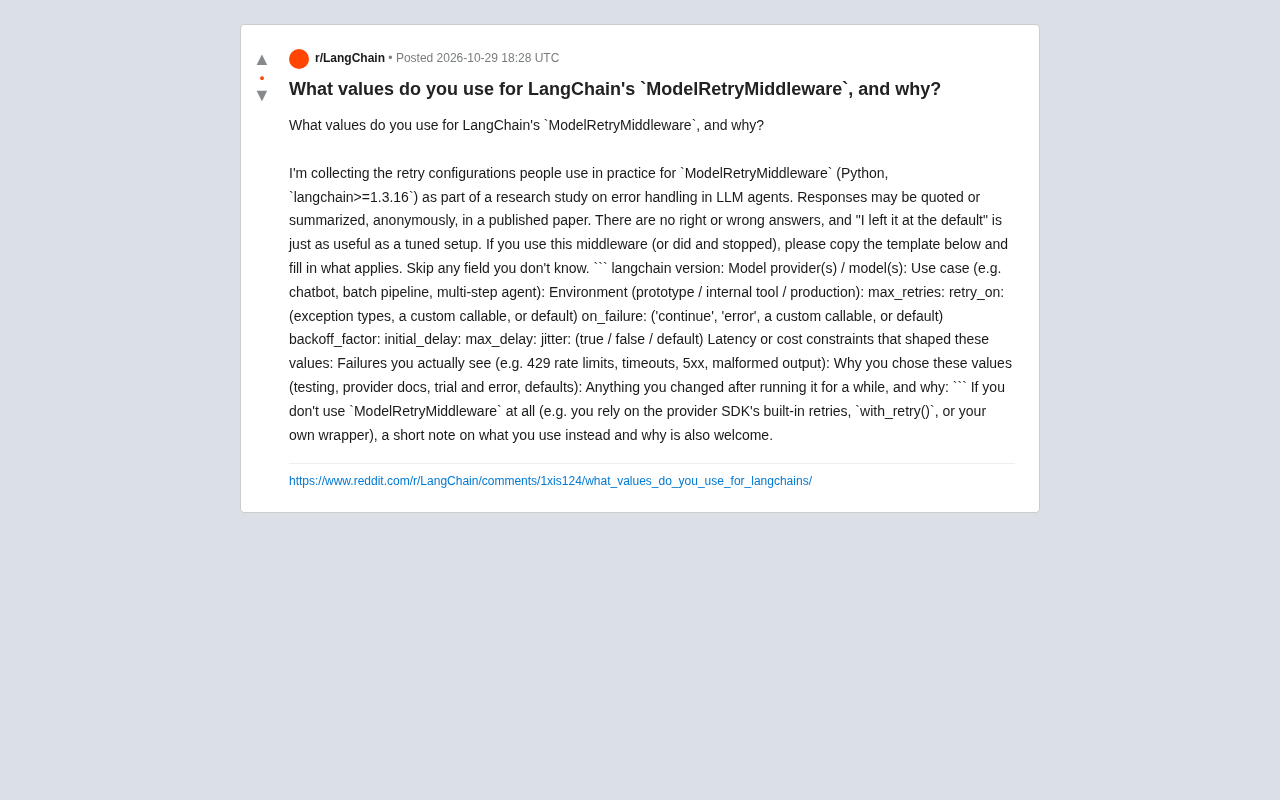
The researcher who initiated the discussion explicitly stated that they are collecting retry configurations for Python environments with langchain>=1.3.16 for a study on LLM agent error handling, and plan to cite or summarize them anonymously in a paper. You may not have noticed that the survey deliberately emphasizes "there are no right or wrong answers"—even "keeping default values" counts as valid data. This hints that default and tuned configurations are equally common in community practice.
Exponential Backoff & Jitter are two mechanisms often mentioned together in retry strategies. Exponential backoff means the wait time before each retry grows by a fixed multiplier—for example, with an initial delay of 1 second and a backoff factor of 2, the wait sequence is 1s, 2s, 4s, 8s... The goal is to give the server a recovery window during overload, avoiding repeated hammering in a short period. Jitter adds a random amount on top of the computed backoff delay; common approaches include "full jitter" (random value between 0 and the computed delay) and "equal jitter" (random between half and the full delay). The core purpose of jitter is to break the "thundering herd" phenomenon where multiple clients retry in sync due to identical backoff curves—especially valuable under high concurrency. In LLM calls, since providers typically rate-limit by API key or organization, jitter also lets multiple agent instances within the same team stagger their retries, reducing the chance of collectively triggering 429s.
What the Configuration Template Reveals About Concerns
From the solicitation template, it's clear the researcher cares about more than just numbers. The template asks for model provider and specific model, use case (chatbot, batch pipeline, or multi-step agent), deployment environment (prototype, internal tool, or production), and parameters such as max_retries, retry_on, on_failure, backoff_factor, initial_delay, max_delay, and jitter. These fields cover three layers of a retry strategy: trigger conditions (which exceptions are worth retrying), the backoff curve (how long to wait before trying again), and failure destination (after retries are exhausted, whether to continue, raise an error, or invoke a custom callback).
Particularly noteworthy is that the retry_on field allows passing exception types, custom callables, or default values. This reflects a real-world split: some developers rely on the middleware's default exception-type judgment, while others write custom predicate logic—for example, retrying only on specific HTTP status codes or specific error messages. The on_failure options similarly reflect different engineering philosophies—choosing continue to skip failed items in batch scenarios, or error in multi-step agents to let upper-level orchestration take over.
The template also asks how latency and cost constraints influence parameter choices, which failure types were actually encountered, and what adjustments were made after running for a while. This line of questioning indicates that retry parameters are hard to nail down in one shot and often require iterative refinement based on production observations.
The callable form of retry_on allows developers to pass a function that decides whether to retry based on the exception instance. This design is more flexible than simply listing exception types, because many LLM providers' error messages are not fully structured: rate limiting may appear as a 429, or may be wrapped in an error field within a 200 response; overly long context may raise a specific exception, or may return an ordinary response with an error code. Custom predicate logic can inspect keywords in the exception message, HTTP status codes, or even response body structure, precisely distinguishing "transient failures worth retrying" from "permanent errors where retrying is futile" (such as authentication failures or malformed requests). The trade-off is that this logic must be maintained as provider APIs evolve, or it may miss or misclassify failures.
The Real-World Trade-off Between Defaults and Tuning
Although the discussion has not yet produced complete statistical results, the survey design itself signals that a significant portion of developers may be using default configurations directly. The reason is not hard to understand—LangChain's middleware defaults already cover common best practices like exponential backoff and jitter, and for prototypes and internal tools, the payoff from manual tuning is limited.
But when scenarios move to production—especially for multi-step agents—the default strategy may not suffice. A single task for a multi-step agent triggers multiple model calls, and any one failure can interrupt the entire task, so retry budget allocation needs to be more granular: should each call retry independently, or should retries be unified at the task level? Setting max_delay too long drags down interactive experiences; setting it too short may hit the provider's rate-limit window.
Cost is another hidden constraint. Each retry means additional token consumption, and for usage-based APIs, aggressive retry strategies can significantly inflate the bill. The backoff_factor and jitter listed in the discussion are exactly the levers to mitigate this: exponential backoff widens retry intervals, while jitter prevents multiple concurrent requests from retrying simultaneously in a "thundering herd."
Retry budget allocation for multi-step agents is an issue easily overlooked from a single-call perspective. A multi-step task may include multiple model interaction stages—planning, tool calls, result integration, etc. If each stage independently configures max_retries=3, then a task with five model calls could produce up to fifteen retries in the worst case, multiplying total latency and cost. A common approach is to set a global retry budget at the orchestration layer (e.g., at most five retries for the entire task), shared across steps; another is to give higher retry priority to critical steps (such as final answer generation) while adopting a more conservative strategy for degradable intermediate steps. Either way, this requires an additional layer of task-level counting and coordination beyond the middleware configuration—often beyond the scope of ModelRetryMiddleware itself.
Alternative Paths Without the Middleware
The survey deliberately leaves an open-ended item at the end: if not using ModelRetryMiddleware, what alternatives do developers use? Options mentioned include provider SDK built-in retries, with_retry(), and custom wrapper layers. This design acknowledges ecosystem diversity—many teams prefer to control retries at a lower level, because provider SDK retries tend to be more tightly coupled with connection pools and timeout settings, while custom wrappers make it easier to integrate unified logging and monitoring.
The reason for choosing alternatives is usually related to observability. Middleware-level retries happen inside application logic; without instrumentation, retry counts and failure reasons can easily get buried. Retrying at the SDK or gateway layer, by contrast, integrates more easily with existing APM systems. This also explains why some teams "tried it and stopped"—when monitoring needs outweigh convenience benefits, migrating to a lower-level solution is a natural choice.
Takeaways for Practitioners
The value of this discussion is not in providing a standard answer, but in bringing retry configuration out of the blind spot of "just use the default." For teams building LLM applications, several actionable recommendations can be distilled: record the actual distribution of failure types before deciding the scope of retry_on; set latency caps based on the interaction scenario—conversational applications tolerate far less latency than batch processing; design explicit degradation paths for on_failure rather than letting exceptions bubble up; and periodically review retry logs, because provider-side rate-limiting policies and model behavior change over time.
Retry middleware is just one piece of the LLM engineering puzzle, but it vividly illustrates the triangle of reliability, cost, and latency. When the community begins systematically collecting these parameters, it signals that this field is moving from "just make it work" toward reproducible engineering practice.
One-line Summary
Reddit community solicits LangChain retry middleware configurations, revealing the trade-offs among reliability, cost, and latency in LLM applications.
Paragraph Summary
The article centers on a Reddit community discussion about configuring LangChain's ModelRetryMiddleware, outlining the key role of retry strategies in LLM agent applications. The survey template asks for model, scenario, deployment environment, and parameters such as max_retries, retry_on, on_failure, backoff factor, and jitter—covering three layers: trigger conditions, backoff curve, and failure destination. The article notes that default configurations suffice for prototypes, but production environments—especially multi-step agent scenarios—require more granular retry budget allocation, while being wary of the extra token costs and latency that retries introduce. Some teams choose provider SDK retries or custom wrapper layers due to observability needs. Finally, it distills practical recommendations: record failure distributions, set latency caps, design degradation paths, and conduct regular reviews.
Related articles

How Gen Turns Data into Decisions with ChatGPT Work
In an OpenAI user case, business leader Gen shares how ChatGPT Work turns data into decisions: within hours of launch, teams can judge whether integrations and onboarding flows work, shifting decision iteration from hundreds of trial-and-error attempts to a fast feedback loop.

ChatGPT vs. Claude In-Depth Comparison: Strong at Coding but Weak at Research — How to Bridge the Gap?
A user considers switching from ChatGPT to Claude, finding Claude stronger at coding but shallower at research. We analyze the differences and share tips to make Claude's research deeper.

Theranos Whistleblower Warns: The AI Boom Is "a Great Opportunity to Deceive"
Theranos whistleblower Tyler Shultz warns the AI boom is "a great opportunity to deceive" as never-profitable companies raise capital at trillion-dollar valuations. This article examines the real-world context, key differences between AI and Theranos, and practical criteria for investors and practitioners.