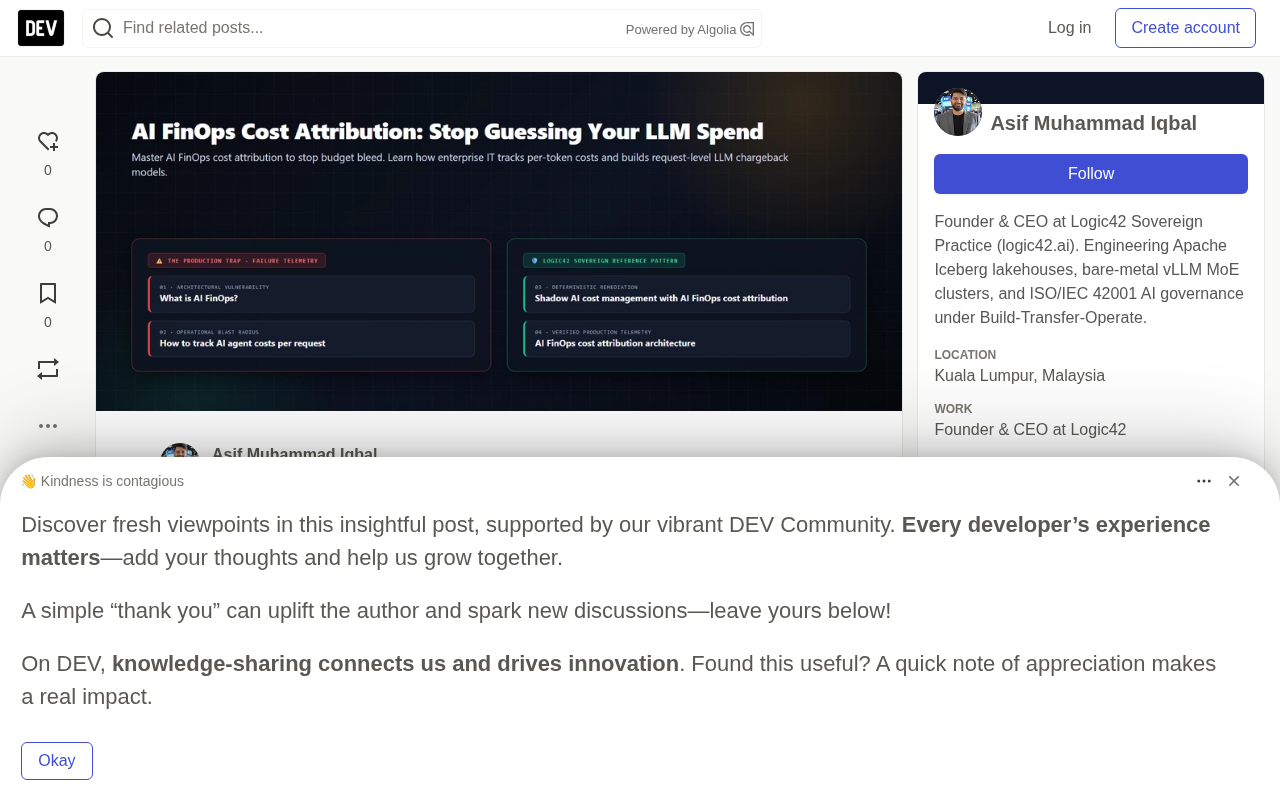
AI FinOps Cost Attribution: Stop Guessing Your LLM Spend

Fixed-rate IT budgeting is dead; enterprises must track AI token costs per request to stop the budget bleed.
The article notes global enterprise AI spending will hit $2.59 trillion this year, yet most can't prove measurable returns because autonomous agents shattered fixed-rate IT budgeting. Traditional cloud FinOps watches CPU/memory utilization and can't parse LLM token-based variable costs, leaving API consumption invisible. The fix is request-level AI FinOps cost attribution: inject correlation IDs at the API gateway, propagate context through orchestration layers, intercept LLM calls to emit OpenTelemetry spans with token metadata, and convert them to dollars in a FinOps aggregation engine. It also exposes the 'super adopter' pattern—5% of users generating over 60% of spend—and offers cost-cutting tactics like semantic caching, request-level budgets, and repatriating high-volume, low-complexity workloads to self-hosted open-weight models, stressing AI should be treated as variable COGS tied to user behavior.
Global enterprises will spend $2.59 trillion on AI this year, but most can't prove measurable returns. The fixed-rate IT budgeting model is dead—autonomous agents have shattered it. If you can't trace every cent of AI spend back to a specific business request, you're flying blind. Request-level AI FinOps cost attribution is the only way to stop the budget bleed.
What Is AI FinOps?
AI FinOps is the operational practice of tracking, forecasting, and optimizing the cost of artificial intelligence infrastructure, especially for the variable cost model of large language models (LLMs) billed per token. It establishes financial accountability for generative AI workloads.
Traditional cloud models rely on instances and SKUs. You spin up an EC2, monitor CPU utilization, and map the bill to a business unit. That approach has failed. Today, a single user request triggers an autonomous agent that executes chained model calls, accesses vector databases, and invokes external APIs. The cost of answering one prompt can range from a fraction of a cent to five dollars, depending entirely on the complexity of the agent's reasoning path.
Per-request cost fluctuates wildly and is completely decoupled from underlying infrastructure usage. When budgets depend on static forecasts, managing the cost of agentic AI becomes an impossible task. You will blow through your quota before the quarter ends.
Token-based billing is the mainstream commercial model for LLM services: models don't charge by runtime or compute resources, but instead split input prompts and output text into semantic units called tokens (roughly equivalent to 0.75 English words, or about 1 to 2 Chinese characters), then settle at a per-million-token unit price. This means that on the same server, answering a casual chat and running a multi-turn agentic inference can differ in cost by a hundredfold. Unlike the linear model of traditional cloud hosts—"billing starts at boot, stops at shutdown"—token consumption depends on text length, model tier, whether chain-of-thought is enabled, and retry counts. The cost function is highly non-linear and directly determined by application logic. This is precisely why AI FinOps must drill down to the "single request" granularity—only by establishing price tags at the token level can ChatGPT-style invocation behavior be translated back into auditable financial figures.
How to Track AI Agent Costs Per Request
The correct way to track AI agent costs is: inject correlation IDs at the API gateway, propagate these IDs through the orchestration framework, and intercept all LLM API calls to emit standard OpenTelemetry spans with token metadata.
Token-based billing reveals the fatal fracture between cloud bills and business value. You pay for raw language units, and there's no intrinsic link between tokens and the task performed. There's no instance ID to tag—only a continuous bleed of microtransactions.
When developers hardcode API keys into microservices, token costs become invisible. Enterprises receive massive OpenAI or Anthropic bills at month-end with zero visibility into which applications or features drove the consumption. You can't optimize what you can't map. If you can't identify who's spending, you can't build an AI chargeback dashboard.
Gartner's 2026 prediction estimates that 70% of organizations will experience "cloud shock" due to untracked LLM API calls. We've already seen this happen firsthand.
OpenTelemetry (OTel) is an open-source observability standard that unifies the collection and export formats for three types of telemetry data: traces, metrics, and logs. It is currently hosted by the CNCF and has become the de facto industry standard in the cloud-native space. In AI cost tracking scenarios, it provides two key capabilities: first, span as the smallest tracing unit can carry arbitrary key-value attributes such as gen_ai.usage.input_tokens, gen_ai.usage.output_tokens, and model name; second, context propagation, through specifications like W3C Trace Context, allows a correlation ID to flow seamlessly across gateways, agent orchestration frameworks, and LLM provider calls. This means finance teams don't need to modify every AI application—as long as they emit OTel spans with token metadata at a unified interception layer, they can reconstruct the complete "request → model call → dollar cost" mapping chain at the aggregation end.
Shadow AI Cost Management and AI FinOps Cost Attribution
Shadow AI cost management requires identifying the "super adopter" failure mode—a tiny fraction of users generating the majority of API spend through unvetted tools and endless experimentation loops.
The danger isn't evenly distributed. Industry telemetry data from Datadog shows that 5% of users generate over 60% of total enterprise AI spend. These super adopters run large-scale data extraction tasks through premium models when a cheaper, specialized model would suffice.
Without AI FinOps cost attribution, teams can't discover these outliers and can only impose one-size-fits-all rate limits. This kills the productivity of high-performing engineering teams.
Why Do Traditional Cloud FinOps Tools Fail on Generative AI?
Traditional tools focus on infrastructure utilization (CPU/memory). LLM APIs are billed entirely by input/output tokens. Legacy tools don't parse token metrics from API payloads, leaving API-based AI consumption as a blind spot.
Shadow AI is the generative AI era's extension of "shadow IT": employees or teams using personal accounts, free credits, or credit card subscriptions to process work content with AI tools without IT department approval. Its danger lies not only in data compliance and leakage risks, but also in complete financial invisibility—these expenses never enter enterprise procurement processes, yet quietly drain budgets or create violations. When developers hardcode API keys into microservices, or when marketing teams batch-generate copy using personal ChatGPT Plus accounts, enterprises can neither obtain usage data nor implement cost optimization. Identifying shadow AI is a prerequisite step for AI FinOps: only by first funneling all calls through a unified gateway with enforced authentication can both cost attribution and security auditing be implemented simultaneously.
AI FinOps Cost Attribution Architecture
AI cost attribution architecture relies on a centralized AI gateway: intercepting requests, enforcing rate limits, routing to the most cost-effective model, and emitting asynchronous telemetry with token counts to a FinOps data store.
You need to associate token consumption with immutable business constructs. Specifically, four steps:
- Edge tagging: Inject
x-correlation-id,x-business-unit, andx-application-idat the API gateway layer using Kong or Envoy. This aligns with the zero-trust principles outlined in NIST SP 800-207—authenticate and tag every request. - Context propagation: Carry these headers through the agent orchestration layer (LangChain, AutoGen).
- Telemetry emission: Intercept LLM API calls and emit OpenTelemetry spans with token usage metadata.
- Aggregation: Ingest spans into an observability data store to reconstruct the financial execution path.
+----------------+       +-------------------+       +------------------+
|                |       |                   |       |                  |
|  Client Apps   +------->  AI Gateway /     +------->  LLM Providers   |
|  & Agents      |       |  Model Proxy      |       |  (OpenAI, etc.)  |
|                |       |                   |       |                  |
+-------+--------+       +---------+---------+       +---------+--------+
        |                          |                           |
        | 1. Request + Tags        | 2. Proxy + Auth           |
        |                          |                           |
        v                          v                           |
+--------------------------------------------------+           |
|                                                  |           |
|          OpenTelemetry Collector                 <-----------+ 3. Async
|                                                  |           Usage Stats
+------------------------+-------------------------+
                         |
                         | 4. Spans + Token Metrics
                         v
+------------------------+-------------------------+
|                                                  |
|          FinOps Aggregation Engine               |
|          (Calculates $ based on pricing table)   |
|                                                  |
+------------------------+-------------------------+
                         |
                         | 5. Chargeback Data
                         v
+------------------------+-------------------------+
|                                                  |
|          AI Chargeback Dashboard                 |
|                                                  |
+--------------------------------------------------+
Direct client-to-API connections must stop. The AI gateway acts as the funnel point, cross-referencing token counts against dynamically updated pricing tables.
How to Reduce Enterprise LLM Spend
Methods to reduce enterprise LLM spend include: implementing semantic caching at the gateway, enforcing strict request-level budgets, and repatriating high-volume extraction workloads to self-hosted small open-weight models.
As visibility improves, the financial inefficiency of public cloud APIs becomes glaring. The trend of repatriating AI workloads from public cloud to private infrastructure is worth watching. When does it make financial sense? When the monthly spend on using a single model through an API exceeds the amortized monthly cost of running a dedicated GPU node (such as an AWS p4d instance) that can serve that model at the required latency, it's time to repatriate.
| Workload Type | Recommended Deployment | LLM Cost Optimization Strategy |
|---|---|---|
| Basic entity extraction | Self-hosted (Llama 3 8B, Mistral) | High volume, low complexity. Fine-tune open weights. |
| Complex reasoning | Public API (GPT-4o, Claude 3.5 Sonnet) | Low volume, high complexity. Rely on frontier models. |
| RAG pipelines | Hybrid | Route basic queries locally, escalate complex queries to public API. |
If you're running agent workflows generating millions of tokens per day while relying on closed-source models for basic entity extraction, you're burning money. McKinsey's 2025 infrastructure report shows that fine-tuning open-weight models can reduce inference costs by 70% to 90% for sustained workloads.
How Do Enterprises Accurately Attribute LLM Costs Per Request?
Enterprises inject correlation IDs at the API gateway, propagate context headers across agent toolchains, and collect fine-grained token usage metrics through OpenTelemetry. This maps variable token consumption directly to specific tenants and business transactions.
Open-weight models refer to large models whose weight parameters are publicly released and can be downloaded, self-deployed, or fine-tuned. Typical examples include Meta's Llama series, the Mistral series, and the Qwen series. Their core difference from closed-source API services (such as GPT-4o and Claude) is: the former puts the model itself as an asset in the enterprise's hands, while the latter only sells inference results. This difference has a huge impact on cost structure—the upfront investment for self-hosted open-weight models is a fixed amortized cost of GPU nodes, with marginal inference costs approaching electricity and depreciation; closed-source APIs are purely variable costs, where the bill grows linearly with usage. For high-volume, low-complexity tasks generating millions of tokens per day (such as entity extraction, classification, and summarization), open-weight models paired with light domain fine-tuning can often achieve accuracy close to frontier models while reducing unit inference cost by an order of magnitude. This is precisely the technical prerequisite that makes the "repatriation" strategy economically viable.
Key Takeaways
Stop treating AI as a line item on your cloud bill. Treat it as variable cost of goods sold (COGS) tied to specific user behavior. If your AI FinOps cost attribution strategy can't tell you exactly how much it cost to answer a single user query yesterday, you don't have an AI strategy—you have a financial liability.
One-line Summary
Fixed-rate IT budgeting is dead; enterprises must track AI token costs per request to stop the budget bleed.
Paragraph Summary
The article points out that global enterprise AI spending will reach $2.59 trillion this year, but most can't prove measurable returns, rooted in autonomous agents shattering the fixed-rate IT budgeting model. Traditional cloud FinOps focuses on CPU/memory utilization and can't parse the variable costs of LLM token-based billing, leaving API consumption as a blind spot. The solution is request-level AI FinOps cost attribution: inject correlation IDs at the API gateway, propagate context through the orchestration layer, intercept LLM calls to emit OpenTelemetry spans with token metadata, then have a FinOps aggregation engine convert them to dollar costs. The article also reveals the "super adopter" pattern—5% of users generate over 60% of spend—and offers cost reduction strategies such as semantic caching, request-level budgets, and repatriating high-volume, low-complexity workloads to self-hosted open-weight models, emphasizing that AI should be treated as variable cost of goods sold (COGS) tied to user behavior.
Related articles

Chain of Thought Isn't Just for AI: How Humans Can Use CoT to Improve Thinking Quality
Chain of Thought isn't just a prompt trick for large models. Starting from a Hacker News discussion, this article analyzes why CoT works for human thinking too, breaks down actionable ways to transfer it, and highlights the key differences between human CoT and machine CoT.
Cloudflare Teams Up with OpenAI: Closi…
Cloudflare Teams Up with OpenAI: Closing the Loop from Vulnerability Discovery to Defense with AI
Cloudflare uses OpenAI Daybreak to investigate security vulnerabilities and generate reviewable remediation plans, while developers use Codex to boost coding efficiency and quality.

Orca Multi-Agent Orchestration in Practice: A Guide to Parallel Collaboration with Claude and Codex
Orca is Stable AI's free open-source agent workbench supporting 34 agents like Claude Code and Codex in parallel. Learn its Git worktree isolation, multi-model orchestration, and mobile management.