AI for Absolute Beginners: A Complete Learning Path from Core Concepts to Machine Learning

From concepts to approaches, untangling the layered relationships between AI, machine learning, and deep learning.
Starting from the simple definition of 'machines imitating human intelligence,' the article explains AI's input-processing-output pipeline and its core trait of self-learning. It distinguishes strong AI from weak AI, noting we remain in the weak AI stage. It then introduces two implementation paths — rule-based symbolic learning and data-driven machine learning — and clarifies that machine learning is a subset of AI, while deep learning is a subset of machine learning.
What Exactly Is Artificial Intelligence? Starting with a Simple Example
Many people encountering artificial intelligence for the first time get tripped up by Wikipedia's definition: "intelligence exhibited by machines created by humans." While accurate, this definition leaves you more confused than before — what does "exhibited intelligence" even mean?
Let's try a simpler approach. The Chinese term for artificial intelligence literally breaks down into "artificial" plus "intelligence." The core meaning of intelligence is "the ability to learn independently and solve problems," so artificial intelligence is essentially "machines imitating human intelligence." Machines imitating how humans think and act — that's artificial intelligence.
In the course, instructor Freyr offers an even more concise summary: Artificial intelligence is fundamentally the simulation of human thought or behavioral processes by machines, enabling machines to think or act like humans.
This process is very similar to how we humans handle problems. Say you have a friend named Xiaoming, and a new emotional drama just hit theaters. You want to figure out whether he'll like it. Your brain automatically does something: it pulls up memories of Xiaoming enjoying action and war films, combines that with the genre of this new movie, and reaches a conclusion — he probably won't like it.
The logic a machine uses to make judgments is exactly the same. You feed it input information, it processes it through its internal model structure and weights, then outputs a result. The entire pipeline is: input information → model processing → output result.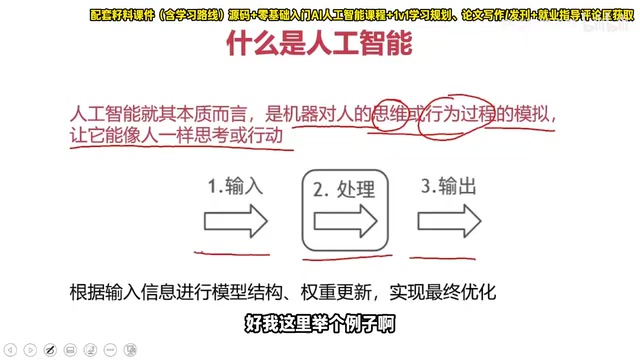
What truly sets artificial intelligence apart from traditional programs is self-learning and optimization. Give it data, and it can find relationships within that data and build a model on its own. Give it new data, and it can update the model. This means the model can continuously iterate — and even surpass humans on certain tasks.
Models and weights are the two cornerstones for understanding machine learning. A "model" can be understood as a mapping function from input to output — it defines how the machine derives results from input information. "Weights" are the adjustable parameters within this function, similar to the dial settings on a radio, determining how much each input signal influences the final output.
The training process is essentially the continuous adjustment of these weights: the machine receives large quantities of labeled samples, calculates the gap between its output and the correct answer (i.e., the error), then fine-tunes the weights through algorithms like backpropagation to gradually reduce that error. Once training is complete, the weights are fixed and become the model's "memory" of the data's patterns. So when someone says "the model has learned something," they really mean the weights have been adjusted to a numerical combination that fits the data well. This also explains why switching tasks requires retraining — the old weights are only valid for the original data distribution.
Strong AI vs. Weak AI: Where Are We Now?
When discussing the stages of AI development, two concepts are unavoidable: strong AI and weak AI.
Strong AI refers to machines that possess genuine reasoning ability and the capacity to solve complex problems, with comprehensive thinking that matches or surpasses humans, along with self-awareness. Anyone who's seen Resident Evil probably remembers the "Red Queen" — that kind of machine that can make autonomous decisions and even exceed human cognitive boundaries is the imagined strong AI.
But the reality is, we're still very far from this stage, and no one can accurately say just how far.
Weak AI is the stage we're currently in. Machines can become expert-level tools in specific domains but lack genuine reasoning ability and self-awareness. For example, AI in healthcare can rapidly identify potential risks from millions of medical records — a doctor couldn't review that many cases in a lifetime, but AI can do it efficiently. It's extremely powerful on specific tasks, but switch to a different scenario and it may fail completely.
This distinction matters. Much of the fear and misunderstanding surrounding AI stems from mistaking weak AI's capabilities for strong AI. Even just pushing the boundaries of weak AI, there's already so much we can accomplish.
Self-awareness in the AI context typically refers to a machine's ability to form self-representations, understand its own existence, and autonomously set goals based on that understanding — rather than merely executing externally given instructions. It's not the same thing as "intelligence": a system can surpass humans at chess or diagnosing diseases while having no "awareness" that it's playing chess or diagnosing anything, and no concern for the outcome.
Currently, all AI systems exist in this "unconscious" state — their behavior is entirely determined by training data and objective functions. Even when they appear creative, it's merely high-dimensional interpolation or recombination of the training data distribution. There's no academic consensus on criteria for judging whether a system possesses self-awareness, but it's generally agreed that it would require at least continuous self-modeling, cross-domain goal transfer, and a motivation system independent of humans. This is the core reason strong AI remains distant — it's not a lack of computing power, but our lack of scientific explanation for how "consciousness" itself arises.
Two Paths to Implementing AI: Symbolic Learning vs. Machine Learning
There are currently two main approaches to implementing artificial intelligence: symbolic learning and machine learning.
Symbolic Learning: The Underlying Logic of Expert Systems
Symbolic learning is based on logic and rules. The core idea is to codify expert experience into a set of predefined logic and sequences, then have machines execute according to those rules. At the programming level, this means writing large numbers of if-then statements — if A happens, the machine executes B.
The classic example is Deep Blue defeating a human chess champion, which used an expert system.
But symbolic learning has a fatal flaw: it cannot dynamically optimize for new scenarios, and the model cannot automatically upgrade. Real-world problems often come with new data and new situations, and you need the model to iterate automatically. This limitation has largely suppressed the development potential of symbolic learning.
Expert systems were the most representative product of the symbolic learning era, popular in the 1970s and 1980s. Their core consists of two parts: a knowledge base and an inference engine. The knowledge base stores rules hand-written by domain experts, such as "if a patient's white blood cell count is elevated and accompanied by fever, suspect bacterial infection." The inference engine is responsible for matching rules in logical order and deriving conclusions.
Expert systems achieved practical results in vertical domains like medical diagnosis, geological exploration, and fault troubleshooting, but they face two fundamental bottlenecks: first, knowledge acquisition is difficult — writing expert experience into rules one by one is time-consuming and prone to missing tacit knowledge; second, rules may conflict with each other, and as the number of rules grows, maintenance costs rise exponentially. More critically, they cannot automatically correct rules from new data, and fail when encountering situations not covered by the knowledge base. Deep Blue's victory over Kasparov is classified in this category precisely because it relied on chess evaluation rules written by human engineers and massive computing power, rather than learning autonomously from game data.
Machine Learning: The Current Mainstream Approach to AI
Machine learning takes a completely different approach — finding relationships and patterns in data to build models that solve problems. Its characteristics are distinctive: data-driven and self-optimizing.
You tell the machine what you want, and it needs large amounts of data to learn.
Application scenarios cover autonomous driving, stock price prediction, image recognition and localization, automatic spam detection, housing price prediction, and more. It's fair to say that machine learning is the current mainstream approach to AI, and it's also the core content of this course.
So what does the future hold? The more likely direction is a combination of symbolic learning and machine learning. Symbolic learning has clear mechanisms and strong interpretability but lacks self-iteration capability; machine learning can self-iterate but is highly dependent on data. Future complex models will likely be a fusion of both.
Machine Learning and Deep Learning: Containment Relationship and Core Differences
After learning about artificial intelligence and machine learning, there's another high-frequency concept: deep learning. What exactly is the relationship between the three?
In one sentence: Machine learning is a subset of artificial intelligence, and deep learning is a subset of machine learning.
Machine learning is one method of implementing artificial intelligence (symbolic learning is another, and machine learning is the most mainstream), while deep learning is a specific technique for implementing machine learning.
Here's an analogy.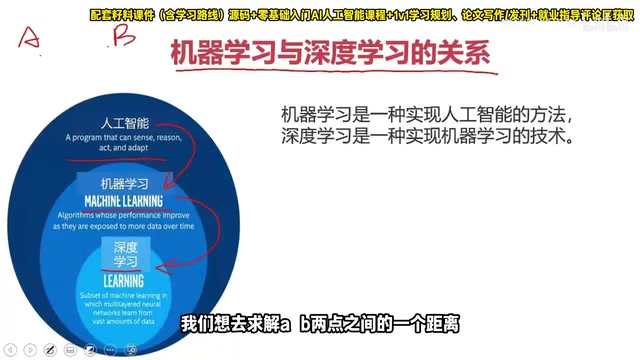
Given two points A and B on a plane, find the distance between them. Method one: introduce a third point C, calculate the distances AC and BC and the angle ACB, then indirectly derive AB. Method two: establish a coordinate system, get the coordinates of A and B, and directly calculate the distance from coordinates. Both methods solve the problem, but the "coordinate system" in method two is a specific technique within the geometric approach.
Mapping this to AI: artificial intelligence is the goal of "finding the distance AB," machine learning is the "geometric method," and deep learning is the specific technique of "establishing a coordinate system."
Deep learning is characterized by mimicking human neural networks to build models, then performing data analysis. But one thing must be remembered — deep learning is equally inseparable from data. Complex applications like facial recognition, semantic understanding, and autonomous driving are all supported by deep learning behind the scenes.
Neural networks are the structural foundation of deep learning, inspired by how neurons connect in biological brains. A typical artificial neural network consists of multiple layers of nodes: an input layer receives data, several hidden layers extract features progressively, and an output layer produces results. Each node performs a weighted sum of signals from the previous layer, then uses an activation function to decide whether to "activate" and pass the signal to the next layer.
The word "deep" refers to the large number of hidden layers. Shallow networks can only learn simple linear relationships, but after stacking multiple layers, the network can automatically abstract edges, textures, parts, and even semantic concepts from raw pixels or text — this is precisely why deep learning dramatically outperforms traditional methods on image and speech tasks. Training relies on the backpropagation algorithm: output errors are propagated backward from the last layer layer by layer, adjusting each layer's weights along the gradient direction. Notably, deep learning's "automatic feature extraction" capability, while powerful, comes at the cost of requiring massive amounts of labeled data and computing power, which makes it difficult to directly apply in data-scarce domains.
Key Takeaways
- Artificial intelligence is machines imitating human intelligence, with self-learning and optimization as its core characteristics
- We are currently in the weak AI stage — machines can become expert-level tools in specific domains but lack self-awareness
- Symbolic learning relies on rules and expert experience and cannot self-iterate; machine learning learns patterns from data and is the current mainstream AI approach
- Machine learning belongs to artificial intelligence, deep learning belongs to machine learning — the three form a layered containment relationship
- The future trend may be a combination of symbolic learning and machine learning, balancing interpretability with self-learning capability
One-line Summary
From concepts to approaches, clarifying the layered containment relationships between artificial intelligence, machine learning, and deep learning.
Paragraph Summary
Starting from the simple definition of "machines imitating human intelligence," the article uses the example of a friend named Xiaoming watching a movie to illustrate AI's input-processing-output pipeline, and points out that its core distinction from traditional programs lies in self-learning and optimization. It then distinguishes between strong AI and weak AI, emphasizing that we remain in the weak AI stage where machines have expert-level capabilities only in specific domains without self-awareness. Next, it introduces two paths to implementing AI: symbolic learning, which relies on expert rules and cannot self-iterate, and machine learning, which is data-driven and capable of self-optimization — the latter being the current mainstream approach. Finally, it clarifies the relationship between the three — machine learning is a subset of artificial intelligence, and deep learning is a subset of machine learning — using the geometric analogy of finding the distance between points A and B, and notes that the future trend may be a fusion of symbolic learning and machine learning.
Related articles

Chain of Thought Isn't Just for AI: How Humans Can Use CoT to Improve Thinking Quality
Chain of Thought isn't just a prompt trick for large models. Starting from a Hacker News discussion, this article analyzes why CoT works for human thinking too, breaks down actionable ways to transfer it, and highlights the key differences between human CoT and machine CoT.
Cloudflare Teams Up with OpenAI: Closi…
Cloudflare Teams Up with OpenAI: Closing the Loop from Vulnerability Discovery to Defense with AI
Cloudflare uses OpenAI Daybreak to investigate security vulnerabilities and generate reviewable remediation plans, while developers use Codex to boost coding efficiency and quality.

Orca Multi-Agent Orchestration in Practice: A Guide to Parallel Collaboration with Claude and Codex
Orca is Stable AI's free open-source agent workbench supporting 34 agents like Claude Code and Codex in parallel. Learn its Git worktree isolation, multi-model orchestration, and mobile management.