AI for Everyone and AI Safety: The Core Themes of a Tech Leaders Roundtable

Silicon Valley investors debate AI's three social imperatives: distributing benefits, building trust, and ensuring safety.
Prominent tech investors including Chamath Palihapitiya and David Sacks held an in-depth discussion on the social contract behind AI deployment, focusing on three core themes. First, AI's economic gains are currently concentrated among a small group of capital holders — how to broaden access through affordable products, redistribution, or equity democratization is key to long-term social acceptance. Second, AI adoption requires earning community permission through bottom-up trust-building rather than top-down imposition, as lessons from autonomous vehicles show a single trust crisis can erase years of progress. Third, ensuring AI systems are predictable, controllable, and aligned with human intent is deeply tied to social acceptance and cannot be solved by technical means alone.
A High-Quality Conversation About the Future of AI
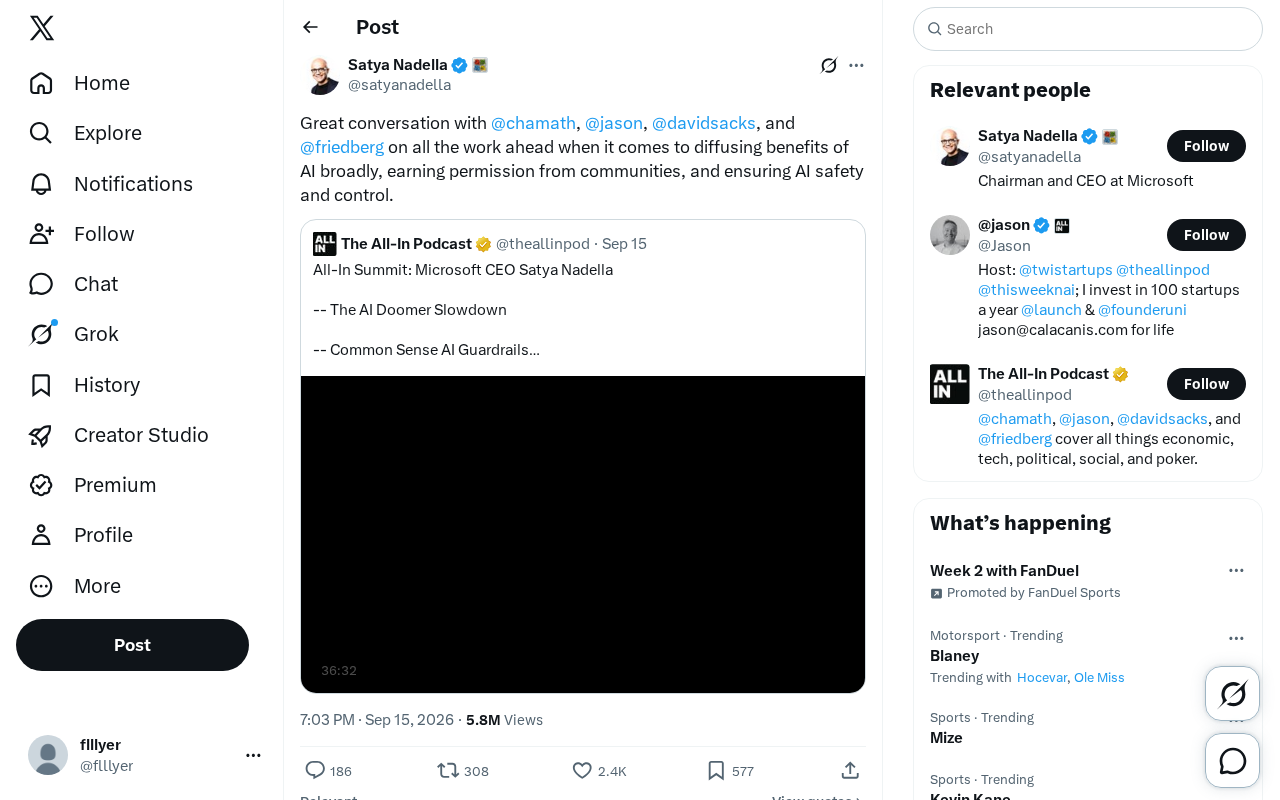
Recently, a group of prominent tech investors and entrepreneurs — including Chamath Palihapitiya, Jason Calacanis, David Sacks, and David Friedberg — engaged in a deep discussion about the most pressing challenges in AI development. The conversation centered on three core questions: how to broadly distribute the benefits of AI across society, how to earn trust and permission at the community level, and how to ensure AI remains safe and controllable.
These participants are long-time veterans of Silicon Valley's technology and investment scene. Their discussion went well beyond technical considerations, focusing instead on the social contract underlying AI's real-world deployment. This reflects a broader shift in AI discourse — from "capability" to "responsibility."
How to Broadly Distribute the Benefits of AI
"Diffusing benefits of AI broadly" was the first key theme of the conversation. The value created by technological progress tends to concentrate among a small number of companies and individuals in its early stages. How the wider public comes to share in these gains is a fundamental question for AI's long-term social acceptance.
Underlying this theme is a real concern: if AI primarily serves as a tool for boosting productivity and replacing labor — while the economic returns flow mainly to capital — it could deepen social divisions. Discussing "broad diffusion," then, is really a conversation about how the gains from technology get distributed, whether through creating new types of jobs, reducing the cost of services, or building more accessible products.
In economic terms, this maps onto the classic tension between technological unemployment and unequal distribution of gains. Historically, the mechanization wave of the early Industrial Revolution sparked fierce labor-capital conflict, and it took union movements, labor legislation, and public education systems to gradually forge a new social contract. Today's discussions about distributing AI's benefits generally fall into a few broad approaches: the "universal product" path, which lowers the cost of AI services so that small businesses and ordinary users can benefit too; the "taxation and redistribution" path, which levies a dedicated tax on the excess profits generated by AI and uses the revenue for vocational retraining and social safety nets; and the "equity democratization" path, championed by some advocates in the form of an "AI dividend" that would allow citizens to directly share in the growth of AI companies. These approaches are not mutually exclusive, but they vary significantly in political feasibility and implementation difficulty.
Earning "Permission" from Communities
Another concept worth noting in the discussion was "earning permission from communities." This framing implies that rolling out AI should not be a one-way technological push, but must be built on a foundation of social trust.
Trust Is a Prerequisite for AI Deployment
Whether the technology is autonomous vehicles, medical AI, or generative content tools, public acceptance directly affects how quickly it can actually be deployed. Historically, many technologies have faced fierce backlash because they ignored how communities felt about them. "Earning permission" emphasizes building legitimacy from the bottom up — companies need to communicate proactively, operate transparently, and respond to the genuine concerns of communities rather than scrambling to repair damage after the fact.
This perspective sets a higher bar for AI companies: success depends not only on model performance, but on whether the technology can develop a healthy relationship with the society it operates in.
The autonomous vehicle space offers a textbook example. While Waymo, Cruise, and other companies were expanding their robotaxi operations in San Francisco, Cruise mishandled the aftermath of an accident and triggered a massive public backlash, ultimately leading California regulators to suspend its operating license. This incident powerfully illustrated how a single trust crisis can undo years of hard-won technical progress. In practice, "earning permission" typically involves stakeholder consultations with community representatives before entering new markets, establishing transparent incident disclosure mechanisms, and designing phased deployment plans that can be rolled back if needed. Some researchers call this process "Social License to Operate" (SLO) — a concept originally developed in the mining industry that has since been introduced into AI governance discussions, emphasizing that public approval must be continuously maintained rather than obtained once and taken for granted.
AI Safety and Controllability
The third theme was "AI safety and control," which is also a focal point of global AI governance debates. As model capabilities advance rapidly, ensuring that AI systems behave predictably, remain open to intervention, and align with human intent has become a shared concern for both industry and regulators.
Safety and controllability are not simple technical switches — they involve designing the entire chain from model training and deployment to ongoing oversight. The fact that this topic was discussed alongside "diffusing benefits" and "earning community permission" suggests that the participants see safety as deeply intertwined with social acceptance: only AI that is trustworthy and controllable can earn lasting support from society.
The AI safety field typically distinguishes between two fundamentally different types of problems. The first is the "alignment problem" — ensuring that an AI system's goals and behaviors remain consistent with human intent and preventing models from drifting or producing unintended consequences during optimization. The second is the "misuse problem" — the deliberate use of AI capabilities to generate disinformation, conduct cyberattacks, or develop dangerous materials. The former is a long-term challenge at the intersection of technology and philosophy; leading organizations like OpenAI, Anthropic, and DeepMind all have dedicated alignment research teams working on it. The latter relies more heavily on policy, regulation, and platform governance. On the technical side, "controllability" encompasses interpretability research (understanding why a model makes a particular decision), red-teaming (simulating adversarial scenarios to identify vulnerabilities), and deployment-level guardrail design (such as content filtering and tiered permissions). Situating safety within a social trust framework means that technical measures alone are insufficient — verifiable third-party audit mechanisms are also needed.
Conclusion: The "Homework" Beyond the Technology
The value of this conversation lies in the fact that it refused to treat AI as purely a technical or commercial issue, instead examining it within a much broader social framework. The three threads — distribution of benefits, community trust, and safety and control — all point to the same conclusion: for AI to go the distance, technical capability is only the starting point. There is equally demanding work to be done on the social front.
For practitioners and observers who follow AI's development, discussions like this serve as a reminder: what ultimately determines the future of AI may not be the next, larger model — but whether we can successfully manage the relationship between technology and society.
(Note: This article is based on a summary of a conversation shared on social media. For specific details, please refer to the original discussion.)
Related articles

@ai-sdk/vue 3.0.306 Patch Release Syncs with [email protected] Update
@ai-sdk/vue 3.0.306 released, synced with [email protected]. A routine patch release for the Vercel AI SDK ecosystem with no public API changes; the Vue adapter layer stays version-aligned with the core package.

Gemini 4 Argon API Launches: The Era of Million-Token Output Begins
Google launches Gemini 4 Argon with sparse MoE architecture, up to 1M output tokens, and a 68.90% Vals Index score, available across API, AI Studio, and the Gemini app.

DukaanAI: Turning Product Photos into Inventory Lists with Open-Source AI
DukaanAI is an AI inventory tool for small retailers that turns product photos into inventory entries using the open-source Gemma 3 model, with local inference, editable fields, and CSV export.