AI Gateway Data Reveals: Anthropic's Closed-Source Share Rises to 65%, Open-Source Model Spending Surges

Gateway spending data shows Anthropic's closed-source share at 65% and open-weight models at 29%, with the market concentrating at both ends.
AI Gateway spending data circulating on X shows that since the release of Opus 5.5 and Fable 5.2, Anthropic's share of closed-source model spending rose from 52% to 65%, widening its lead over other closed-source vendors. In the same data, open-weight models' spending share jumped from 2% to 29%. These seemingly opposite shifts point to the same trend: developers tend to choose between the most capable closed-source models and the most cost-effective self-hostable ones, skipping mid-tier closed-source vendors lacking differentiation—an early signal of a "dumbbell-shaped" model market. The article also notes the data comes from a single tweet with undisclosed methodology, so it only indicates trend direction, not overall API market share.
Anthropic Widens Its Lead in the Closed-Source Model Market
According to AI Gateway spending data circulating on the social platform X, since the release of Opus 5.5 and Fable 5.2, Anthropic's share of closed-source model spending has risen from 52% to 65%. This shift means that among developers calling closed-source models through unified gateways, Anthropic is pulling away from other closed-source vendors.
Image: Screenshot of the original X post
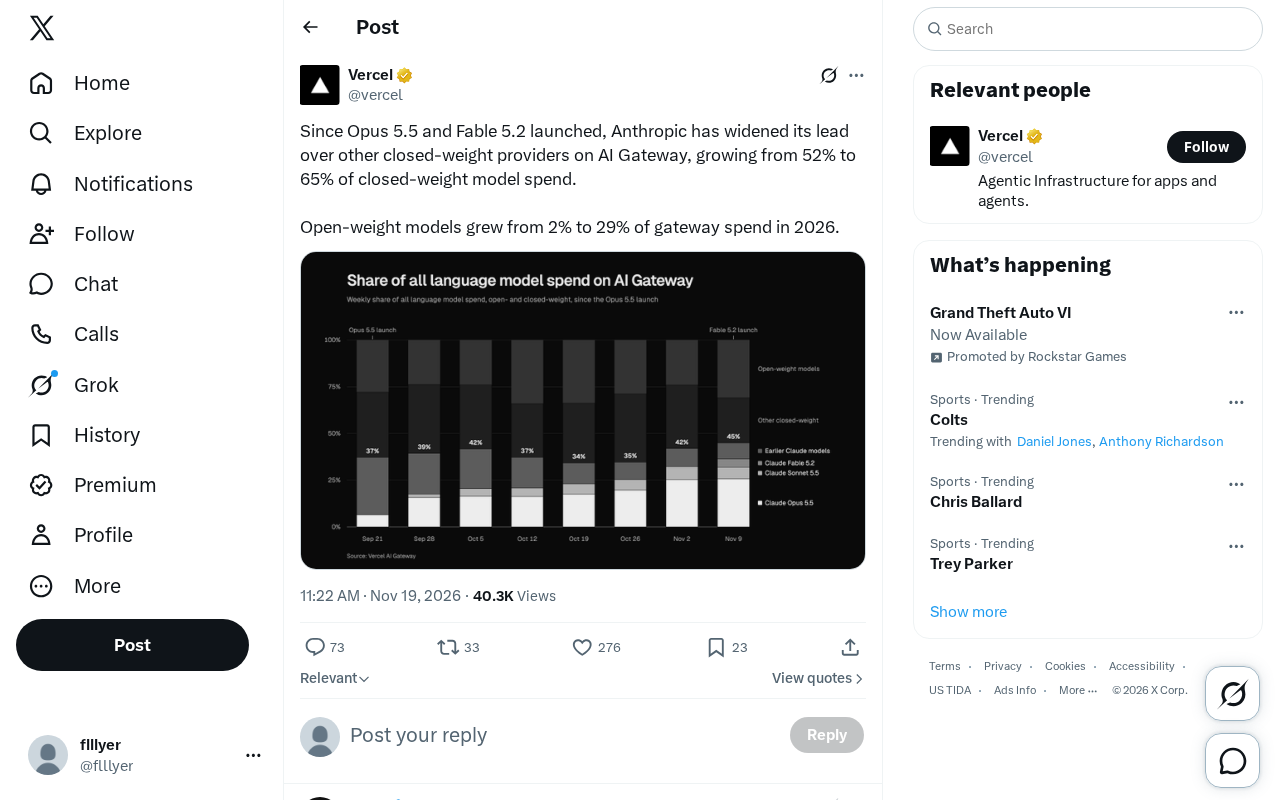
An AI Gateway typically refers to a middleware service that enterprises or individual developers use to access multiple model APIs through a single interface. The spending structure generated through gateways reflects developers' real-world production choices—"voting with their feet"—rather than just benchmark rankings. Anthropic's rising share shows that new model releases directly drive its call volume.
Opus 5.5 and Fable 5.2 are the two model versions cited in the article as driving Anthropic's share increase. The Opus series is Anthropic's flagship closed-source model line, typically aimed at highly complex reasoning and long-context tasks; Fable is mentioned alongside Opus in the article as another model from the same release cycle, though the original text does not elaborate on its specific positioning. After both were released, Anthropic's gateway spending share jumped from 52% to 65%, showing that version iterations have a clear migration effect on developers' actual usage—developers re-evaluate and switch their default model after a new release rather than locking into a single version long-term.
Open-Weight Model Spending Share Jumps from 2% to 29%
Another, more noteworthy change in the same dataset: open-weight models' share of gateway spending grew from 2% to 29%. The original text flags this change as a 2026 trend.
Open-weight models generally refer to models whose parameters are publicly downloadable and can be self-deployed, in contrast to closed-source models that can only be accessed via API. The spending share climbing from the edge of single digits to nearly 30% indicates that a substantial portion of gateway traffic is migrating toward self-hostable, more cost-controllable solutions. For scenarios that need to control inference costs or keep data within a domain, open-source models are becoming a practical option rather than merely an experimental alternative.
Open-weight differs slightly from what is commonly called "open-source models": it emphasizes that the weight files are publicly available after training, so users can download them and deploy inference on their own hardware or cloud instances, though the training data and training code may not be released alongside them. The typical advantages of open-weight models are therefore self-hosting, fine-tuning capability, data staying within a domain, and controllable marginal cost per token; the trade-off is that you must bear the compute, operations, and inference optimization yourself. This distinction explains why their rising share of gateway spending is meaningful: adopting them means developers have cleared the deployment threshold and are using them for production traffic rather than just evaluation.
The Two Data Points Are Not Contradictory: The Market Is Both "Concentrating" and "Dispersing"
On the surface, Anthropic's rising share represents concentration toward the top of the closed-source market, while the rising open-source share represents dispersion toward the outside. Both happening at once points to the same thing: mid-tier closed-source vendors are being squeezed.
One explanation is that developers tend to choose between the most capable closed-source models and the most cost-effective open-source models, skipping closed-source mid-sized vendors that lack clear differentiation. The structural shift in gateway spending can therefore be seen as an early signal of a "dumbbell-shaped" distribution in the model market.
It should be noted that this data comes from a single-source tweet disclosure, and the sample scope and statistical methodology are not public, so it cannot be directly equated with overall API market share. Still, its indicative value for trend direction is worth noting.
"Dumbbell-shaped" distribution is borrowed from market structure analysis and refers to demand concentrating at both ends while the middle shrinks. In the model market, one end is the most capable, higher-priced top closed-source models, and the other end is "good enough," lower-cost open-weight models; vendors in between—lacking either a significant capability gap or a price advantage—are the easiest to skip during model selection. The contrasting structure is "pyramid-shaped," where the top takes all and the long tail is tiny. The key implication of the dumbbell judgment is that mid-tier vendors' share loss is not being absorbed unilaterally by the top, but diverted simultaneously by both ends.
Implications for Developers and Model Vendors
For developers, the shift in gateway spending structure means more options for model selection and lower risk of single-vendor lock-in. Abstracting the call layer above a gateway and routing to different models by task type is becoming a more common engineering practice.
For model vendors, the share fluctuations driven by new model releases show that this market is still in a phase of rapid reshuffling. Closed-source vendors' lead depends on a sustained capability gap, while open-weight models will quickly gain adoption in price-sensitive scenarios once their capabilities approach a "good enough" level.
Key takeaway: Anthropic's share of closed-source model spending rose from 52% to 65%, and open-weight models' share rose from 2% to 29%. Together, these show that AI model spending is concentrating at both ends, with mid-tier vendors facing the greatest pressure.
Related articles

From 0 to 1: Vibe Coding an AI Knowledge Base — A Practical Retrospective and Tech Stack Breakdown
A retrospective on building the AI knowledge base OilBook from scratch with Vibe Coding: Next.js+Neon stack, Oil Dev Skill workflow, Stripe paywall security, interview-style writing, AI-flavor control, and Vercel deployment.

GLM-5.4 Hands-On: Native Vision Meets a New Vibe Coding Workflow
Hands-on with Zhipu GLM-5.4: native vision tested across a 3D product demo, pure-code video generation, and remote-control Vibe Coding, compared with GPT-6.2 and Gemini Neon.

AI and Humans Claim to Prove the Riemann Hypothesis: Machine-Verified, Yet Nobody Can Understand It
Anthropic mathematician and AI Claude claim to prove the Riemann Hypothesis with 17 million lines of Lean code, machine-verified but unreadable by humans. This article analyzes the event, the zero proportion record from 41.6% to 67.2%, and the gap between machine verification and human understanding.