AI Gateway: One-Stop Enterprise AI Management with Self-Hosted Models and Multi-Provider Unified Access

AI Gateway unifies self-hosted and multi-cloud models behind an OpenAI-compatible endpoint, with local GPU priority and access governance.
AI Gateway is a self-hosted AI gateway on Product Hunt that unifies an enterprise's own GPU cluster with external providers like OpenAI, Groq, and Together behind one OpenAI-compatible API endpoint. Requests prefer local inference and fall back to cloud when needed, improving GPU utilization and controlling costs. It supports compliance-friendly self-hosting and per-member or per-project model access control, though public details and community validation remain limited.
Enterprises face a real dilemma when embracing large models: there are more and more model providers, each of OpenAI, Groq, and Together has its strengths, and self-built GPU clusters shouldn't sit idle. How to schedule, control access, and balance costs in one place? A new product on Product Hunt, AI Gateway, tries to answer this question—it unifies self-hosted models and multiple providers behind a single OpenAI-compatible endpoint, letting enterprises control AI traffic with their own servers.
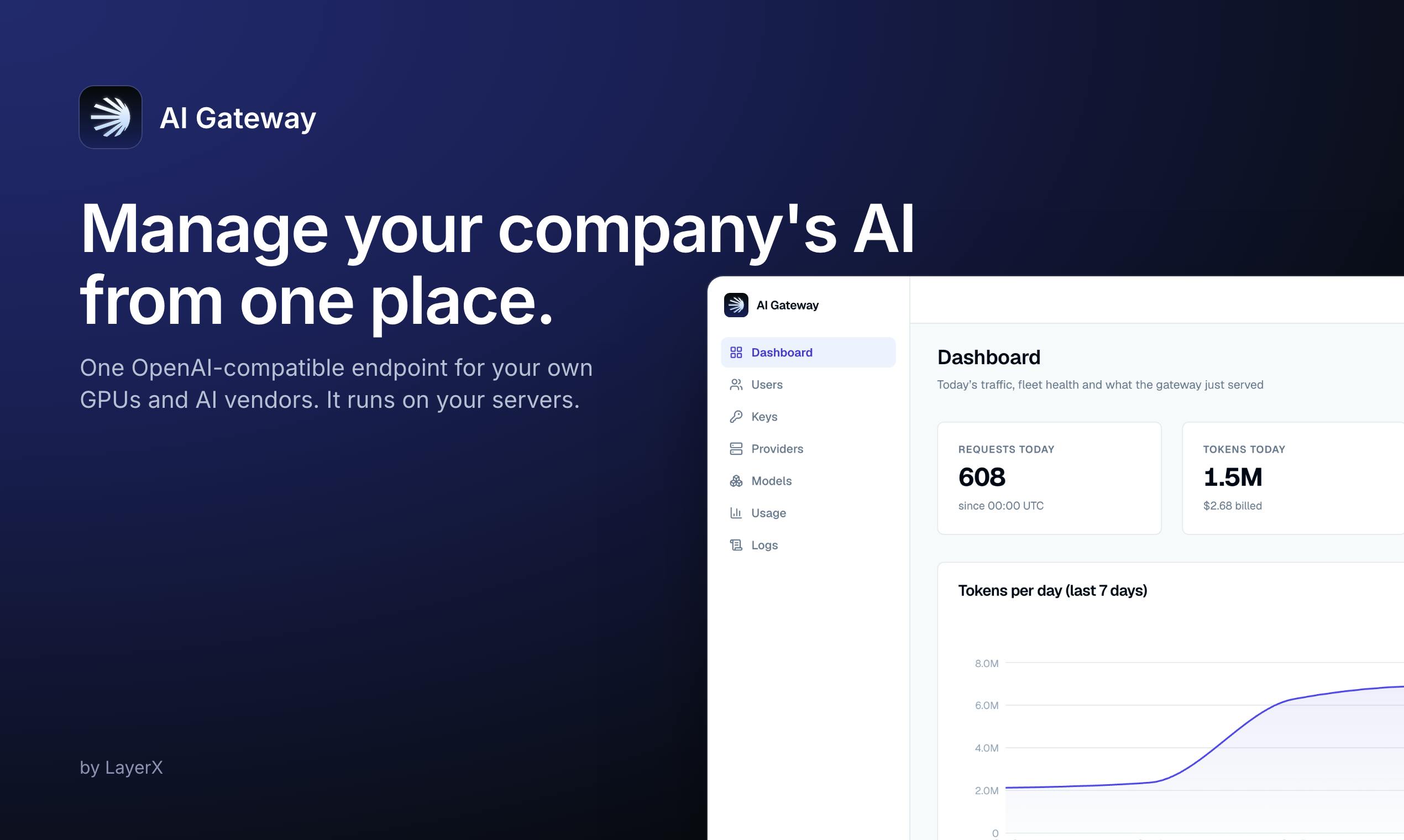
One Endpoint, Unified Scheduling of Self-Hosted and Cloud Models
The core idea of AI Gateway isn't complicated, but it addresses a real problem in enterprise AI deployment. It provides an OpenAI-compatible API endpoint, so developers don't need to write different invocation logic for each provider, and existing applications based on the OpenAI SDK can migrate almost seamlessly. According to the product introduction, requests are routed to the enterprise's own GPU cluster first, and when local compute is insufficient or model capabilities don't match, they automatically fall back to external providers like OpenAI, Groq, and Together.
This "local-first, cloud-fallback" architecture means enterprises don't have to choose between building and buying. Idle GPUs can prioritize traffic, external APIs fill in during peak periods, and the cost structure is more controllable than relying solely on cloud providers. For teams that already have inference servers but low utilization, this logic is especially appealing.
OpenAI-compatible API endpoint means the interface exposed by the gateway is consistent with the official OpenAI API in request format, response structure, and authentication (such as the /v1/chat/completions path, the model field, the messages array, etc.). This means any application using the official OpenAI SDK or HTTP wrapper only needs to point base_url to the gateway address and replace the API Key to switch backend models without changing business code. The compatibility layer also typically needs to handle streaming output (SSE), function calling, structured output, and other extended capabilities. Providers do not implement these details uniformly, so the completeness of compatibility is a key metric for evaluating gateway quality.
Self-Hosted Deployment and Access Control
Unlike many SaaS-form AI gateways, AI Gateway emphasizes running on the enterprise's own servers. This brings two direct benefits: data doesn't leave the internal network, and latency is controllable. For industries sensitive to data compliance, such as finance and healthcare, self-hosting is often a hard requirement.
The product description mentions "you decide who uses which model," indicating that access permissions are one of the core features. Teams can assign model access rights by member or project, preventing everyone from indiscriminately calling the most expensive model. This governance capability is a pragmatic design direction at a time when runaway AI costs have become a widespread anxiety. However, public information currently does not disclose the specific permission granularity, audit logs, or billing tracking details, so the full capabilities in this area still need to be verified through actual experience.
Self-hosting refers to deploying software on servers or private clouds controlled by the enterprise itself, rather than having a third party host it as a SaaS. For an AI gateway, self-hosting means all request metadata, prompt content, and logs remain on the internal network and do not pass through an external service provider. This not only meets data residency and compliance audit requirements but also lets enterprises decide their own upgrade cadence and network topology. The cost is that the enterprise bears responsibility for deployment, operations, high availability, and version upgrades, which places certain demands on the team's infrastructure capabilities.
The Value and Trade-offs of a Multi-Provider Abstraction Layer
Putting OpenAI, Groq, and Together behind the same abstraction layer makes enterprise provider strategy more flexible. Groq is known for inference speed, Together offers hosting for various open-source models, and OpenAI is the benchmark for general capabilities—after unified access, teams can route requests based on task type without being locked into a single provider.
This abstraction layer also has costs. Each provider's API differs in parameters, streaming output, tool calling, and other details, and whether the compatibility layer can fully preserve each provider's features directly determines the developer experience. According to the Product Hunt page, the project has received 68 votes and 5 comments and ranks 13th, indicating it has attracted some developer attention, but the sample size is still small and community validation is not yet sufficient. Whether it is suitable for production environments requires careful evaluation based on one's own traffic scale.
An API abstraction layer is an intermediate layer inserted between applications and multiple underlying services, providing a unified interface externally and handling protocol conversion, routing, and fault tolerance internally. Its core value lies in decoupling: applications are no longer bound to a single provider and can dynamically switch based on latency, price, and model capabilities. But an abstraction layer naturally faces the "least common multiple" problem—it can only expose the subset of capabilities shared by all providers, and provider-specific parameters or features are easily flattened. A well-designed abstraction layer preserves differences through passthrough fields or capability flags, while a crude implementation sacrifices functionality for uniformity.
Who Should Consider This Type of Tool
Judging from its positioning, AI Gateway is best suited for two types of teams: first, technical teams that already have self-built inference infrastructure and want to improve GPU utilization; second, medium and large enterprises that connect to multiple model providers and need a unified entry point and cost control. For small teams using only one cloud API, an additional gateway layer may increase operational burden with limited benefit.
One detail: the AI gateway space is not empty, and solutions such as LiteLLM and OpenRouter each have their adherents. AI Gateway's differentiation lies in its self-hosting-first approach and GPU-traffic-first routing strategy. Whether it can establish itself depends on the maturity of the compatibility layer and the depth of permission governance.
Conclusion
AI Gateway uses a combination of "one OpenAI-compatible endpoint + self-hosted deployment + provider fallback" to target the scheduling and governance pain points in enterprise AI management. The product idea is clear, but public information is limited and community feedback is still early. For teams building AI infrastructure, it is worth adding to the evaluation list.
One-line Summary
AI Gateway uses an OpenAI-compatible endpoint to unify scheduling of self-hosted and multi-cloud models, focusing on local GPU priority and access governance.
Paragraph Summary
AI Gateway is a self-hosted AI gateway product on Product Hunt. Its core is unifying an enterprise's own GPU cluster with external providers such as OpenAI, Groq, and Together behind a single OpenAI-compatible API endpoint. Requests prioritize local inference and automatically fall back to the cloud when compute is insufficient or models don't match, thereby improving GPU utilization and controlling costs. Self-hosted deployment meets the data compliance needs of industries such as finance and healthcare, and supports assigning model access permissions by member or project. The product's differentiation lies in its self-hosting-first and GPU-traffic-first routing strategy, but public information is limited, the maturity of the compatibility layer and depth of permission governance remain to be verified, and community feedback is still early (68 votes, 5 comments, ranked 13th).
Related articles

From 0 to 1: Vibe Coding an AI Knowledge Base — A Practical Retrospective and Tech Stack Breakdown
A retrospective on building the AI knowledge base OilBook from scratch with Vibe Coding: Next.js+Neon stack, Oil Dev Skill workflow, Stripe paywall security, interview-style writing, AI-flavor control, and Vercel deployment.

GLM-5.4 Hands-On: Native Vision Meets a New Vibe Coding Workflow
Hands-on with Zhipu GLM-5.4: native vision tested across a 3D product demo, pure-code video generation, and remote-control Vibe Coding, compared with GPT-6.2 and Gemini Neon.

AI and Humans Claim to Prove the Riemann Hypothesis: Machine-Verified, Yet Nobody Can Understand It
Anthropic mathematician and AI Claude claim to prove the Riemann Hypothesis with 17 million lines of Lean code, machine-verified but unreadable by humans. This article analyzes the event, the zero proportion record from 41.6% to 67.2%, and the gap between machine verification and human understanding.