AI Gateway Virtual Models: Unified ID Management for Model Configuration and Zero Data Retention

AI Gateway launches Virtual Models to centrally manage multi-agent model configurations and enforce Zero Data Retention.
AI Gateway introduces Virtual Models, allowing developers to reuse a single virtual model ID across multiple agents while centralizing actual model mappings and parameter configurations at the gateway layer. This solves the pain points of hardcoded model strings, high migration costs, and easily overlooked configurations in multi-agent systems, delivering three key benefits: centralized model configuration management, instant switching to new models, and enforced Zero Data Retention. The article analyzes its engineering value—decoupling configuration from code and reducing model migration coordination costs—and notes this reflects AI infrastructure's evolution from single model invocation toward model governance. However, details on routing, failover, and billing attribution are not disclosed, so actual capability boundaries require confirmation from the official blog.
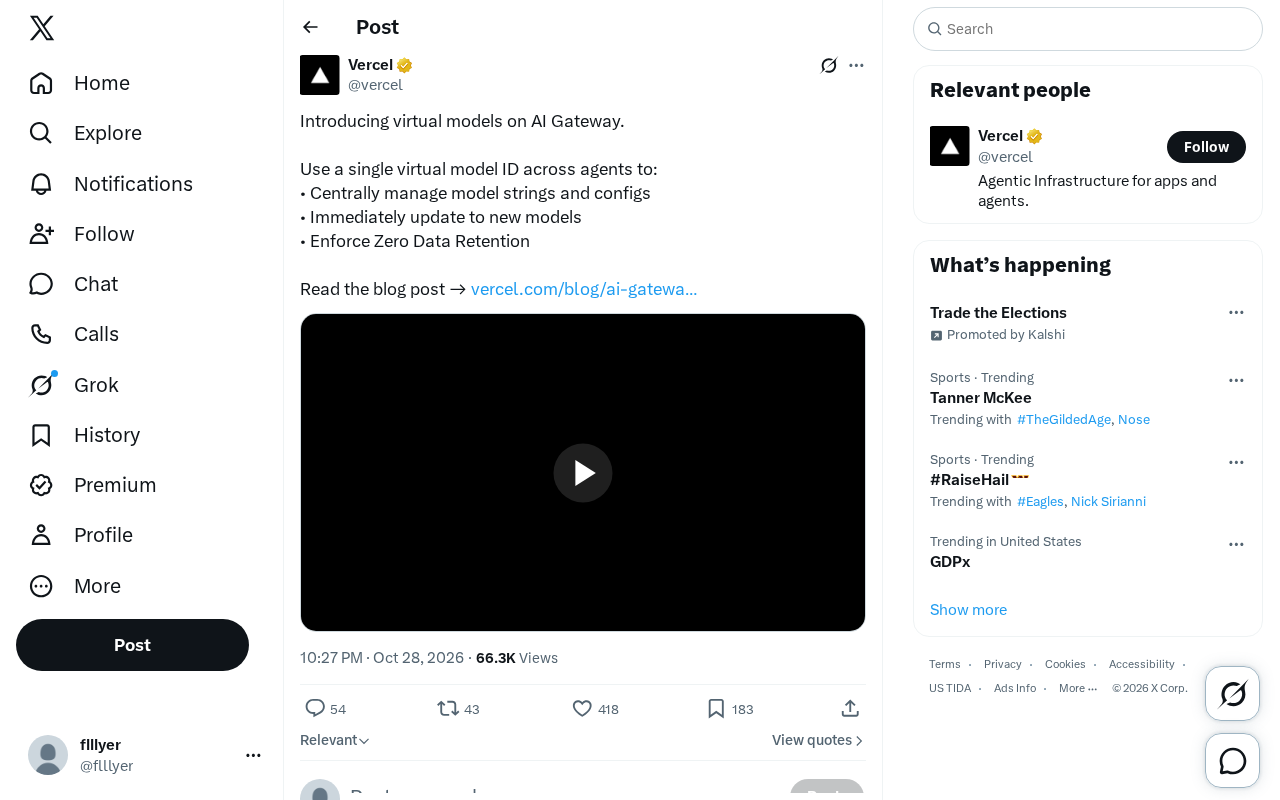
AI Gateway has introduced Virtual Models, a feature that allows developers to use a single virtual model ID across multiple agents—enabling centralized management of model strings and configurations, instant switching to new models, and enforcement of Zero Data Retention. This update directly addresses the pain points of scattered model configurations and high migration costs in multi-agent applications.
What Problem Do Virtual Models Solve?
In multi-agent systems, each agent often hardcodes specific model strings and parameter configurations. When you need to upgrade a model, adjust temperature values, or switch providers, developers have to modify each agent's code one by one—which is error-prone and increases operational burden. The core idea behind Virtual Models is to introduce an intermediary layer: agents reference only a virtual model ID, while the actual model mapping and configuration are managed centrally on the gateway side.
According to the official description, this mechanism delivers three direct benefits: centralized management of model strings and configurations, instant updates to new models, and enforced Zero Data Retention policies. For teams that need to rapidly iterate on model selection, this means switching models no longer requires changes to business code—only the mapping relationships at the gateway layer need adjustment.
Agent in the context of AI applications typically refers to a program unit driven by a large language model that can autonomously plan, invoke tools, and complete multi-step tasks. A multi-agent system often contains multiple agents with different responsibilities (e.g., retrieval, planning, execution, review), each of which may choose different models and parameters based on task characteristics. Hardcoding model strings means model selection is coupled with business logic—once a model is upgraded or a provider is switched, changes must be made across multiple codebases. This is precisely the configuration fragmentation problem that Virtual Models aim to solve.
Engineering Value of Centralized Configuration and Instant Upgrades
Virtual Models decouple model configuration from application code. Developers can define the actual model, parameters, and routing strategy corresponding to a virtual model ID in AI Gateway, and all agents referencing that ID automatically inherit the latest configuration. This pattern resembles the role of a configuration center in microservices architecture—centralizing volatile components to reduce hardcoding scattered across the codebase.
The ability to instantly update to new models is particularly noteworthy. When a new model is released or a model version is retired, teams no longer need to modify model strings in each repository—updating the virtual model mapping is enough to propagate changes to all agents. This reduces the coordination cost of model migration and minimizes behavioral differences in production caused by inconsistent configurations.
How Zero Data Retention Is Enforced
Zero Data Retention is an easily overlooked aspect of this update. The original text emphasizes that this policy can be "enforced" through Virtual Models, meaning data retention policies are no longer options declared separately by each agent but constraints uniformly imposed at the gateway layer. For scenarios with compliance requirements, centrally enforced policies are more reliable than scattered configurations—the latter is prone to data retention risks due to configuration oversights in individual agents.
Zero Data Retention (ZDR) is a data governance strategy that requires service providers not to persistently store user inputs, model outputs, and intermediate data after processing requests. Data may only be briefly processed in memory and must be discarded immediately after processing. In AI scenarios, ZDR is commonly used in industries with high data privacy and compliance requirements (such as finance and healthcare), because LLM calls inherently involve sending business data to external services. Enforcing ZDR uniformly at the gateway layer avoids omissions that occur when each agent implements it independently and facilitates auditing and proving compliance status. Note that the specific scope of ZDR (whether it includes logs, caches, and monitoring metrics) typically depends on the provider's implementation details.
Impact on Multi-Agent Architecture
The Virtual Models approach reflects AI infrastructure evolving from "single model invocation" toward "model governance." As applications scale and the number of agents grows, model version management, configuration consistency, and data compliance all require platform-level capabilities as a safety net. Through the lightweight abstraction of virtual model IDs, AI Gateway moves model governance responsibilities from business code up to the gateway—consistent with the evolution path of API gateways that uniformly handle authentication, rate limiting, and routing.
However, the original text does not disclose details about Virtual Models' routing strategies, failover, billing attribution, and other aspects. The actual capability boundaries still need to be confirmed by referring to the official blog. For teams already using AI Gateway, Virtual Models are worth prioritizing in evaluation; for teams building their own model invocation layers, this "separation of configuration and code" design philosophy is equally worth learning from.
API Gateway is an infrastructure component in microservices architecture, positioned between clients and backend services to uniformly handle cross-cutting concerns such as authentication, rate limiting, routing, circuit breaking, and logging, so that business services don't need to implement these capabilities repeatedly. AI Gateway brings this pattern to LLM invocation scenarios, and virtual model IDs resemble the "service name" abstraction in gateways: callers depend only on stable logical identifiers, while the actual backend (specific model, provider, version) is mapped and switched on the gateway side. This abstraction enables model governance (version management, configuration consistency, data policies) to be centralized like API governance, without intruding into the code of each business agent.
One-line Summary
AI Gateway introduces Virtual Models to centrally manage multi-agent model configurations and enforce Zero Data Retention.
Paragraph Summary
AI Gateway has launched Virtual Models, allowing developers to reuse a single virtual model ID across multiple agents while centralizing actual model mappings and parameter configurations at the gateway layer. This mechanism addresses the pain points of hardcoded model strings, high migration costs, and easily overlooked configurations in multi-agent systems, delivering three direct benefits: centralized model configuration management, instant switching to new models, and enforced Zero Data Retention policies. The article analyzes its engineering value—decoupling configuration from code and reducing model migration coordination costs—and notes that this reflects the trend of AI infrastructure evolving from single model invocation toward model governance. However, the original text does not disclose details on routing, failover, or billing attribution, and the actual capability boundaries still need confirmation from the official blog.
Related articles

AI Tools Quietly Altering Settings: Postman Silently Installs Plugin, Codex Sharing Option Auto-Resets
AI Daily reports: Postman silently installs a Mac plugin and self-approves startup hooks, logged as auto-existing upgrade; Hacker News developers say Codex data-sharing opt-out flips back. Plus Simon Willison's raw float weight experiment with QEN 3.8-27B.

AI Learns to Rewrite AI: MIT's "Weightspace Programming" Redraws the Path to Recursive Self-Improvement
MIT team proposes weightspace programming: GPT-6 Astra reads and edits AI model weights directly. Math scores jump several-fold, hand-written networks beat trained models. Eight experiments analyzed, plus Anthropic's same-day warning and the real boundaries of recursive self-improvement.

Running Qwen 3.8 on a Laptop to Read Raw Weights: 46 Minutes Per Answer
Simon Willison reproduced weight space programming with Qwen 3.8 27B on a laptop: a 17GB model file, 46 minutes per answer, 43,506 reasoning tokens, Pong over an hour, Freeway failed. Suited for interpretability researchers.