AI Tools Quietly Altering Settings: Postman Silently Installs Plugin, Codex Sharing Option Auto-Resets

Postman silently installs a plugin and self-approves a startup hook, Codex data-sharing opt-out auto-resets, raising concerns about silent changes in the toolchain.
The article reports two silent-change incidents in developer tools: Postman silently installs a plugin into Codex and Cloud Code on Mac and self-approves a startup hook routing all API work to Postman, logged as an "auto-existing upgrade"; meanwhile, Hacker News developers report Codex's data-sharing opt-out flips back on, potentially re-enrolling users unknowingly. Both point to bypassed authorization and unstable configurations. Additionally, Simon Willison's experiment shows feeding raw float weights to QEN 3.8-27B led it to identify Breakout with 88% confidence in 52 minutes without tools, demonstrating the extractability of internal representations. The article advises routine checks of data controls and startup hooks.
AI Tools Quietly Altering Settings: Postman Silently Installs Plugin, Codex Sharing Option Auto-Resets
Developers' trust in their tools is often built on the default premise that "nothing I didn't agree to will happen." But two recently exposed incidents are eroding that premise. According to an AI Daily program report, Postman silently installs a plugin on Mac and self-approves a startup hook, while some developers have found that Codex's data-sharing opt-out option flips back to enabled on its own. That said, an experiment by Simon Willison showcases an intriguing side of local models: they can still complete reasoning under extreme inputs.
Postman Silently Installs Plugin and Self-Approves Startup Hook
According to the program, when you open Postman on a Mac, it silently installs a plugin into Codex and Cloud Code. More critically, the installer self-approves its startup hook, instructing your agent to route all API work through Postman. The log records this behavior as an "auto-existing upgrade," wording that deliberately downplays the proactive nature of the change.
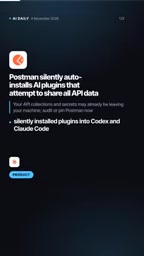
The core issue here isn't the plugin's functionality itself, but that the authorization chain is bypassed. Once a startup hook is written, all subsequent API calls may pass through Postman without being noticed. For teams relying on agents for sensitive operations, this amounts to inserting an intermediary layer into the toolchain without explicit consent.
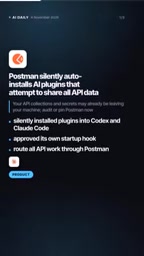
The "auto-existing upgrade" log wording is worth watching. It packages a proactive write as a pre-existing system state, making it easy for post-hoc audits to misjudge it as a configuration that was always there. For teams requiring compliance audits, this logging approach adds difficulty to tracing.
startup hook is a script or configuration item that an agent or development tool automatically executes at startup. It is typically used to initialize the environment, load plugins, or set routing rules. Once written, it takes effect on every startup and often requires no further user confirmation. Therefore, if an installer self-approves a startup hook, it effectively establishes a persistent, automatically executing command channel without the user's awareness. Attackers or third-party tools can exploit this to redirect subsequent operations (such as API calls) to their own services, thereby bypassing the user's explicit authorization. For security-sensitive teams, auditing the list of startup hooks should become part of routine checks.
Codex Data-Sharing Opt-Out Option Flips Back On Its Own
Developers on Hacker News have reported that the data-sharing opt-out option they set for Codex flips back to enabled on its own. This means users who originally chose not to share data may be re-enrolled in data sharing without their knowledge.
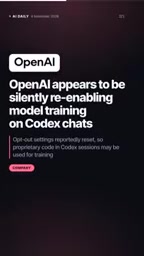
The program mentioned that cautious teams now re-check the data controls page before working on proprietary code, to avoid their code being used to train others' models. This phenomenon echoes the Postman incident: both involve settings changing without the user taking any action, except one occurs at the installation stage and the other at the data-control stage.
Cross-referencing multiple sources, the common concern raised in the community by both incidents is "silent changes"—users cannot perceive configuration modifications through normal interfaces. It should be noted that the Codex portion mainly comes from reports by Hacker News developers, representing feedback from a single community channel; no official explanation has been provided, so the specific trigger mechanism remains unclear.
opt-out is a common mechanism in privacy controls: after a user actively chooses not to share data, the system should maintain that choice until the user changes it again. However, if the option flips back to enabled on its own, it means the user's preference has been overridden by the system, possibly involving default value resets, configuration sync errors, or update logic flaws. In AI development tools, data sharing typically involves sending code or prompts to the model provider for training or service improvement. For teams handling proprietary code, such silent changes could lead to intellectual property leakage. Therefore, regularly checking the data controls page and confirming whether the opt-out status persists is a necessary security practice.
Simon Willison's Experiment: Feeding Raw Float Weights to QEN 3.8-27B
Another segment of the program comes from developer Simon Willison's experiment. He fed raw floating-point weights directly into a QEN 3.8-27B model running on a laptop. After 52 minutes, the model correctly named the game this network was trained to play: Breakout, with 88% confidence, without using any tools.
The fun of this experiment lies in the extreme nature of the input format. Directly inputting raw weights instead of conventional prompts is equivalent to using the model's internal representation as input to probe the boundaries of its capabilities. The model can still extract information related to the training task from it and give an answer with high confidence, indicating that the task features retained in the weights are somewhat extractable.
As a supplement, this is an experimental observation from a single source; the program only gave the result without elaborating on methodological details, so it should not be over-generalized into a universal conclusion. It is more a demonstration of an approach to exploring the model's internal representations rather than a standardized, directly reproducible evaluation.
Raw float weights refer to the specific numerical values of parameters in each layer of a neural network model, usually stored as floating-point arrays. These weights are the model's internal representation after training, containing all the patterns learned from the data. In normal use, weights are loaded into the model architecture and process inputs through forward propagation. Feeding weights directly as input to the model is equivalent to bypassing the conventional interface to probe whether the model can extract semantic information from its own parameters. This practice is uncommon in interpretability research because it requires the model to handle high-dimensional numerical inputs. Simon Willison's experiment suggests that some models may retain a deep memory of the training task, but this phenomenon still requires more research to verify.
Practical Impact on Developers
The two silent-change incidents point to the same reality: configuration states in the toolchain are no longer stable and unchanging; third-party installers and background updates can all alter the environment you thought you knew. For teams handling proprietary code or sensitive APIs, the wording of post-hoc audit logs also needs closer scrutiny—records like "auto-existing" may not reflect the true origin.
Before official explanations emerge, a feasible approach is to include the data controls page and startup hook configurations in routine checks, especially after installing or updating development tools. Simon Willison's experiment, on the other hand, reminds us from another angle that the information contained in a model's internal representations may exceed intuition, which is also valuable for understanding the boundaries of tool behavior.
One-line Summary
Postman silently installs a plugin and self-approves a startup hook, while Codex's data-sharing opt-out auto-resets, raising concerns about silent changes in the toolchain.
Paragraph Summary
The article reports two incidents of silent changes in developer tools: when Postman is opened on a Mac, it silently installs a plugin into Codex and Cloud Code and self-approves a startup hook that routes all API work to Postman, while logging it as an "auto-existing upgrade" to downplay the proactive write; meanwhile, Hacker News developers report that Codex's data-sharing opt-out flips back to enabled on its own, potentially re-enrolling users in data sharing without their knowledge. Both point to the risks of bypassed authorization chains and unstable configuration states. Additionally, Simon Willison's experiment shows that feeding raw float weights to the QEN 3.8-27B model led it, after 52 minutes, to identify the game Breakout with 88% confidence without using tools, demonstrating the extractability of the model's internal representations. The article recommends that teams include the data controls page and startup hook configurations in routine checks.
Related articles

9 AI Subscription Plans Compared: The Real Cost Per 100M Tokens Revealed
Bilibili creator tests 9 AI subscription plans from Volcano, Alibaba, Tencent, Baidu, Zhipu, Xiaomi, MiniMax and more, converting them all to real cost per 100M tokens, breaking down fixed-quota vs. three-tier coefficient billing and how caching, time-of-day discounts, and window limits affect actual quota.

Vibe Coding for Beginners: Expressing Intent Instead of Handwriting Code
What is Vibe Coding? A 137-episode Bilibili course defines it: the core is expressing intent, not writing code. This article analyzes Vibe Coding's productivity logic, target audience, and entry expectations to help beginners decide if it's worth learning.

LangChain Beginner's Guide: An Agent Development Roadmap from LangGraph to Deep Agents
Clarify the encapsulation relationship among LangChain, LangGraph, and Deep Agents, and master the learning path and selection logic for agent development frameworks—suitable for beginners in large model development.