AI-Generated Images Are Driving Away Your Blog Readers: A Trust Crisis and How to Respond

AI-generated blog images are triggering reader trust crises—here's why and what to do about it.
A viral Hacker News discussion reveals that AI-generated blog images are causing readers to lose trust and leave. The homogenized, obviously artificial look signals low-effort content, triggering a reverse halo effect on the entire article. This piece analyzes the trust mechanics at play and offers practical advice: question whether images are necessary, minimize the 'AI look' through better prompts and post-processing, and ensure every image serves the content rather than merely decorating it.
One AI Illustration Might Be Enough to Make Readers Close Your Blog
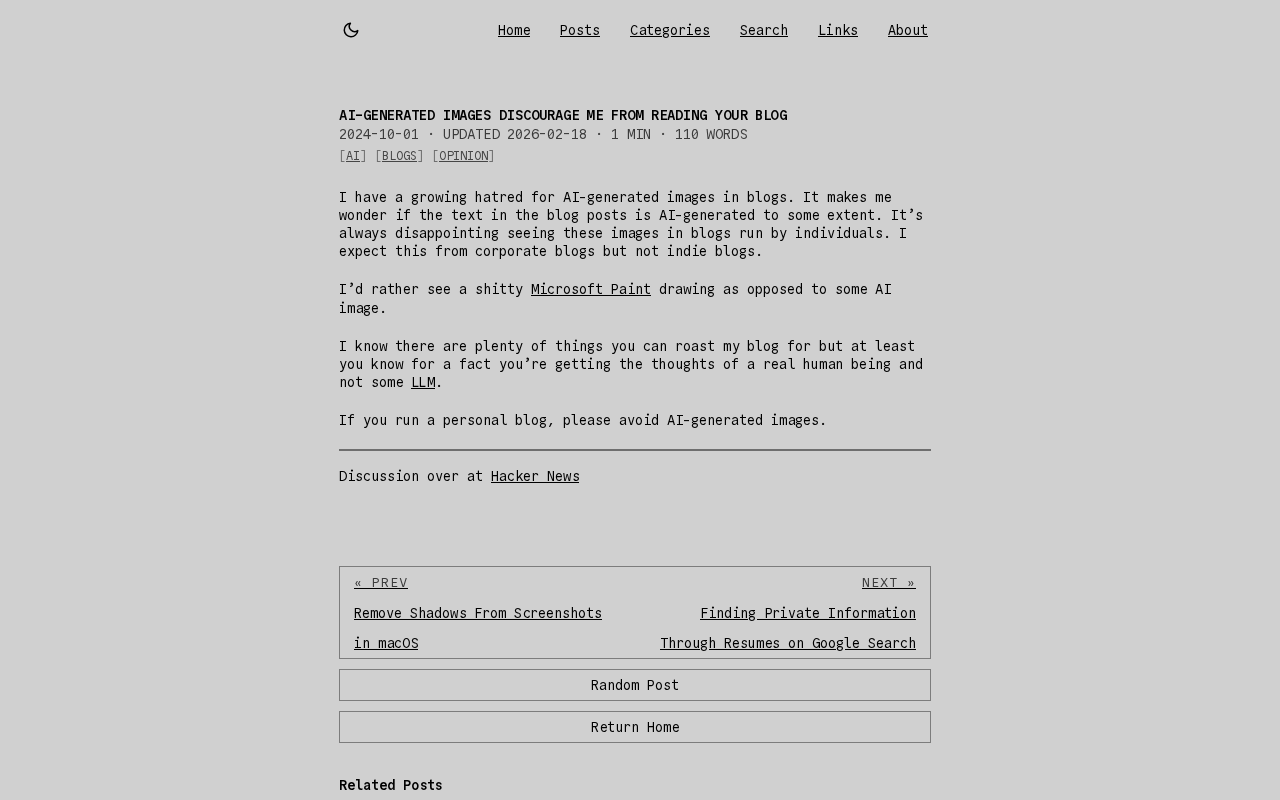
Recently, a post titled "AI-Generated Images Discourage Me from Reading Your Blog" sparked heated discussion on Hacker News, accumulating 254 upvotes and 136 comments. Hacker News, operated by Y Combinator, is a technology community known for high-quality technical discourse, with a user base primarily consisting of developers, founders, and technical decision-makers who are extremely sensitive to content quality. Gaining this much attention in such a community means the topic struck a strong chord with the tech elite.
The author's point hits a nerve in today's content creation landscape: As more and more blogs use AI-generated illustrations as article images, some readers' first reaction isn't attraction—it's a trust crisis, with many choosing to leave immediately.
The reason this topic resonates so widely is that it touches on a commonly overlooked problem in the AIGC wave—the abuse of technology is diluting the perceived value of content. Since ChatGPT's release in late 2022, AIGC (AI Generated Content) tools have spread far faster than expected. By 2024, the proportion of AI-generated or AI-assisted new content on the internet has risen significantly, directly leading to "content inflation"—an sharp increase in absolute content volume with a decline in average quality. Against this backdrop, readers' alertness to AI traces has continuously heightened, forming a new kind of "content immune response." When image generation becomes zero-cost and one-click accessible, creators rush in without considering what these images actually mean to readers.
Why AI Images Become a "Turn-Off Signal" for Readers
The Visual "Cheapness" Instantly Kills Reader Interest
The most central consensus in the discussion is this: current mainstream AI-generated images (especially those glossy, greasy, oversaturated "AI-style" illustrations) have formed a highly homogenized visual language. When readers can instantly identify "this was made by AI," they subconsciously equate it with low-quality, fast-food, mass-produced content.
This homogenization has technical roots. Current mainstream AI image generation tools (such as Midjourney, DALL-E, and Stable Diffusion) are mostly based on Diffusion Model architecture. These models learn the process of gradually restoring images from noise by training on large-scale image datasets. Due to the distribution characteristics of training data and architectural similarities, images generated by different tools tend to exhibit similar visual traits: overly smooth material rendering, a tendency toward high color saturation, and a "perfection" that lacks the optical imperfections found in real photography (such as chromatic aberration, noise, and depth-of-field transitions). This technical convergence is the root cause of the "obviously fake" problem with AI images.
This recognition is instantaneous. Those images with abnormal finger counts, unnatural lighting, and overly smooth textures send a subconscious signal to readers: "If the author couldn't even bother to find a real, appropriate image, how much effort could they have put into the written content?"
Collateral Damage to Content Trustworthiness
The deeper issue lies in the transmission of trust. One commenter pointed out sharply: if the author used AI to generate the images, couldn't the body text also be largely AI-generated? Once this suspicion arises, it's very hard to dispel.
From a cognitive psychology perspective, this phenomenon can be explained by the reverse of the "Halo Effect." The Halo Effect refers to people's tendency to judge the whole based on a single trait. When readers identify low-quality AI-generated images, it triggers a "reverse halo effect"—generalizing the negative judgment of image quality to the content quality of the entire article. Additionally, this involves "Signaling Theory" from economics: in an environment of information asymmetry, every choice a creator makes sends signals to readers about content quality. Carefully chosen images signal "care," while casually generated AI images signal "carelessness."
Images should supplement and support content, but AI illustrations often have no substantive connection to the text—they're merely decorative pieces that just "look like there's an image there." These decorative, information-free images don't help; instead, they expose a careless attitude toward content production. In an age of information overload, readers' attention is extremely precious, and any negative signal could become the reason to close the page.
The Debate: Not Everyone Dislikes AI Images
It's worth noting that the comment section wasn't one-sided. The opposing views are equally thought-provoking:
The first voice argues that images simply don't matter. Some readers stated they almost never look at images when reading technical blogs—whether AI-generated or photographed by humans, it doesn't affect their reading judgment. What truly matters is the quality of the writing itself. From this perspective, obsessing over image sources misses the point.
The second voice defends AI images. For independent bloggers without design skills or budget for stock photos, AI-generated images at least offer a "something is better than nothing" option. Compared to the free stock images that used to fill screens (those equally cheap, equally overused business handshake and smiling office photos), AI images aren't any worse. In fact, free stock libraries like Unsplash and Pexels experienced similar "aesthetic fatigue" over the past decade—when every blog uses the same few hundred popular images, those images equally lose their ability to convey information.
These two perspectives reveal a fundamental contradiction: The problem may not be the technical means of "AI generation" itself, but whether the image serves the content. A carefully designed, content-relevant AI image versus a casually grabbed free stock photo—which is better actually isn't clear-cut.
Practical Advice for Content Creators
Synthesizing this discussion, here are several pragmatic principles for bloggers who want to retain readers:
First Ask: "Is This Image Necessary?"
Many technical articles don't actually need images. Rather than forcing in an irrelevant AI illustration, it's better to simply leave white space, or substitute with code blocks, charts, or diagrams that actually convey information. Functional diagrams are far more valuable than decorative illustrations.
In the field of technical writing, information visualization expert Edward Tufte's concept of "Data-Ink Ratio" applies equally to blog images. The concept emphasizes that the information-carrying portion of visual elements should be maximized while purely decorative elements should be minimized. Functional visual elements like architecture diagrams, flowcharts, code screenshots, and data visualizations have far higher information density than decorative illustrations. Tools like Mermaid (text-to-diagram), draw.io (online diagramming), and Excalidraw (hand-drawn style diagrams) allow authors to quickly create diagrams closely related to their content. These diagrams may not be as visually stunning as AI-generated illustrations, but they far surpass them in information delivery efficiency.
If You Must Use AI Images, Avoid the Obviously "AI Look"
If images are genuinely needed, put effort into prompts and post-processing to avoid that obviously fake "AI look." Make images as natural and restrained as possible to reduce reader discomfort. Specifically, try specifying more concrete photography styles in prompts (such as "35mm film photography" or "editorial illustration"), and avoid keywords like "4K," "ultra-detailed," or "cinematic lighting" that tend to trigger typical AI output styles. After generation, moderately adding noise, adjusting color saturation, and cropping to non-standard compositions can effectively reduce AI traces.
Maintain Strong Image-Text Relevance
Regardless of the image source, it should have a substantive connection to the body text—explaining a concept, showing a result, or presenting a process. Adding images for the sake of adding images is a common trait of all low-quality content. An effective self-check method: if you remove this image, would the article's information completeness decrease? If the answer is "no," the image is probably unnecessary.
Conclusion: "Content Authenticity" in the AIGC Era Determines Whether Readers Stay or Leave
This discussion ostensibly debates images, but it actually reflects readers' collective anxiety about "content authenticity" amid the proliferation of AIGC. When generating everything becomes so easy, content that is truly thoughtful and uniquely valuable needs to somehow prove to readers that "a real person made this with care."
This trend aligns with broader shifts in the internet content ecosystem. In Google's 2023 updated Search Quality Evaluator Guidelines, E-E-A-T (Experience, Expertise, Authoritativeness, Trustworthiness) was established as the core evaluation dimension for content quality. The addition of the "Experience" dimension is a direct response to the problem of AI-generated content lacking real-world experience. Readers' rejection of AI images is essentially an instinctive defense against "content without experience or investment."
AI tools themselves bear no original sin—the question is whether users treat them as assistants for enhancing expression or as shortcuts for cutting corners. For creators, the real takeaway might be this: In an era where anyone can generate anything with one click, restraint and genuine effort have become the scarcest qualities.
Related articles

Workbuddy for Absolute Beginners: How a Desktop AI Agent Fits Into Real Workflows
A beginner's guide to the Workbuddy desktop AI agent: installation, claiming credits, file management, and building automated workflows—compared with CodeX for fit and cost, helping professionals shift from AI question-askers to AI managers.

OpenAI's New Agent Stack: Computer Use, Decisions API, and Ultra-Fast Workflows
OpenAI Dev Day unveiled a new agent stack: Computer Use outperforms humans, Decisions API delivers ultra-low-latency classification via Luna, Agents API opens the same Computer Use capabilities, and GPT-6.1 Sol costs only one-seventh of Astra. Core updates, benchmark data, and developer insights.

Liang Wenfeng Open-Sources DeepInfo Inference Framework, Takes On U.S. Ban
DeepSeek open-sources its DeepInfo inference framework after its models, featuring GPU/CPU cross-pipelining, small-model prediction with large-model verification, and full Huawei Ascend and NVIDIA chip support—facing the U.S. federal ban head-on. This article analyzes its significance for AI deployment and open-source strategy.