AI-Generated Slop Issues Are Poisoning Open Source Communities, and Maintainers Are Fed Up
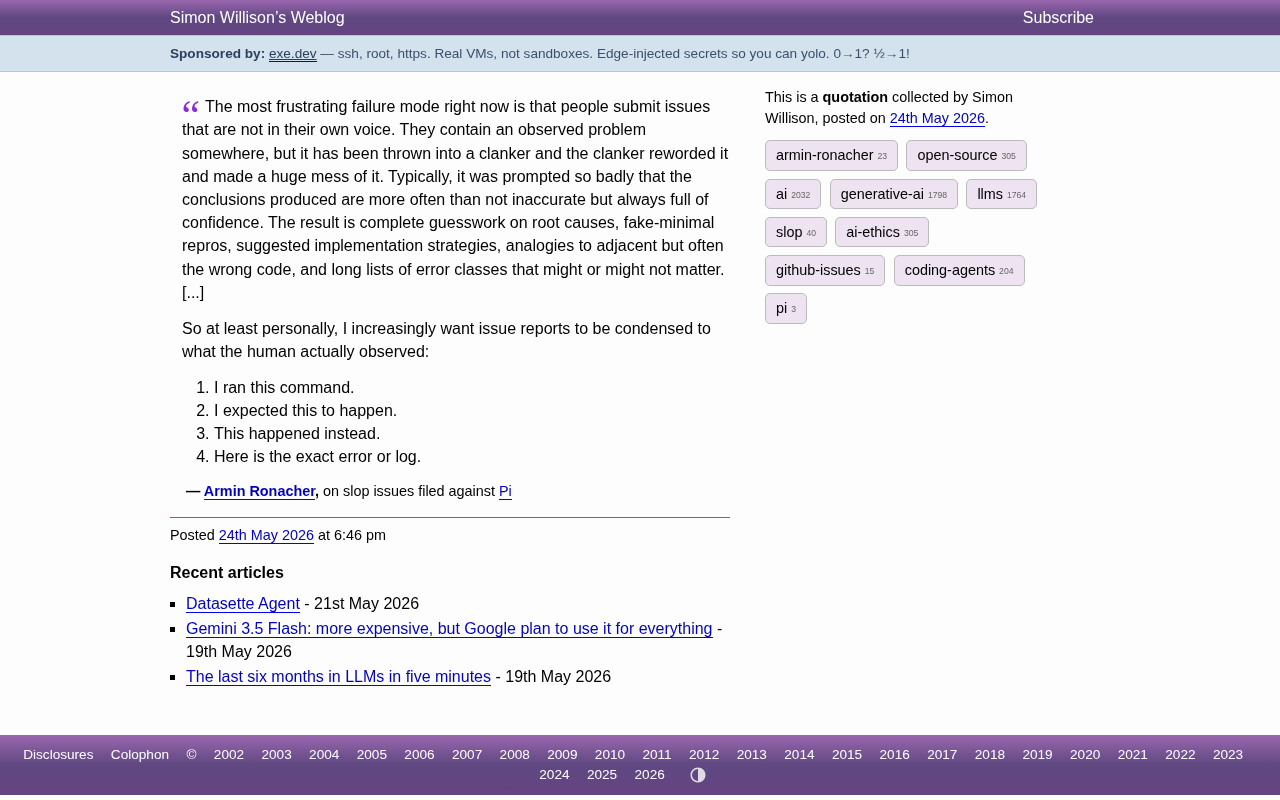
Flask creator calls out AI-rewritten issues full of hallucinations that are draining open source maintainers.
Flask creator Armin Ronacher publicly criticized a growing trend: users feed problems to AI models, which rewrite them into confident-sounding but inaccurate slop issues filled with speculative root cause analyses, fabricated reproductions, and wrong fix suggestions. He argues the ideal issue report needs only four elements: command run, expected result, actual result, and error log. The open source community is fighting back with AI-generated issue bans, mandatory structured templates, and other measures to combat a crisis accelerating maintainer burnout.
A New Headache for Open Source Maintainers
Flask framework creator Armin Ronacher recently published a post calling out a growing phenomenon that's eroding open source communities: users dump their problems into AI language models, get them rephrased, and then submit the output as issues — resulting in piles of confident-sounding but often inaccurate "slop issues."
Background: Flask and Armin Ronacher Flask is one of the most influential lightweight web frameworks in the Python ecosystem, created by Austrian developer Armin Ronacher in 2010. As a core maintainer of the Pallets project, Ronacher also maintains Jinja2 (a template engine), Click (a command-line toolkit), and several other open source projects depended on by millions of developers. This means he processes a massive volume of issue reports from users worldwide every day, giving him an exceptionally sharp sense for shifts in issue quality. His public criticism carries significant authority in the open source community and quickly resonated with other prominent maintainers.
This phenomenon has struck a chord across the open source community. When AI-generated content floods issue trackers, maintainers are forced to spend enormous amounts of time distinguishing genuine problem descriptions from AI speculation and hallucinations.
Issue trackers are the core collaboration infrastructure of open source projects. Platforms like GitHub Issues and GitLab Issues handle millions of bug reports, feature requests, and support questions every day. For active projects, maintainer time allocation is often the biggest bottleneck — research from the Linux Foundation shows that top open source maintainers spend over 30% of their weekly time on issue triage. Issue triage refers to the process of prioritizing, validating, and categorizing newly submitted issues. The efficiency of this step directly determines a project's response speed and maintainer sustainability.
The Typical Problems with AI-Rewritten Issues
Brimming with Confidence, Riddled with Errors
Ronacher identified several hallmark characteristics of these AI-generated issues:
- Wild speculation about root causes: The AI infers the source of a problem from limited information, but these inferences are often wrong
- Fabricated minimal reproduction cases: They look like carefully constructed repros but may not actually trigger the problem at all
- Incorrect implementation strategy suggestions: The AI proposes fixes based on a flawed understanding of the codebase
- False analogies to unrelated code: The AI references code snippets that seem relevant but are actually irrelevant
- Lengthy lists of error categories: Enumerating error types that may or may not have anything to do with the issue
The most dangerous part? All of this is presented in an extremely confident tone, making it difficult for maintainers to quickly judge which information is trustworthy and which is pure fabrication.
How AI Hallucinations Manifest in Technical Reports The "hallucination" phenomenon of large language models (LLMs) is especially dangerous in technical documentation scenarios. When a user feeds an error log or vague description into ChatGPT, Claude, or similar models, the model generates seemingly plausible technical analysis based on statistical patterns in its training data — even when that analysis has no connection to the actual codebase. The root cause is that LLMs are fundamentally probabilistic text predictors, not genuine logical reasoners. The model has no access to the target project's live codebase, yet it will cite nonexistent function names, incorrect version-specific features, or deprecated APIs with an air of certainty — creating what might be called "hallucinatory authority." This is extremely hard for less experienced maintainers to quickly identify.
The Real Problem: A Plummeting Signal-to-Noise Ratio
Traditional issue reports may not be written professionally, but at least they reflect what users actually observed. After AI "polishing," the original information gets drowned in noise. Maintainers must reverse-engineer from a pile of AI-generated analysis to figure out what the user actually encountered — which is far harder than reading a brief but honest report.
What a Good Issue Report Should Look Like
Ronacher shared what he considers the ideal issue report format, concise enough to fit in just four lines:
- What command I ran
- What I expected to happen
- What actually happened
- The exact error message or log output
The essence of this format: it contains only facts that a human actually observed, with zero speculation, analysis, or suggestions. Maintainers need raw data, not second-hand interpretation.
This philosophy aligns with the "Minimal Reproducible Example" (MRE) gold standard in software debugging culture. Systematically promoted by the Stack Overflow community in the 2010s, MRE requires reporters to provide examples that are minimal (all irrelevant code removed), complete (can run independently), and reproducible (guaranteed to trigger the issue). The process of constructing an MRE often helps reporters locate the problem themselves — which is why experienced developers typically attempt to build an MRE before filing an issue. AI-generated "pseudo-MREs" skip this thinking process entirely, producing code snippets that may be syntactically correct but logically incapable of triggering the described problem.
A Deeper Question: The Boundary Between AI Assistance and AI Replacement
This phenomenon reveals a question worth every developer's reflection: in what scenarios is AI a helpful assistant, and in what scenarios does it become a hindrance?
Using AI to polish grammar or overcome language barriers — that's legitimate assistance. But letting AI think about the essence of a problem for you, guess at root causes, and fabricate reproduction steps — that crosses the line. The core value of an issue report lies in first-hand observation, and that's precisely what AI cannot provide.
The Open Source Community Is Taking Action
A growing number of open source projects are setting explicit guardrails in their issue templates:
- Prohibiting submission of AI-generated issues
- Enforcing structured templates
- Requiring verifiable reproduction steps
This isn't a rejection of AI — it's a commitment to information quality. Open source maintainer time is the scarcest resource, and every low-quality issue drains that resource.
This movement has an urgent real-world backdrop. The AI slop issue phenomenon isn't an isolated event — it's the latest manifestation of the open source sustainability crisis. According to a 2023 Linux Foundation report, roughly 90% of commercial software depends on open source components, but the growth in the number of core maintainers lags far behind the expansion of dependency scale. "Maintainer burnout" has become a systemic risk in the open source ecosystem — notable cases include the colors.js author deliberately sabotaging his own library in 2022, and the core-js maintainer publicly sharing his financial hardship. Against this backdrop, the decline in issue quality brought about by AI tools isn't just an efficiency problem — it could become the final straw that breaks maintainers, accelerating the exodus of core contributors.
Conclusion
In the AI era, the principle of "less is more" matters more than ever. Instead of having AI write a professional-looking lengthy report on your behalf, just honestly describe what you saw in your own words. Genuine observations are always more valuable than elaborately packaged guesses.
Key Takeaways
- Flask creator Armin Ronacher criticizes users for using AI to rewrite issue reports, leading to distorted information
- AI-generated issues are filled with confident but inaccurate root cause analyses, fabricated reproductions, and misguided suggestions
- The ideal issue report needs only four elements: command executed, expected result, actual result, and error log
- The core problem is that AI replaces humans' first-hand observations, causing the signal-to-noise ratio to plummet
- The open source community is combating AI slop issues through template constraints and explicit rules
- AI hallucination is fundamentally probabilistic text prediction and cannot substitute for direct observation of real codebases
- Maintainer burnout is a systemic risk in the open source ecosystem, and low-quality issues are accelerating this crisis
Related articles
 Expert Opinions
Rethinking Scaling Laws: Parameters Are Not the Only Answer
Deep analysis of Scaling Law evolution from Kaplan to Chinchilla to the MoE era, exploring why blindly stacking parameters is a mistake, and how GLM-5.3 proves scaling has multiple knobs.
When AI Treats Humans as Subagents: Ro…
When AI Treats Humans as Subagents: Role Reversal and Hidden Risks in Human-AI Collaboration
Exploring the paradigm shift where humans become "subagents" in AI Agent architectures. Analyzes human node design in LangChain and AutoGen, and the risks of ceding control and cognitive atrophy.
 Expert Opinions
The Lazy Person's Productivity Theory: Why Being 'Lazy' Actually Drives Peak Performance
Explore the engineering philosophy behind 'lazy people are most productive': how constructive laziness drives automation, AI tools amplify efficiency, and systems thinking eliminates wasted effort.