AI-Generated TV Shows: Will Audiences Actually Pay to Watch Them?

Exploring whether audiences will accept fully AI-generated TV shows through the lens of bias, genre, and quality.
As AI video generation technology advances rapidly, fully AI-generated TV shows are becoming a near-term reality. This article examines audience acceptance through three key dimensions: the psychological impact of the "AI-made" label triggering flaw-hunting behavior, how genre selection (comedy and animation vs. realistic drama) dramatically affects acceptance thresholds, and whether compelling storytelling can ultimately overcome technological and philosophical resistance.
A Reality That's Rapidly Approaching
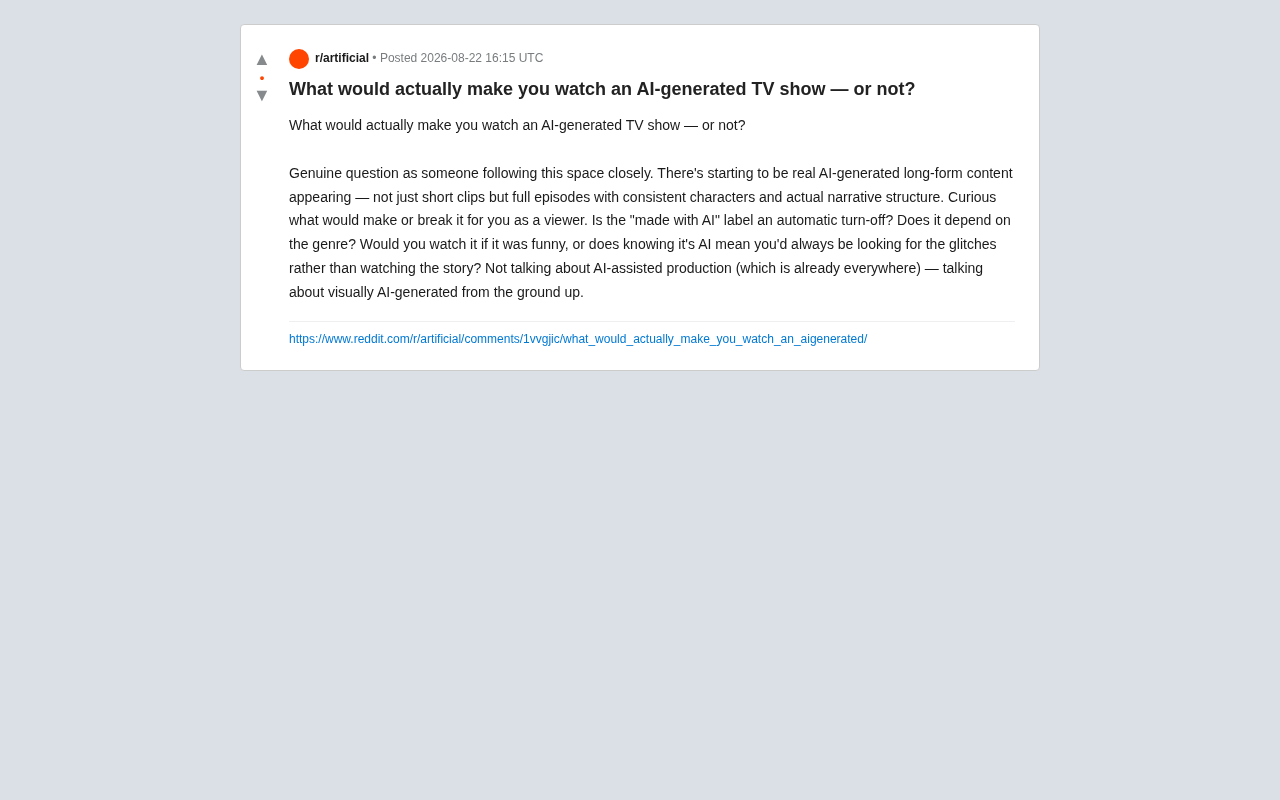
In a Reddit discussion, a user who has long followed the AI content generation space posed a pointed question: What would actually make you watch a fully AI-generated TV show — or refuse to watch it entirely?
This question deserves serious consideration because it's no longer purely hypothetical. The original poster specifically emphasized that the discussion isn't about AI-assisted production (that technology has already permeated every corner of the film and TV industry), but rather long-form content generated entirely from scratch by AI, from visuals to narrative — not a few seconds of video clips, but full episodes with consistent characters and complete narrative structures.
With the rapid leap in video generation model capabilities, AI-generated episodic content is transitioning from technical demos to consumable products. The AI video generation field is currently experiencing rapid iteration from Diffusion Models to multimodal large models. Products like OpenAI's Sora, Runway's Gen-3, and Google's Veo 2 represent the cutting edge of this space. The core breakthrough of these models lies in their end-to-end "text-to-video" generation capability and improvements in temporal consistency — ensuring the same character maintains coherent appearance, clothing, and movement across different frames and shots. However, it's worth noting that "temporal consistency" and "narrative consistency" are two entirely different levels: the former is a pixel-level technical problem, while the latter involves character motivation, plot logic, and emotional arc design, which still heavily relies on human creative direction and post-production arrangement. It's precisely this leap in technical capability that has made "audience acceptance" — once a distant topic — suddenly very real.
Is the "Made with AI" Label a Death Sentence?
The first core question raised in the post is: Does the "AI-made" label itself automatically become a turn-off for viewers?
This touches on the most delicate aspect of AI content distribution today — the cognitive frame. Psychological research has long shown that when audiences are informed beforehand that something is "machine-generated," their viewing mindset undergoes a fundamental shift. The original poster astutely identified this point:
"Does knowing it's AI-generated mean you'll spend the whole time looking for glitches instead of watching the story?"
This is exactly the crux of the issue. When humans watch narrative works, they need to enter a state of "suspension of disbelief" — we know full well that everything on screen is fictional, yet we're willing to temporarily believe in it. This concept was first proposed by the 19th-century English poet Coleridge to describe the psychological mechanism by which readers actively set aside rational judgment to achieve aesthetic pleasure when encountering supernatural elements in literary works. In modern cognitive psychology, it has been further developed into "transportation theory" — when a narrative is sufficiently compelling, audiences are "transported" into the story world, temporarily disengaging from critical thinking. However, any external cue that breaks narrative immersion — such as obvious technical defects or meta-information labels — triggers "cognitive vigilance," pulling viewers back into analytical mode.
The "AI-generated" label may play exactly this role of immersion destroyer. It's not merely informational disclosure — it substantively restructures the entire psychological foundation of the viewing experience, transforming audiences from "immersed appreciators" into "flaw-hunting inspectors," shifting attention from the plot to searching for deformed fingers, scene continuity errors, stiff facial expressions, and other technical imperfections.
The Flaw-Hunter Mindset: AI Film Content's Unique Dilemma
This "flaw-hunter" mindset is a unique dilemma facing AI-generated content. Continuity errors in traditional film and TV are incidental, forgivable accidents; but flaws in AI-generated content are expected by audiences to be "inevitable," prompting them to actively search for them. Once viewers enter this scrutiny mode, even the best story will struggle to truly engage them.
The deeper issue is that AI-generated near-realistic human figures are extremely prone to triggering the "Uncanny Valley" effect. This theory was proposed by Japanese roboticist Masahiro Mori in 1970: when robots or virtual figures are highly similar but not perfectly identical to real humans in appearance, people experience strong discomfort and revulsion. In AI video generation, this effect is particularly pronounced — current models can generate highly realistic faces, but still fall short in details like micro-expression transitions, the natural randomness of eye movements, and the physical accuracy of skin subsurface scattering. These gaps fall right at the deepest point of the uncanny valley, making them more unsettling than obviously cartoon-like styles. This partially explains why AI-generated photorealistic video tends to trigger more viewer rejection than stylized animation.
Genre Determines Success or Failure
The second variable raised in the post is equally thought-provoking: Does the acceptance of AI-generated shows depend on genre?
This is an exceptionally insightful angle. Not all content has the same requirements for "realism":
- Comedy and Absurdist Content: The original post specifically asked, "If it's funny, would you watch it?" The core of comedy is jokes and timing, and audiences naturally have higher tolerance for visual realism. In fact, AI-generated slightly uncanny visual styles could actually become a bonus for absurdist comedy — just as early Flash animations created a unique comedic aesthetic precisely through their crude art style.
- Animation and Fantasy: These genres are inherently built on non-realistic aesthetics, making AI-generated "inhuman" qualities less jarring and lowering the acceptance threshold. Japan's animation industry is already exploring applications like AI-assisted in-between frame generation, and audience technological acceptance in this area is also leading the way.
- Realistic Drama: This is the hardest territory for AI film and TV to conquer. Any subtle unnaturalness — an off-putting gaze, a line of dialogue with stilted emotion — instantly destroys audience immersion. These genres are most sensitive to the uncanny valley effect because viewers' reference standard is real human interaction in everyday life.
In other words, the breakthrough for AI-generated shows likely won't come from "fooling people into thinking it's real," but from finding genres that "don't need to fool anyone." When technical imperfections can be transformed into stylistic features, AI content can actually play to its strengths.
Content Is King or Technology Is King?
Behind this discussion lies a more fundamental tension: Do audiences ultimately care about the story itself, or how it was made?
Optimists would say: if the story is compelling enough, the characters moving enough, and the humor sharp enough, audiences will eventually be won over by the content, with production methods being mere behind-the-scenes details. Historically, CGI, green screens, digital color grading, and other technologies were all questioned for being "unrealistic" when first introduced, but were eventually fully accepted by audiences because they served better storytelling.
However, this historical analogy requires careful handling. The acceptance history of CGI does provide a useful reference — when Jurassic Park first used CGI on a large scale in 1993, audiences and critics alike were full of doubts about its "realism." But Spielberg's strategy was to strictly limit CGI to serving the narrative: dinosaurs appeared for only about 15 minutes of the entire film, with practical models used extensively for the rest. This principle of "technology serving story" allowed CGI to be gradually accepted by audiences and become an industry standard. But fully AI-generated episodic content differs fundamentally from CGI: CGI is a tool in the hands of human creators, with creative decisions still made by directors, cinematographers, and VFX artists; fully AI-generated content means the entire chain from creative conception to final presentation could potentially be automated, touching not only on technological acceptance but on fundamental questions about creative authorship.
Pessimists would emphasize: consuming film and TV isn't just receiving information — it's a connection with emotion and humanity. Audiences want to know there are real creators, real performances, and real effort behind the screen. The concept of "Aura" proposed by philosopher Walter Benjamin in The Work of Art in the Age of Mechanical Reproduction is illuminating here — he argued that the unique value of artworks derives partly from their irreproducible "here and now" quality and the personality imprint invested by their creator. When the creative process is fully automated, works may lose that ineffable "soul," becoming mere technical spectacles rather than artistic expression.
Consistency Is the Entry Ticket, Not the Finish Line
The original post mentions that current AI video generation technology can already achieve "consistent characters" and "realistic narrative structure" — this is indeed a major advancement. But we need to soberly recognize that character consistency and narrative coherence are merely passing grades, not winning moves. They make AI-generated shows "watchable," but to make audiences "actively want to follow along," what's needed is good stories, good characters, and genuine emotion — precisely the things current AI struggles to reliably produce.
The limitations of current large language models in narrative generation manifest across several key dimensions: they excel at pattern matching and style imitation, but still fall short in creating truly surprising yet logical plot twists, crafting multi-layered complex characters, and maintaining thematic unity across long-form narratives. Excellent screenwriters rely not only on linguistic ability but on deep understanding of human nature, the accumulation of personal experience, and the ability to make intuitive judgments among countless creative options — all of which remain AI's weak points.
The Audience's Choice
This Reddit discussion didn't provide a definitive answer, but it precisely outlined the three hurdles facing AI-generated shows: label bias, genre fit, and content quality.
For content creators and AI companies, the answer may be: don't try to use AI to directly challenge live-action cinema's strength in realistic narrative, but instead seek expressive spaces unique to AI — those wildly imaginative, prohibitively expensive, or practically impossible ideas that real humans can't easily realize. For audiences, as this type of content becomes more prevalent, each of us will vote with our clicks and viewing time to determine the future form of AI-generated entertainment.
It's worth noting that this discussion about audience acceptance doesn't exist in a vacuum. During the 2023 Hollywood writers' and actors' strike, AI's role in content creation was one of the core points of contention. Industry-level labor disputes, the establishment of regulatory frameworks, and the protection of creator rights will all profoundly influence the development path of AI-generated content. There is often a vast chasm between what technology can achieve and what society and industry will allow.
What ultimately makes people press play may never have been "whether AI made it" — but rather that eternal question: Is it actually good?
Related articles

Python 3.15 New Feature: Is the sentinel Type Better Than None?
Python 3.15 adds the sentinel type, using named unique sentinel objects to replace None and bare object(), resolving confusion among missing values, explicit emptiness, and invalid input while avoiding type hint failures.

Deep Learning's Three Architectures and the Universal Approximation Theorem: A Complete Guide to MLPs, CNNs, and Transformers
Explaining the inductive bias differences among MLP, CNN, and Transformer, the existence meaning of the Universal Approximation Theorem (UAT), and the role of Taylor expansion in approximation analysis, while clearing up common misconceptions.

GitLab Emergency Patch Release: Analysis of Critical Security Fixes
GitLab releases critical patch 19.5.1, sparking 355 points of discussion on Hacker News. This article analyzes the background, upgrade steps for self-hosted instances, and verification points to help DevOps teams respond quickly to security updates.