AI Generates Research Ideas Too Fast for Me to Test: The Dilemma of an ML Researcher

AI makes research idea generation nearly free, but experimental verification remains costly, leaving researchers in an idea overload dilemma.
Starting from a machine learning researcher's Reddit post, this article highlights a new bottleneck in AI-assisted research: brainstorming and prototype generation are extremely fast, with a single conversation spawning dozens of research directions, but experimental verification, result interpretation, and next-step decisions remain slow and human-dependent. This "idea overload" stems from the marginal cost of generating ideas approaching zero while verification remains costly, and AI-generated ideas often seem logically coherent but lack genuine insight, adding screening burden. Community strategies include setting screening criteria, engineering parallel experiments, regular idea audits, and maintaining deep understanding—essentially building a buffer between generation and verification. The article also notes that current AI research tools focus on generation rather than project management; researchers need augmentation, not replacement, and must learn to consciously ignore some ideas.
The Researcher's New Bottleneck: Too Many Ideas, Verification Too Slow
A machine learning researcher recently posted on Reddit describing an increasingly common phenomenon: using AI for research makes brainstorming and rapid prototyping faster than ever, but actual experimental verification remains slow.
He mentioned asking AI to review 30 papers backlogged in his reading list and cross-reference them with the current project status to find relevant ideas. A single conversation spawned dozens of promising research directions. With coding agents, it's theoretically possible to explore these directions in parallel. But as a researcher, he still needs to manage experiments, launch training runs, evaluate results, decide what to do next, and more importantly, understand what's happening. The result: a flood of interesting ideas he can't keep up with, and he's not even sure what the "smartest next step" is.
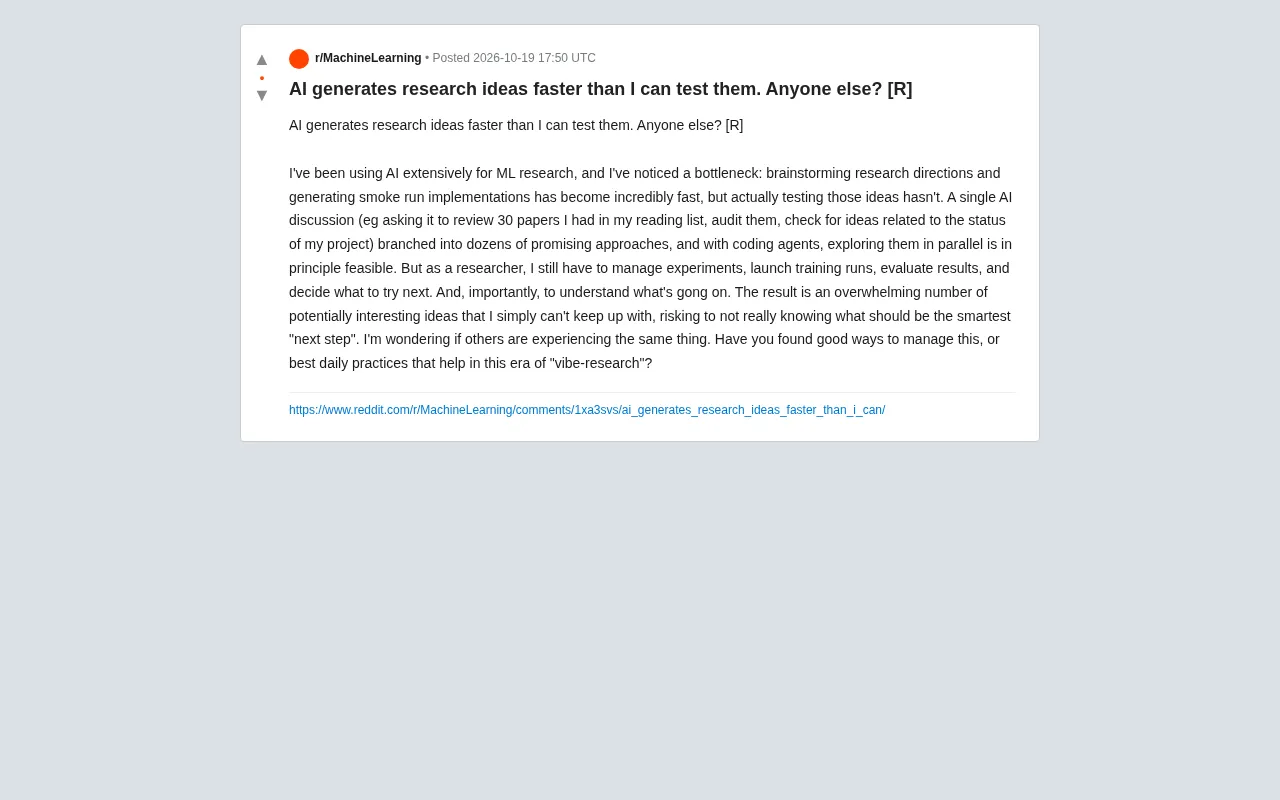
This post resonated with many because it touches on a core contradiction in AI-assisted research: the marginal cost of generating ideas approaches zero, but the marginal cost of verifying ideas remains high.
Why Has "Idea Overload" Become a Problem?
In traditional research, coming up with good ideas is itself the bottleneck. Researchers need extensive reading, thinking, and discussion to find a direction worth pursuing. AI compresses this phase—it can quickly summarize literature, identify patterns, and propose combinations.
But the value of research ultimately depends on verification. No matter how novel an idea is, without experimental testing it remains just a hypothesis. Experiments involve compute, time, engineering implementation, and result interpretation—all of which are far less automated than idea generation.
More subtly, AI-generated ideas often "all seem reasonable." They are pattern combinations based on existing literature, logically coherent, but may lack genuine insight or feasibility. Researchers need to spend extra effort discerning this, which itself adds cognitive burden.
Daily Practice in the Era of "Vibe-Research"
The post author uses "vibe-research" to describe this state—somewhat like "vibe coding," moving quickly by feel but lacking systematic control. He asks: are there good management methods or daily practices?
From community discussions, some possible coping strategies include:
- Establish clear screening criteria: Not every AI-generated idea is worth pursuing. Use simple heuristic rules (such as implementation cost, fit with current projects, potential impact) for quick filtering.
- Engineer parallel experiments: Use coding agents to automate experiment launching and result collection, but retain human decision points.
- Regular "idea audits": Archive AI-generated ideas and review them periodically to avoid being led by novelty.
- Maintain deep understanding: Even if experiments can run in parallel, researchers still need to deeply analyze key results; otherwise, they accumulate data rather than knowledge.
The core of these methods is to establish a buffer zone between idea generation and verification, rather than letting AI output directly drive the pace of research.
The term "vibe coding" was first coined by Andrej Karpathy in early 2025, referring to a working style where developers describe intent in natural language, have AI generate code, and iterate quickly with less line-by-line code review. Its core feature is: reducing explicit control over low-level implementation in favor of intuition and fast feedback loops. Transferred to the research context, "vibe research" means researchers use AI to rapidly generate hypotheses, code, and experimental configurations, advancing projects by feel rather than first establishing a complete theoretical framework or experimental design. This mode can significantly accelerate exploration, but also brings risks such as reduced reproducibility, incomplete experiment records, and lack of systematic review of results, thus requiring supporting management practices to back it up.
Implications for AI Research Tool Design
This dilemma also points to a design gap in AI research tools. Current tools mostly focus on "generation"—generating code, generating ideas, generating experimental plans. But what researchers truly need is research project management: how to track dozens of parallel experiments? How to visualize relationships between ideas? How to dynamically adjust priorities based on early results?
Some teams are exploring "AI Scientist" systems, attempting to automate the research process end-to-end. But from this researcher's experience, full automation may not be the answer. Researchers need augmentation, not replacement—tools should help manage complexity, not create more of it.
"AI Scientist" systems are a class of research prototypes that attempt to automate the research process end-to-end, typically covering literature review, hypothesis generation, experimental design, coding, result analysis, and paper writing. Representative works include Sakana AI's The AI Scientist and multi-agent research frameworks from institutions like Google. The goal of such systems is to complete the loop from idea to paper with minimal human intervention, but their limitations are also obvious: generated experiments are often small-scale with limited novelty, and result interpretation and error troubleshooting still rely on human judgment. Therefore, the more pragmatic positioning at present is as a collaboration layer for researchers, handling repetitive engineering and record-keeping work, while leaving direction selection and key decisions to humans.
Conclusion: Slow Down, Think Clearly
AI has indeed accelerated certain parts of research, but it has also exposed the incompressible parts: understanding, judgment, and decision-making. Ideas can be generated quickly, but wisdom takes time to accumulate.
For researchers in the era of "vibe research," perhaps the most important practice is not chasing every AI-generated idea, but consciously choosing which ones to ignore. As one commenter might say: AI can help you think of more, but only you can decide what's worth doing.
(This article is based on Reddit community discussions, with views from multiple researchers, and does not constitute specific research advice.)
Related articles

Workbuddy for Absolute Beginners: How a Desktop AI Agent Fits Into Real Workflows
A beginner's guide to the Workbuddy desktop AI agent: installation, claiming credits, file management, and building automated workflows—compared with CodeX for fit and cost, helping professionals shift from AI question-askers to AI managers.

OpenAI's New Agent Stack: Computer Use, Decisions API, and Ultra-Fast Workflows
OpenAI Dev Day unveiled a new agent stack: Computer Use outperforms humans, Decisions API delivers ultra-low-latency classification via Luna, Agents API opens the same Computer Use capabilities, and GPT-6.1 Sol costs only one-seventh of Astra. Core updates, benchmark data, and developer insights.

Liang Wenfeng Open-Sources DeepInfo Inference Framework, Takes On U.S. Ban
DeepSeek open-sources its DeepInfo inference framework after its models, featuring GPU/CPU cross-pipelining, small-model prediction with large-model verification, and full Huawei Ascend and NVIDIA chip support—facing the U.S. federal ban head-on. This article analyzes its significance for AI deployment and open-source strategy.