AI Infrastructure or App Feature? The Architecture Debate Sparked by CogniCore
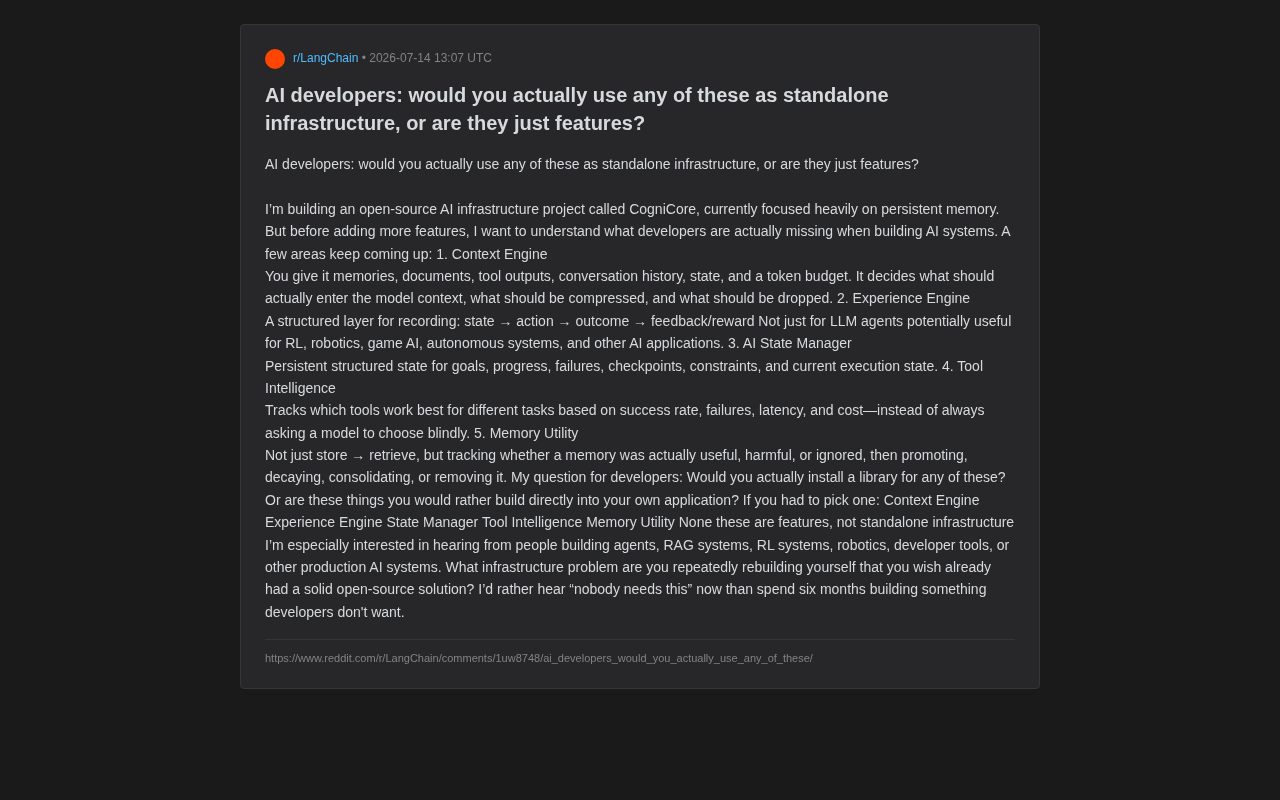
CogniCore sparks debate: should AI memory and context management be infrastructure or just app features?
An open-source project called CogniCore has sparked a sharp architectural debate in AI engineering: should capabilities like persistent memory, context engines, state management, tool intelligence, and memory utility be abstracted as reusable infrastructure, or built directly into applications? This article examines all five directions and explores why the "standard middleware" of the agent era has yet to emerge.
One Open-Source Project, One Critical Question
Recently, a developer sparked a genuinely valuable discussion on Reddit around an open-source AI infrastructure project called CogniCore. The project currently focuses on "persistent memory" — the ability for AI systems to retain context across multiple sessions or task executions. Unlike traditional stateless LLM calls, persistent memory allows agents to accumulate knowledge, preferences, and interaction history beyond a single conversation window. It's a foundational prerequisite for building truly "memory-aware" AI assistants and long-running task agents. But before piling on more features, the author posed a question that cuts to the heart of the industry:
"AI developers — would you actually use these as standalone infrastructure? Or are they just features inside an app?"
Deceptively simple on the surface, this question strikes at the most critical architectural decision in modern AI engineering: Which capabilities should be abstracted into a reusable infrastructure layer, and which should be embedded directly into specific applications? For developers building agents, RAG systems, reinforcement learning (RL) pipelines, or robotics systems, this is a trade-off they face every single day.
Five Capability Directions CogniCore Has in Mind
The author outlined five recurring candidate directions — each mapping to a genuine pain point in AI systems development.
1. Context Engine
Take memory, documents, tool outputs, conversation history, state, and token budgets as input — and let the engine decide: what actually enters the model's context, what gets compressed, and what gets discarded.
This is one of the thorniest problems in long-context and RAG systems. Retrieval-Augmented Generation (RAG) is currently the dominant approach for knowledge-augmented LLMs: relevant document chunks are dynamically retrieved from an external knowledge base at inference time and stitched into the prompt context. But with the emergence of ultra-long-context models like GPT-4 Turbo (128K tokens) and Claude 3 (200K tokens), the naive "retrieve and concatenate" strategy faces new challenges. Too much irrelevant content dilutes key information, causing the model to get "Lost in the Middle." Context engineering has thus emerged as its own research area — as context windows grow larger, what you put inside matters more than how big the window is. An intelligent context scheduling layer — covering content compression, dynamic truncation, and priority ranking — could theoretically reduce inference costs and improve output quality significantly.
2. Experience Engine
A structured recording layer that follows the state → action → outcome → feedback/reward paradigm. The author specifically notes this isn't just for LLM agents — it could bring value to reinforcement learning, robotics, game AI, and autonomous systems as well.
This direction is notably ambitious — it shares its lineage with experience replay in deep reinforcement learning. Experience replay was introduced by DeepMind in their 2013 DQN paper: the (state, action, reward, next_state) tuples generated by agent-environment interactions are stored in a replay buffer and randomly sampled during training to break temporal correlations and improve sample efficiency. CogniCore's Experience Engine transposes this mechanism into the LLM agent domain, aiming to build a general-purpose experience storage and retrieval layer. The goal is to treat "experience" as a first-class citizen — enabling agents to learn optimal behavior patterns from historical interactions without reasoning from scratch each time.
3. AI State Manager
Persistent, structured state management for goals, progress, failure logs, checkpoints, constraints, and current execution status.
For long-running agents, state management is an unavoidable core challenge. The difficulties closely mirror those of distributed systems: tasks can be interrupted by network timeouts, model API rate limits, or host process crashes — requiring reliable checkpoint mechanisms for resumable execution. Frameworks like LangGraph and AutoGen have started incorporating state persistence, but standardization remains low. The deeper challenge is "state explosion" — an agent's goal decomposition, subtask dependency graph, and retry strategies collectively form a complex directed acyclic graph (DAG). Efficiently serializing and deserializing this kind of structured state is often the dividing line between a demo and a production system.
4. Tool Intelligence
Track which tools work best for which tasks based on success rates, failure patterns, latency, and cost — rather than letting the model blindly choose every time.
This is an exceptionally pragmatic direction. With Function Calling (OpenAI) and Tool Use (Anthropic) interfaces now relatively standardized, LLMs' ability to call external tools has matured — but tool selection strategy still relies heavily on the model's in-context judgment, with no systematic optimization. In enterprise settings, the available tool count can reach dozens or even hundreds, making the model prone to hallucination, redundant calls, or selecting the wrong tool. Drawing on collaborative filtering from recommendation systems, introducing a tool routing layer based on historical success rates, latency distributions, and cost data effectively shifts "selection" from probabilistic model inference to deterministic statistical decision-making — meaningfully improving reliability and reducing inference overhead.
5. Memory Utility
Beyond simple "store → retrieve," this means tracking whether a given memory is useful, harmful, or ignored — then boosting, decaying, consolidating, or deleting it accordingly.
This is a crucial extension to conventional vector-database memory approaches. Current mainstream AI memory solutions center on vector databases: text is encoded into high-dimensional embedding vectors and retrieved via approximate nearest neighbor search (ANN, e.g., HNSW). This solves "how to find relevant memories," but has clear blind spots: all memories are treated equally, with no temporal decay (analogous to the human forgetting curve); there's no way to distinguish whether a memory was actually adopted by the model and produced a positive effect; and there's no mechanism to merge redundant memories or delete harmful ones. Most existing solutions handle "remembering" but not "forgetting" or "prioritization" — yet the latter is precisely what makes human memory intelligent. Emerging projects like Mem0 and MemGPT are beginning to explore memory utility evaluation, but a systematic infrastructure layer is still a considerable distance away.
The Core Debate: Standalone Infrastructure vs. In-App Feature
The author's sharpest question is:
"Would you actually install a library for any of these? Or would you rather just build them into your own app?"
This touches on a classic software engineering philosophy question. The benefits of abstracting into standalone infrastructure are obvious — reusability, standardization, community maintenance. But the cost is the compromises that come with generality. Many experienced developers' instinct is: these capabilities are too deeply coupled with business logic. Rather than pulling in a library that "tries to manage everything," it's often better to write a few hundred lines of custom code tailored to your own use case.
The author's own answer options make his self-awareness clear — the final choice is plainly: "None — these are features, not standalone infrastructure." He openly admits he'd rather hear "nobody needs this" now than spend months building something developers don't actually want. That kind of outcome-first, no-echo-chamber attitude is itself worthy of respect.
The Missing "Standard Middleware" of the Agent Era
Zooming out from CogniCore itself, this discussion reflects a widespread anxiety as AI engineering enters deeper waters: the standard middleware of the agent era has yet to take shape.
The maturation of the web development ecosystem offers an instructive parallel. In the early 2000s, web developers faced the same "everyone reinventing the wheel" problem — until middleware like MySQL, Memcached, and RabbitMQ gradually standardized, and frameworks like Rails and Django crystallized best practices into "convention over configuration" development paradigms, unlocking a leap in productivity. In web development, we have mature databases, caches, message queues, and ORMs. In the AI agent domain, memory, state, context scheduling, and tool orchestration are roughly at the equivalent of web development circa 2003–2005: the core primitives (LLM APIs, vector retrieval) are available, but the higher-level orchestration capabilities are still in the "everyone rebuilding the same wheel" stage.
The author's final question is particularly penetrating:
"What infrastructure problems have you repeatedly rebuilt yourself and wished there was already a reliable open-source solution for?"
That's exactly where the opportunity in the current ecosystem lies. Whoever can first refine one of these capability classes into a standard component developers are willing to pip install — the "Redis" or "Celery" of the AI world — stands a real chance of defining the foundational stack of next-generation AI applications.
Closing Thoughts
CogniCore's public validation exercise is less a product survey than a collective question posed to the entire AI developer community. Context engineering, experience management, state persistence, tool routing, memory utility — none of these five directions are false needs. The real debate is about what form they should take.
For teams building production-grade AI systems, this is a good moment for self-reflection: does all that "glue code" you keep rewriting by hand hint at an infrastructure gap that has yet to be filled? The answer might just be the next open-source project worth investing in.
Key Takeaways
Related articles

ChatGPT Space Launches: Team Collaboration and New Pages Features Explained
ChatGPT Space is OpenAI's new team collaboration feature with Pages, real-time collaboration, and Slack/Google Drive sync. We break down its privacy design, multi-platform integration, and the full workflow from conversation to document.

Migrating Apache Spark UDFs to GPU Acceleration with AI Agents
NVIDIA developer blog explains how AI Agents rewrite Apache Spark UDFs for GPU acceleration, covering migration criteria, agent rewriting and verification workflows, plus pitfalls like result consistency and CPU-GPU transfer overhead.

Zed Editor v0.40.4-rc2 Released: Usage Credits Now Available Without Upgrading
Zed editor releases v0.40.4-rc2, allowing users to use usage credits for AI features without upgrading to a paid plan, lowering the trial barrier.