AI Is the New Dating Minefield: Why Chatbots Are Breaking Couples Up

On dating apps, how you use AI is becoming a new screening signal for sincerity and authenticity.
Using San Francisco user Irene's observations on Hinge as an entry point, the article highlights a new dimension of judgment in dating profiles and conversations: whether someone uses AI and how. Ghostwriting openers and letting AI reply on your behalf are behaviors of different natures, with the latter damaging trust more directly. San Francisco, as a high-density AI city, is a frontier sample for observing this emerging social norm. The article argues that AI pushes dating's long-standing authenticity anxiety from photos to text, making boundaries murkier; dating apps' matching mechanisms rest on the assumption of authentic user content, and platforms may face new disclosure or verification needs, while individuals must know their bottom line, maintain conversational granularity, and be transparent about their own AI use.
When Irene moved to San Francisco from out of town, she downloaded Hinge hoping to meet new people, get to know the city, and find someone who cared about the same things she did. After swiping for a while, the 25-year-old analyst noticed a trend—there was a prompt question on Hinge, and a certain kind of signal in the answers kept recurring, making her rethink what kind of person she actually wanted to date.
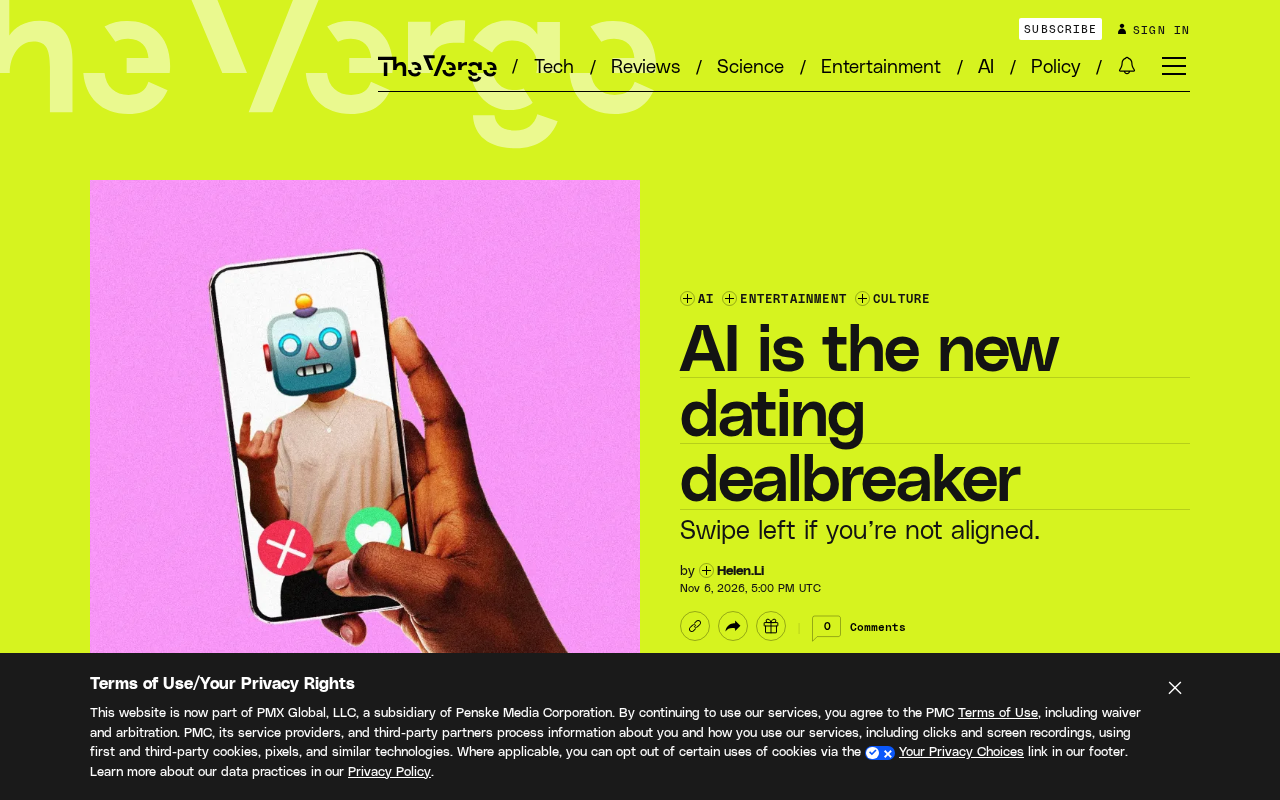
The New Red Flag on Dating Apps: What AI Do You Use?
What Irene observed is not an isolated case. In a city like San Francisco, dense with tech workers, a new dimension of judgment has appeared in dating profiles: whether the other person uses AI, and how they use it.
This isn't a simple binary question of "do you use ChatGPT or not." The subtler signals hide in the details: some people use AI to ghostwrite their dating app bios and opening lines, some feed chat logs to models to help "decode" what the other person means, and some simply let AI reply to messages on their behalf.
For some, these practices are a natural extension of efficiency tools; for others, they are direct evidence of a lack of sincerity. Dating is built on an unspoken agreement about authenticity, and AI's intervention blurs that line.
Hinge is a dating app built around "prompts," where users answer fixed questions like "My ideal weekend is..." to construct their profile. Others can like or comment on specific answers to start a conversation. This design emphasizes personal expression and detail, and also makes "whether the answer was written by the person themselves" a signal that can be scrutinized. Unlike Tinder, which relies mainly on photo swiping, Hinge is more text-heavy, so AI ghostwriting interferes more directly with match quality—it erodes precisely the expressive authenticity the platform relies on for matching.
Why AI Usage Has Become a Gauge of Character
Dating app matching logic depends on personal expression: what you write, how you reply, your word habits, your sense of humor. When this content may come from a model, the recipient faces an unverifiable dilemma—who exactly am I talking to?
Irene's experience in the source material points to a key insight: what she noticed was a "trend," patterned signs recurring across profiles and conversations. This shows the problem isn't one-off use, but that when AI traces become the default configuration, the signals people send each other become distorted.
This distortion brings more than awkwardness. It changes the upfront screening cost of dating: in the past you had to judge whether the other person was interesting and compatible; now you have to add another layer—is this interestingness theirs, or the model's?
Ghostwritten Opening Lines: From Assist to Penalty
Using AI to polish a message is harmless in many contexts. But in dating, the opening line itself is a signal: it showcases your observational skills and humor. If that text was generated by a model, the signal the other person receives is false.
What's more troublesome is that AI-generated text often has a recognizable texture—overly smooth, lacking rough edges, neatly structured. In a context like dating that relies heavily on personal style, this texture actually exposes the problem.
Letting AI Reply for You: The Direct Collapse of Sincerity
More transgressive than ghostwriting is letting AI maintain the conversation on your behalf. This isn't just about authenticity but also respect: the time and energy the other person invests is being exchanged with someone who isn't present.
Once this behavior is discovered, trust is nearly impossible to repair. The message it sends is direct—I don't think this conversation is worth my own participation.
"Signaling" is a concept from evolutionary biology and economics: under information asymmetry, one party proves their traits through costly signaling, such as using humor or specific experiences to demonstrate intelligence and sincerity. The text in dating profiles is credible because writing it requires an investment of time and personal style. When AI can generate equally or even smoother text at extremely low cost, the cost of the signal is flattened, and the recipient struggles to distinguish "real traits" from "model output"—this is the mechanism by which AI traces cause signal distortion.
The Dating Ecosystem of Tech Cities Is Being Reshaped
San Francisco is a frontier sample for observing this phenomenon. It's one of the places with the highest density of AI professionals and power users, and the user base of dating apps overlaps heavily with power users of AI tools.
This means AI use in dating isn't marginal behavior but everyday practice among mainstream groups. When the use of a tool becomes a group habit, it enters the discussion of social norms. Irene's observations on Hinge are essentially the process of this norm taking shape.
Interestingly, this norm isn't one-directional. Some treat "not using AI to write messages" as a sign of honesty, while others see "skilled use of AI" as a reflection of competence and modernity. The disagreement itself shows that AI's place in intimate relationships is far from settled.
Authenticity Anxiety: An Old Problem, a New Carrier
Authenticity anxiety in dating is nothing new. Photo editing, height exaggeration, career embellishment—these are all old topics. AI merely pushes this old problem to the textual level—and text is precisely the most information-dense part of dating apps.
The difference is that photo fakery has relatively clear social consensus (excessive editing gets criticized), while the boundaries of AI-assisted writing are far murkier. Does polishing a sentence count as faking? Does using a model to check tone count as insincerity? These questions have no standard answers and can only be negotiated by each potential couple themselves.
For product designers, this is also a signal. Dating apps' matching mechanisms are built on the assumption that user-generated content is authentic. When this assumption is eroded by AI tools, platforms may need new verification mechanisms or disclosure norms.
"The authenticity assumption of user-generated content (UGC)" is an implicit premise of dating platforms' matching logic: the platform assumes profiles and messages are written by users themselves and designs recommendation and matching algorithms accordingly. Once AI tools intervene at scale, this assumption is eroded, and platforms may introduce mechanisms like "AI content disclosure," "conversation behavior verification," or "text style consistency detection." This is structurally similar to the governance dilemma social media faces with AI-generated content, except that the dating context is directly tied to intimate relationship trust, making disclosure norms more sensitive.
Practical Advice for Daters
If you're using dating apps, there are a few things worth thinking about.
Know your bottom line. Can you accept the other person using AI to polish messages? Can you accept AI ghostwriting a bio? Figure out your own answers first, then observe the other person's behavior in conversation.
Maintain conversational granularity. AI-generated text often lacks specific details and personal experiences. Ask more open-ended questions and require the other person to tell concrete stories—model traces usually can't hide under detailed follow-ups.
Be transparent about your own usage. If you've used AI assistance, coming clean once the relationship progresses to a certain point is far better than being discovered. The cost of building trust is much higher than the discomfort of one confession.
AI won't exit the dating scene, just as it won't exit work and social life. The question is whether, once the tool becomes widespread enough, our definition of "authentic" needs to adjust along with it—and to what extent, so that dating doesn't become a conversation between two models.
One-line Summary
On dating apps, how you use AI is becoming a new screening signal for sincerity and authenticity.
Paragraph Summary
Using San Francisco user Irene's observations on Hinge as an entry point, the article points out that a new dimension of judgment is emerging in dating profiles and conversations: whether the other person uses AI, and how. Ghostwriting opening lines and letting AI reply on your behalf are two behaviors of different natures, with the latter causing more direct damage to trust. As a city with high AI density, San Francisco is a frontier sample for observing the formation of this social norm. The article argues that AI pushes the long-standing authenticity anxiety in dating from the photo level to the textual level, where boundaries are murkier; dating apps' matching mechanisms are built on the assumption of authentic user content, and platforms may face new disclosure or verification demands, while individuals need to know their bottom line, maintain conversational granularity, and stay transparent about their own usage.
Related articles
 Tech Frontiers
Gemini Omni 1.2 Flash: AI Video Moves Toward Draft-Style Editing
Google's Gemini Omni 1.2 Flash update enables conversational, draft-style editing of the same video—swap scenes while keeping products, adjust lighting while keeping characters. Clips up to 15s, 720p costs 30% less than the previous Flash—ideal for e-commerce ads, previs, and short-asset production.

Codex Tutorial: One-Command Install and Run Your First Task
Codex tutorial: one-command install and run your first task. Covers the four Codex forms, sandbox and approval guardrails, AGENTS.md and MCP configs, cloud network policy, and the iron rule of human review—everything you need to get started with this autonomous coding agent.
 Tech Frontiers
Localix: An Open-Source Agentic Development Environment with Multi-Model and Local AI Integration
Localix is an MIT open-source Agentic Development Environment (ADE) supporting seamless Claude Code plugin loading, multi-model cloud and local execution, Mini Apps extensions, and agent context management—an open AI collaboration workbench for developers.