AI Is Worsening US Economic Imbalance: Who Benefits, Who Gets Left Behind

AI productivity dividends are unevenly distributed, redrawing lines between capital and labor, leaders and the long tail, and core and periphery.
This article analyzes the Hacker News post title "How AI is creating a lopsided US economy," pointing out that AI's economic effects are asymmetric. It examines the sources of imbalance from four dimensions: the capital-labor divide means productivity dividends first appear on the corporate side, and transmission to wages depends on labor bargaining structure; skill premiums are being repriced from educational dimensions to "the ability to harness AI tools"; economies of scale amplify the superstar firm phenomenon, squeezing SMEs from both ends; and there are obvious time lags and spatial mismatches between regions and industries. The article concludes by emphasizing that imbalance is not technological destiny—institutional arrangements such as retraining systems, social security, antitrust, and data governance will influence final distribution outcomes, and individuals should proactively embed AI into their workflows and cultivate transferable judgment.
A Hacker News Post With No Comments, Pointing to a Real Problem
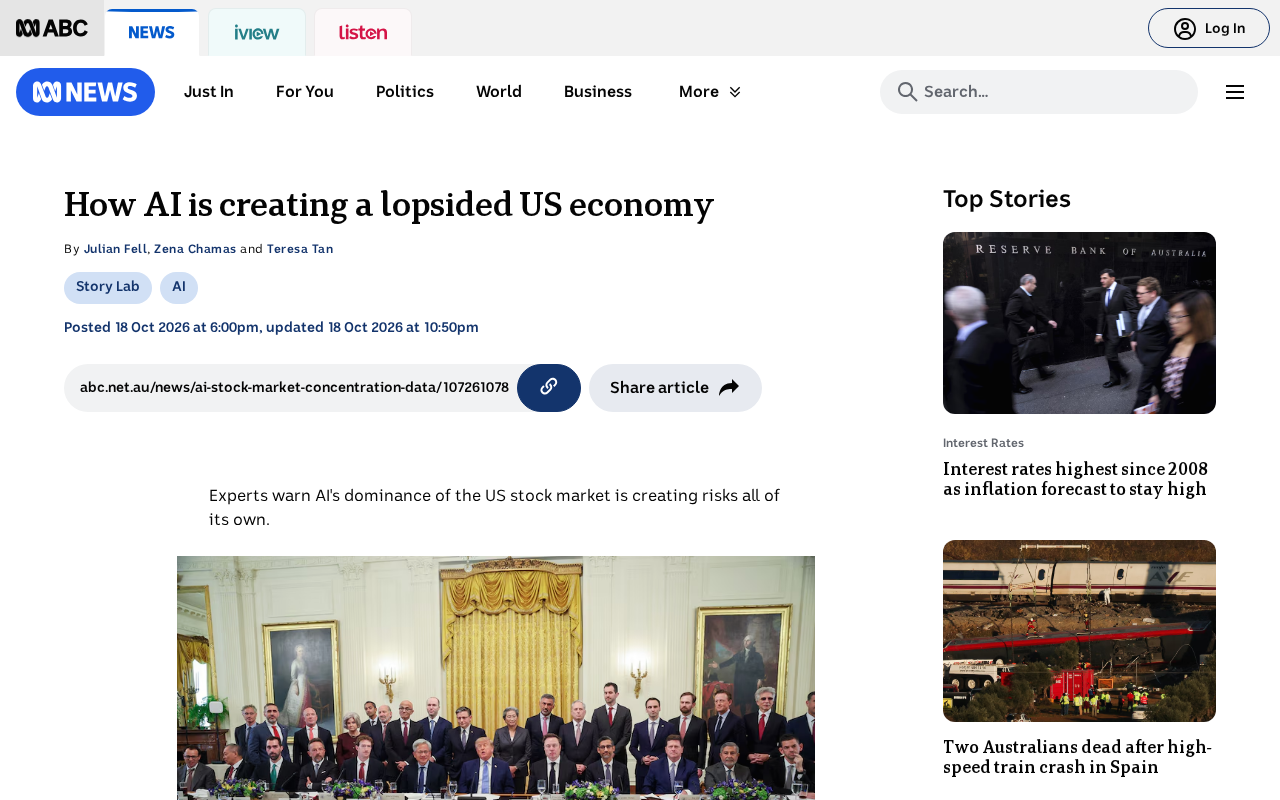
A post titled "How AI is creating a lopsided US economy" appeared on Hacker News with 6 points and 0 comments. That data point itself doesn't warrant over-interpretation—it may simply reflect unfortunate timing, or it may suggest the discussion is still at the headline level. But the question the title points to is unavoidable: AI's economic impact is not evenly distributed. It is amplifying efficiency in some areas while widening the gap between different groups.
It should be noted that this material contains only the title and basic post metadata, with no specific data, cases, or argument structure from the original article. Therefore, this article does not aim to "retell a report" but rather to extend the analysis around the economic phenomenon indicated by the title, with specific facts subject to the original article.
Where Does "Imbalance" Come From: The Distributional Characteristics of AI Benefits
Discussing AI and economic inequality inevitably begins with a basic observation: the productivity gains brought by AI do not fall evenly on every worker like sprinkling pepper.
The Divide Between Capital and Labor
AI is essentially a capital-intensive technology—it requires computing power, data, models, and engineering teams. Companies capable of deploying AI at scale are often themselves the capital-rich party. Productivity dividends first show up in corporate profit margins, per-capita output, and cost structures, and whether these gains trickle down to wages depends on the bargaining structure of the labor market. Every previous round of general-purpose technology revolution has seen similar time lags; what makes AI special is that it simultaneously touches cognitive white-collar work, making the list of "who will be replaced" longer than ever before.
General-Purpose Technology (GPT) is an economics concept used to describe a class of technologies with broad pervasiveness, continuous improvement, and the ability to spawn complementary innovations. The steam engine, electricity, the internal combustion engine, and the internet are all considered typical examples of general-purpose technologies. Economic historians (such as Bresnahan and Trajtenberg) have pointed out that the significant productivity contributions of general-purpose technologies often lag by decades, because firms need to redesign processes, accumulate organizational capital, and wait for complementary technologies to mature—this is the so-called "productivity J-curve." AI is widely believed to possess general-purpose technology characteristics: it permeates almost all cognitive tasks, and its own iteration speed is extremely fast. Understanding this framework helps explain the "time lag" mentioned in the article: the gap between the speed of technology diffusion and the speed of institutional and organizational adjustment is precisely an important source of imbalanced benefit distribution.
The Repricing of Skill Premiums
The traditional view holds that technological change increases demand for high-skilled labor, thereby widening the wage gap between high-skilled and low-skilled workers. The complexity of AI lies in the fact that it both replaces some high-skilled tasks (such as entry-level programming, copywriting, and basic analysis) and significantly amplifies the output of others. The result is that skill premiums are no longer distributed simply along "educational attainment" but are repriced along "the ability to effectively harness AI tools." Those skilled at embedding AI into their workflows see multiplicative output gains, while those who are not face pressure from tasks being broken down and positions being compressed.
Skill-Biased Technological Change (SBTC) is a classic theory explaining how technology affects wage structures. The theory holds that technological progress relatively increases demand for high-skilled labor, thereby widening the wage gap between high-skilled and low-skilled workers. However, AI's replacement of cognitive tasks breaks this linear narrative: the "task polarization" framework proposed by MIT economist Autor and others points out that technology may simultaneously replace middle-skill routine tasks, amplify high-skill judgment tasks, and increase relative demand for low-skill service positions, causing the employment structure to polarize toward both ends rather than simply shifting upward. The article's statement that "skill premiums are repriced along the ability to harness AI tools" is precisely a revision of the SBTC framework—the source of the premium shifts from "educational signals" to "human-machine collaboration capability," a shift that poses entirely new challenges to education and training systems.
Firm-Level Divergence: The Superstar Effect Is Amplified
AI deployment exhibits obvious economies of scale. Model training costs, data infrastructure, and talent reserves all favor leading firms, further reinforcing the already-existing "superstar firm" phenomenon.
The situation for small and medium-sized enterprises is more nuanced. They can access capabilities that previously only large companies could afford through API calls, which to some extent narrows the capability gap; but on the other hand, leading firms leverage proprietary data and closed-loop scenarios to continuously iterate, forming barriers that are difficult to catch up with. The result is polarization at both ends: AI makes "good enough" cheap, but makes "leading" more expensive.
This divergence trickles down to employment structure. Leading firms do more with fewer people, while SMEs under cost pressure are more inclined to use tools to replace incremental hiring. Structural changes in employment growth may be more worthy of attention than aggregate changes.
Superstar Firms is a phenomenon systematically proposed by economists Autor, Dorn, Katz, Patterson, and Van Reenen in explaining the decline in labor income share. The core logic is: driven by information technology and globalization, market share concentrates in the highest-productivity leading firms, and these firms tend to have lower labor income shares, thereby causing the labor share of the entire economy to decline. AI further reinforces this mechanism: the high fixed costs of model training, data network effects, and talent clustering create entry barriers, enabling leading firms to achieve higher output with fewer people. The article's point that AI makes "good enough" cheap and "leading" expensive is precisely a micro-level manifestation of the superstar effect—technology diffusion lowers the capability threshold while simultaneously raising the cost for leaders to maintain their advantage, thus intensifying polarization at both ends.
Regional and Industry Imbalances
Imbalance in the US economy has never been reflected only in income dimensions; geography and industry are equally important facets.
The AI industry is highly concentrated in a few tech hubs, with computing infrastructure, talent, and capital gathering in these areas, bringing local prosperity in housing prices, salaries, and employment. Meanwhile, regions dependent on traditional manufacturing, offline services, or administrative functions find it difficult to directly share in this round of technological dividends, yet must bear the pressure of job structure adjustments brought by AI.
Differences at the industry level are equally pronounced. Content- and decision-intensive industries such as finance, law, software, and media see rapid AI penetration and more dramatic job restructuring; while industries requiring physical operations and on-site judgment are less affected in the short term. This time lag itself creates structural mismatches—the jobs being disrupted and the newly created jobs are often not in the same place, nor do they belong to the same group of people.
Agglomeration Effects is a core concept in economic geography, referring to the positive externalities brought by the spatial concentration of firms and workers, including knowledge spillovers, labor pool sharing, and specialized supplier networks. The prosperity of tech hubs such as Silicon Valley and Seattle is a typical example of agglomeration effects. The AI industry's dependence on computing infrastructure, high-end talent, and venture capital makes its spatial distribution more concentrated than traditional industries, thereby reinforcing the "core-periphery" pattern. At the same time, the problem of Skill Mismatch manifests at the industry level: the jobs impacted by AI and the newly created jobs often do not overlap in geographical location or skill requirements, and labor mobility faces friction, leading to structural unemployment pressure. The "time lag and spatial mismatch" mentioned in the article is essentially the result of agglomeration effects and skill mismatch working together, which also explains why macro-level efficiency gains can coexist with local employment difficulties.
Policy and Individuals: Is the Imbalance Reversible
Treating the economic imbalance caused by AI as technological destiny is a lazy conclusion. Technology changes the production function, but distribution outcomes are jointly determined by institutional arrangements.
From a public policy perspective, discussable directions include: how skill retraining systems can keep up with the pace of AI tool iteration, how social security can cope with shortened career transition cycles, and how antitrust and data governance can prevent the barriers of leading firms from becoming entrenched. These issues are not new, but AI has raised their urgency.
For individuals, a more realistic strategy is not to predict which jobs will disappear, but to proactively embed AI tools into one's core workflow, shifting the focus of capability from "executing tasks" to "defining problems and judging results." In an environment of increasingly uneven benefit distribution, transferable judgment and tool proficiency are among the few things one can control.
Summary
The title of this Hacker News post presents a judgment worth continuously tracking: AI's economic effects are asymmetric. While it improves overall efficiency, it is also redrawing lines between capital and labor, leaders and the long tail, core regions and peripheral regions. How deep these lines will be drawn and whether they can be corrected by policy and individual effort depends on the mode of technology diffusion and the speed of institutional response in the coming years. The original article provides more complete data and cases and is recommended for combined reading.
One-line Summary
AI productivity dividends are unevenly distributed, redrawing lines between capital and labor, leaders and the long tail, and core and periphery.
Paragraph Summary
This article analyzes the Hacker News post title "How AI is creating a lopsided US economy," pointing out that AI's economic effects are asymmetric. The article examines the sources of imbalance from four dimensions: the divide between capital and labor means productivity dividends first appear on the corporate side, and transmission to wages depends on labor bargaining structure; skill premiums are being repriced from educational dimensions to "the ability to harness AI tools"; economies of scale amplify the superstar firm phenomenon, squeezing SMEs from both ends; and there are obvious time lags and spatial mismatches between regions and industries. The article concludes by emphasizing that imbalance is not technological destiny—institutional arrangements such as retraining systems, social security, antitrust, and data governance will influence final distribution outcomes, and individuals should proactively embed AI into their workflows and cultivate transferable judgment.
Related articles
 Tech Frontiers
MuJoCo: An Analysis of DeepMind's Open-Source General-Purpose Physics Simulator
An in-depth analysis of Google DeepMind's open-source physics simulator MuJoCo: high-performance C++ kernel, MJCF modeling format, contact solving principles, MJX GPU acceleration, and robot reinforcement learning use cases.
 Tech Frontiers
Claude API Quick Start: The Official Quickstarts Project Collection
Anthropic's official claude-quickstarts project collection helps developers quickly build deployable apps with the Claude API. Nearly 20k stars, Python-based, great for beginners and prototyping.
 Tech Frontiers
AI Agents Connecting Directly to APIs: Which Calls Can Be Safely Allowed?
AI agents can call any API, but the real challenge is deciding which calls can be safely allowed. This article analyzes allowance decisions from three dimensions—intent matching, least privilege, and controllable impact—and argues that the control layer should sit outside the agent, combined with audit traceability to build a trustworthy API call governance mechanism.