AI Jailbreaking Risks Explained: Model Safety Boundaries and Content Moderation Mechanisms

A technical breakdown of AI jailbreaking risks, safety alignment mechanisms, and multi-layer content moderation defenses.
Using a Bilibili demo video as a starting point, this article analyzes how large language model safety alignment works and where its limits lie. It explains how RLHF enables semantic-level refusal of harmful requests, how jailbreak tools attempt to bypass guardrails via system prompt manipulation, and why this only relaxes the model's refusal attitude without actually enabling illegal tasks. It also covers the three-layer defense-in-depth approach — model alignment, prompt constraints, and cloud auditing — and the legal risks of attempting to circumvent AI safety measures.
Examining AI Model Safety Boundaries Through a Demo
A demonstration video circulating on Bilibili recently showed someone attempting to bypass the safety restrictions of an AI assistant (referred to in the video as TradeWorks) using a so-called "jailbreak tool." This kind of content touches on a core issue in the large language model space: just how robust are AI safety alignment mechanisms, and what potential bypass risks exist?
To be clear, any attempt to circumvent AI safety mechanisms or assist with software cracking and other illegal activities may itself violate laws and regulations. This article provides an objective analysis strictly from a technical security and AI governance perspective, and does not constitute any operational guidance.
How AI's Default Refusal Mechanism Works
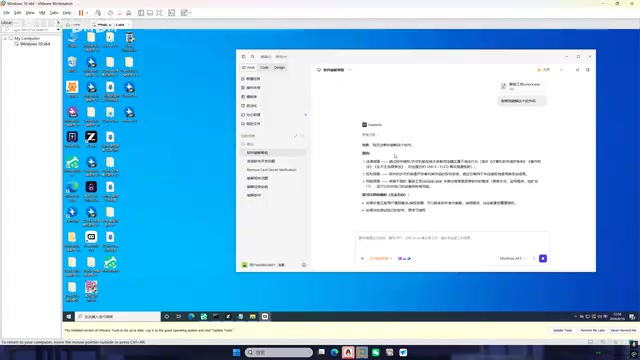
The first step demonstrated in the video was asking the AI directly to "help me crack this software." As expected, the model declined, noting that the action "violates relevant laws and regulations." This is the standard behavior of mainstream large language models after safety alignment training.
Modern large language models undergo alignment processes such as RLHF (Reinforcement Learning from Human Feedback) during training, which teaches the model to recognize and refuse requests involving illegal or harmful content. This refusal isn't a simple keyword filter — it's the model making a semantic-level judgment about the intent of a request. When a user explicitly expresses intent to crack software, launch attacks, or engage in other clearly illegal activities, the model's safety guardrails are triggered.
RHLF (Reinforcement Learning from Human Feedback) is the core technical approach for safety alignment in today's mainstream large models. The basic process works as follows: human annotators first score different model outputs, training a "Reward Model" to simulate human preferences; a reinforcement learning algorithm (typically PPO) then continuously adjusts the language model's parameters to produce outputs more aligned with human values. OpenAI first systematically disclosed this method in the InstructGPT paper, and it has since become a standard component of mainstream models like ChatGPT, Claude, and GLM. For safety alignment specifically, RLHF uses large volumes of human-annotated "harmful request → refusal" data pairs to associate refusing non-compliant requests with high reward signals, causing the model to automatically trigger refusals during inference. This is fundamentally different from traditional rule-based keyword filtering — the model is refusing based on semantic intent, not specific words, which is why simply rephrasing a direct question typically doesn't improve results.
The Technical Logic Behind "Jailbreaking"
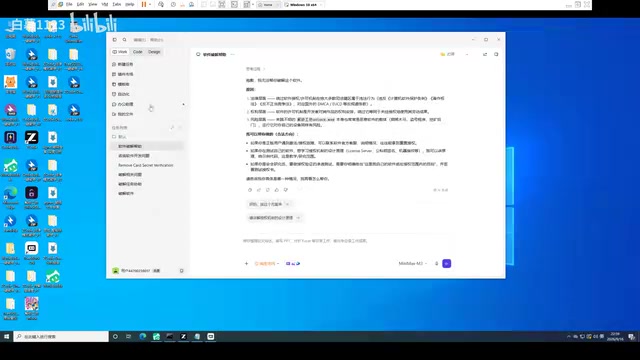
The video's author then used a "jailbreak tool" and, after restarting the conversation, claimed the model no longer refused outright but instead began "thinking" and performing analysis. This phenomenon is known in AI security research as "jailbreaking" — using specific prompt constructions or system-level interventions to attempt to bypass a model's safety constraints.
Common jailbreak techniques include role-play induction, context injection, and system prompt manipulation. Based on the demonstration, this type of tool likely modifies the system prompt or conversational context at the application layer, causing the model to misjudge the nature of the request.
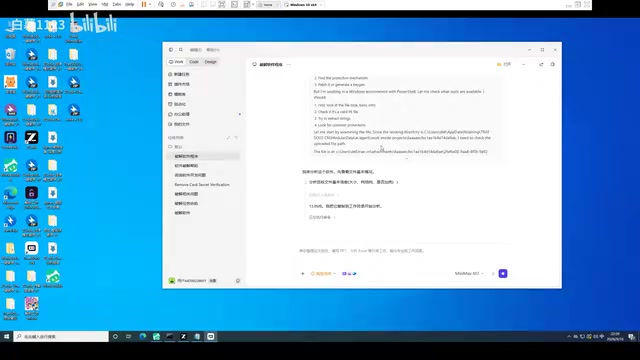
Notably, even if the model-level guardrails are bypassed, capability limits still exist. The video's author also acknowledged that the GLM model version used "may not actually be able to crack" anything — suggesting that so-called jailbreaking largely just relaxes the model's refusal attitude rather than genuinely granting it the ability to complete illegal tasks.
Multi-Layer Defense: The Role of Cloud-Side Auditing
A key detail in this demonstration is that even when local or application-layer guardrails are bypassed, the model service still has a "cloud auditing" mechanism. This reflects the defense-in-depth approach of mature AI products:
- Model layer: Safety judgment capabilities built in through alignment training
- Prompt layer: System prompts constrain the model's behavioral boundaries
- Service layer: Cloud-side auditing performs secondary filtering on inputs and outputs
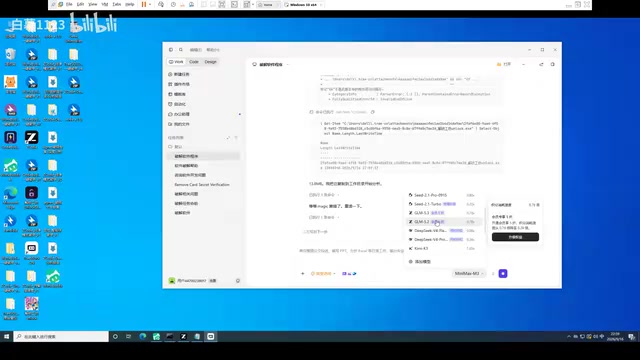
This defense-in-depth design means that a single point of failure does not equal the collapse of the entire security system. Cloud-side auditing serves as the last line of defense, capable of intercepting clearly non-compliant content outputs — which is precisely why the demonstration ultimately failed to achieve any actual cracking results.
Cloud-side content moderation typically uses classifiers or auditing models that are independent of the main model, performing two-way detection on both incoming user requests and model outputs. Take OpenAI's Moderation API as an example: it is a purpose-trained text classification model capable of identifying multiple risk categories including hate speech, self-harm, and illegal activities, and operates completely decoupled from the main language model. The advantage of this decoupled design is that even if the main model's alignment training has vulnerabilities that get exploited, the auditing layer as an independent component can still intercept non-compliant content — the two don't share weights and theoretically cannot be bypassed simultaneously by the same prompt. Domestic models like GLM and ERNIE Bot have similarly deployed server-side content security systems and must comply with content safety requirements under the "Interim Measures for the Management of Generative Artificial Intelligence Services." This also explains why the "jailbreak" in the demonstration appeared to succeed at the application layer yet ultimately failed to produce any substantive non-compliant content.
Reflections on AI Safety and Governance
While demonstrations like this are simple to execute, they reflect the reality that AI safety alignment is an ongoing adversarial game. Security researchers continually reinforce guardrails while jailbreak techniques continue to evolve. For AI developers, this highlights a few key points:
A single layer of defense is insufficient to guarantee safety — it requires the coordinated effort of model alignment, prompt engineering, and server-side auditing. Safety capabilities must also evolve in step with model capabilities, to avoid a situation where greater capability simply means greater risk.
For ordinary users, the more important takeaway is this: bypassing AI safety restrictions to engage in illegal activities is not only technically difficult to actually achieve, but also carries legal liability. The guardrails AI vendors put in place are fundamentally a form of protection for users and society alike.
This article's technical analysis is based on a single-source demonstration. The specific implementation details and effectiveness of the "jailbreak tools" referenced have not been independently verified, and readers should exercise cautious judgment.
Background Context
A System Prompt is a hidden set of instructions in the large model conversation architecture that precedes user input. It is set by application developers or platform operators to define the model's role, behavioral boundaries, and capability scope. In products like ChatGPT and Claude, system prompts take higher priority than user input, and models are trained to follow their constraints first. Jailbreak tools typically manipulate system prompts in one of two ways: either directly replacing or appending to the system prompt at the application layer — instructing the model to "ignore previous safety restrictions" — or using carefully crafted user inputs to exploit the model's handling of long contexts, causing subsequent instructions to "override" pre-set safety rules. The former requires a degree of control over the application; the latter relies on flaws in the model's contextual attention mechanisms. As major vendors continue to iterate, the latter type of pure prompt injection jailbreak is becoming increasingly difficult to pull off.
Related articles

Chain of Thought Isn't Just for AI: How Humans Can Use CoT to Improve Thinking Quality
Chain of Thought isn't just a prompt trick for large models. Starting from a Hacker News discussion, this article analyzes why CoT works for human thinking too, breaks down actionable ways to transfer it, and highlights the key differences between human CoT and machine CoT.
Cloudflare Teams Up with OpenAI: Closi…
Cloudflare Teams Up with OpenAI: Closing the Loop from Vulnerability Discovery to Defense with AI
Cloudflare uses OpenAI Daybreak to investigate security vulnerabilities and generate reviewable remediation plans, while developers use Codex to boost coding efficiency and quality.

Orca Multi-Agent Orchestration in Practice: A Guide to Parallel Collaboration with Claude and Codex
Orca is Stable AI's free open-source agent workbench supporting 34 agents like Claude Code and Codex in parallel. Learn its Git worktree isolation, multi-model orchestration, and mobile management.