AI Keeps Cracking Millennium Problems: VP and VNP Are Low-Hanging Fruit

AI companies keep cracking VP≠VNP and Yang-Mills existence — mathematical research is being repriced.
The article traces a dense stretch of AI breakthroughs on major math problems in 2026: Anthropic published a VP≠VNP proof supporting P≠NP; OpenAI released an independent proof five hours later, claiming it had the result earlier; and both companies produced Yang-Mills existence results within weeks. The author argues AI has crossed a threshold in formal reasoning and symbolic computation, repricing highly formalized problems. Researchers should avoid areas AI handles well and treat AI as a tool. Details come largely from one Bilibili creator and still need peer review.
When Math's Hardest Problems Fall Within AI's "One-Shot Range"
At around 2 a.m. Beijing time on November 24, 2026, Anthropic published a proof concerning VP≠VNP. This result is closely tied to the P vs NP problem — VP and VNP can be understood as the algebraic versions of P and NP. According to a Bilibili creator's video breakdown, the proof provides more evidence for P≠NP.

The derivation itself doesn't hold up directly (the video's author also points out that leaps like "if V is not equal to 0" don't constitute a rigorous logical chain), but the direction it reveals is worth noting: there is a deep connection between algebraic complexity lower bounds and Boolean complexity lower bounds. For those who follow computational theory, this counts as a substantive advance.
P vs NP is the most famous unsolved problem in computational complexity theory. It asks: if a problem's solution can be verified in polynomial time (NP), can it also be solved in polynomial time (P)? Most researchers suspect P≠NP, but no proof exists yet. VP vs VNP is the algebraic version of this problem: VP corresponds to polynomial families that are "easy to compute," and VNP to polynomial families that are "easy to verify." If VP≠VNP holds, several important corollaries for P≠NP follow.
The seven Millennium Prize Problems are seven mathematical problems for which the Clay Mathematics Institute offered a $1 million prize each in 2000, including P vs NP, Yang-Mills existence and mass gap, and the Riemann hypothesis. Among them, the Yang-Mills problem requires proving that a quantum Yang-Mills field exists and has a positive mass gap — a core challenge at the intersection of physics and mathematics.
OpenAI's "Interception" and Withheld Announcement
What really makes this intriguing is what came next. Five hours after Anthropic published its proof, OpenAI released another independent VP≠VNP proof, claiming it had obtained the result as early as November 6 and had simply held off until now. The implication was clear: for results at this level, they couldn't even be bothered to publish on time.
Looking at a longer timeline, this isn't an isolated event. OpenAI had previously published a refutation of the ETH (Exponential Time Hypothesis), work that also bears on P vs NP and provides more evidence for P=NP. Within less than a month, AI has scored results on two major math problems related to P vs NP — one supporting P≠NP and one supporting P=NP. Evidence pointing in both directions appearing at once suggests that exploration in this field is being rapidly pried open by AI.
ETH (the Exponential Time Hypothesis) is a core conjecture in computational complexity: it asserts that NP-complete problems such as 3-SAT have no sub-exponential time algorithm. ETH is stronger than P≠NP; if ETH holds, then P≠NP follows automatically. Thus "refuting ETH" means proving that a sub-exponential algorithm exists, which would directly support the P=NP direction. However, refuting ETH is extremely difficult, and any such claim requires rigorous algorithmic verification and peer review.
Yang-Mills: An Even Earlier "Low-Hanging Fruit"
The video's author points out that the first half of the Yang-Mills existence problem — one of the seven Millennium Prize Problems — had long since become low-hanging fruit. On October 6, 2026, Anthropic's in-house mathematician Levent claimed to have produced a proof of the existence part. The very next day, OpenAI posted 722 mathematics papers across 372 categories on GitHub, directly stealing the spotlight.

Even more striking, on October 27 OpenAI posted related results on Yang-Mills existence, claiming it had solved the problem back in early September. At this pace, a problem that had bedeviled the physics community for decades was compressed into a few weeks' worth of work within an AI company's internal workflow.

The "Psychological Shock" to the Math World
For mathematicians, this situation is quite brutal. A problem someone might spend half a lifetime researching gets effortlessly cracked by AI in a few weeks — and then casually dismissed by the other side as "low-hanging fruit." The video's author describes it as "two AI companies dueling on their own turf, with the shockwave killing off all the geese that lay golden eggs for the math world" — a joking metaphor, but one that captures the core tension: the competitive tempo of AI companies is reshaping the value coordinates of mathematical research.
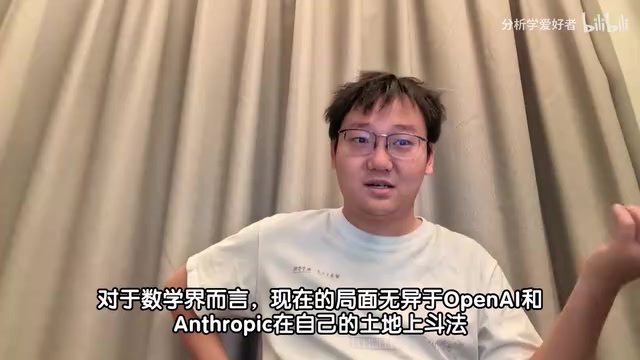
A note: the above content comes mainly from a single Bilibili creator's interpretation, and details such as specific dates and paper counts (372 categories, 722 papers) have not been independently verified. The technical details of the VP≠VNP proof also await peer review from the mathematics community. Still, the pace of AI output in areas like computational complexity and algebraic geometry is clearly accelerating, as can be seen from the public moves of multiple institutions.
After the Low-Hanging Fruit, What Remains?
The so-called "low-hanging fruit" essentially reflects that AI's capabilities in formal reasoning and symbolic computation have crossed a certain threshold. Problems that once required top mathematicians to grind away for years can now potentially be tackled by AI within weeks. This doesn't mean all math problems will become cheap — problems that genuinely require conceptual innovation and cross-domain insight remain difficult — but highly formalized problems like computational complexity and existence proofs are indeed being repriced by AI.
For researchers, this may mean two things: first, topic-selection strategy needs to avoid areas AI can already handle efficiently; second, learn to treat AI as a tool rather than a rival. As for whether P vs NP itself will become the next "low-hanging fruit," evidence currently points in both directions, and the verdict is far from settled.
Formal reasoning and symbolic computation are the two technical pillars of AI's push into mathematics. Formal reasoning refers to translating mathematical proofs into machine-checkable formal languages (such as Lean and Coq), so that a proof's correctness can be verified step by step; symbolic computation refers to precise machine manipulation of algebraic expressions and polynomials. Combined, the two let AI rapidly search for proof paths on highly structured math problems. But such methods depend on how formalizable the problem itself is — work requiring conceptual innovation and cross-domain analogy, which depends on "mathematical taste," remains a blind spot for today's AI.
Related articles

Bin's Live Stream Highlights: Hilarious Interactions from "You Came at the Right Time" to "I'll Support You From Now On"
Bin's hilarious live stream highlights: from "You came at the right time" to "I'll support you from now on," featuring Championship skins, wigs, and other game memes that showcase Bilibili's unique streaming culture.

Hunter Rescues Educated Youth: The Mountain-Chasing System Launches a New Warm-Hearted Viral Drama Formula
Bilibili's early-access period short drama *Everyone Thinks I'm a Poor Hunter* opens with a snowy-night rescue of an educated youth. Hunter Chen Shan activates the mountain-chasing system, using realistic hypothermia first-aid details and mutual-probing character dynamics to deliver a warm-hearted period drama without the sleaze.

Riemann Hypothesis Proven by AI? The Truth Has Nothing to Do With Your Reality
34-year-old mathematician Levent Alpöge claims to have proven the Riemann Hypothesis and Generalized Riemann Hypothesis with Claude, releasing 17 million lines of formal verification code. This article sorts out the facts, debunks myths about RSA collapse and new material revolutions, and analyzes the true significance of mathematics-AI collaboration.