AI Large Language Model Learning Roadmap for Beginners: From Transformer Principles to Project Practice

A structured beginner's roadmap from Transformer fundamentals to enterprise-level LLM project deployment.
This article presents a systematic learning roadmap for AI large language models designed for beginners. It covers three progressive stages: fundamentals (Transformer architecture, pre-training mechanisms, Prompt Engineering), advanced topics (RAG, Agent, private deployment, LoRA fine-tuning), and hands-on project practice (digital humans, enterprise knowledge bases, medical AI). The guide emphasizes building a coherent knowledge framework over fragmented learning.
Why Beginners Need a Systematic Learning Roadmap for Large Language Models
In recent years, AI large language models (LLMs) have become the hottest topic in the tech world. But for beginners, the biggest pain point isn't a lack of resources — it's that there are too many resources, and they're too scattered. According to the creator of this Bilibili tutorial series, before making the course, they reviewed almost every related course on Bilibili and even watched teaching videos from international instructors on YouTube, ultimately reaching one conclusion: over 90% of video content is a mixed bag of quality and lacks systematic structure. Very few tutorials guide learners step-by-step through hands-on practice while providing in-depth explanations of individual concepts.

This precisely reflects the widespread problem with current AI educational content: fragmented learning makes it difficult to build a complete knowledge framework. Fragmented learning refers to the approach where learners acquire information through short videos, blog posts, and other scattered channels without systematic connections. This problem is especially pronounced in the LLM field — a learner might watch a popular science video on attention mechanisms, then watch a demo on fine-tuning, but fail to understand the logical relationship between the two within the overall model training pipeline. Cognitive science research shows that effective learning requires new knowledge to form connections with existing knowledge structures (known as "meaningful learning"), and systematic curriculum design helps learners build this connection network by pre-establishing pathways between knowledge points. Learners often watch dozens of videos yet still don't know how to bridge the gap from Transformer theory to actual project deployment. Therefore, the value of a clearly structured, progressive learning roadmap lies in helping beginners establish an overall cognitive framework for LLM technology.
Three Stages of LLM Learning: A Complete Loop from Principles to Practice
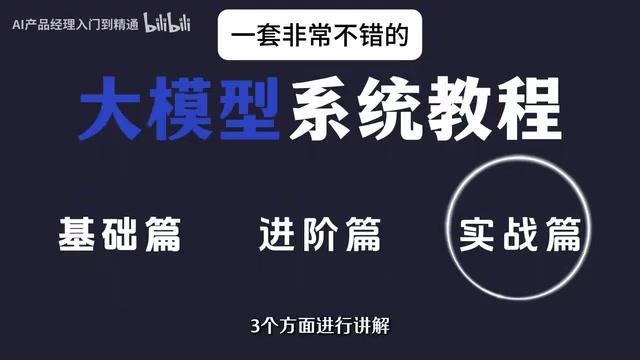
This tutorial divides the learning process into three tiers: Fundamentals, Advanced, and Project Practice. This layered design follows the general pattern of technical learning — first understand the principles, then master advanced techniques, and finally practice through projects.
Fundamentals: Transformer Principles and Development Environment Setup
The fundamentals section covers core LLM principles, AI development environment setup, and Prompt Engineering. The most critical component is the explanation of Transformer architecture and pre-training mechanisms.
Transformer is the underlying architecture of all modern mainstream large models (such as GPT, LLaMA, Qwen, etc.). This architecture was proposed by the Google team in their 2017 paper "Attention Is All You Need," originally designed for machine translation tasks. Its core innovation was completely abandoning the previously dominant Recurrent Neural Network (RNN) and Convolutional Neural Network (CNN) structures, instead relying on self-attention mechanisms to capture dependencies between arbitrary positions in a sequence. The essence of Self-Attention is computing relevance weights between each token in the input sequence and all other tokens, thereby enabling parallel processing of global information. This design not only dramatically improves training efficiency (due to high parallelizability) but also solves the vanishing gradient problem that RNNs face when processing long sequences. Subsequently, BERT adopted the encoder portion of Transformer, the GPT series adopted the decoder portion, and models like T5 used the complete encoder-decoder structure. Understanding Transformer is the foundation of understanding modern large models, and mastering its self-attention mechanism is the core threshold for entering the LLM field.
Regarding pre-training mechanisms, this refers to the process of training a model on large-scale unlabeled text data through self-supervised learning tasks. Autoregressive pre-training, as represented by GPT, uses a "next token prediction" task — the model predicts the next word based on the preceding text, and through repeated training on massive amounts of text, the model gradually acquires grammatical rules, semantic relationships, and even world knowledge. The significance of pre-training is that it enables models to gain powerful general language understanding and generation capabilities without any human annotation. Afterward, only a small amount of task-specific data is needed for fine-tuning to adapt to specific application scenarios. This "pre-training + fine-tuning" paradigm has completely transformed the R&D model in the NLP field.
Prompt Engineering is a practical skill that both regular users and developers can quickly pick up. It refers to the technique of carefully designing text instructions given to large models to guide them toward desired outputs. The reason it works is that pre-trained large models are essentially conditional probability generators — the input prompt sets the generation conditions, and different conditions activate different knowledge pathways within the model. Common prompting techniques include: Few-shot (providing a few examples to guide output format), Chain-of-Thought (having the model reason step by step), and role assignment (specifying that the model play a particular expert role). Excellent prompt design can produce orders-of-magnitude differences in output quality from the same model, making it the lowest-barrier yet highest-return LLM application skill that determines whether you can efficiently leverage the model's capabilities. The goal of the fundamentals section is to help beginners cross the entry threshold and understand the fundamental question of "why large models work."
Advanced: RAG, Agent, and Model Fine-tuning Explained
The advanced section focuses on the most critical technologies in current enterprise applications:
-
RAG (Retrieval-Augmented Generation): This technology was first proposed by Meta AI in 2020, with the core idea of combining information retrieval with text generation. When a user asks a question, the system first retrieves relevant document fragments from an external knowledge base, then concatenates these fragments into the prompt as context, and finally the large model generates an answer based on this real-time retrieved information. RAG addresses two fundamental limitations of large models: first, training data has a cutoff date, so models cannot access the latest information; second, models may produce "hallucinations" — confidently fabricating non-existent facts. By incorporating external knowledge sources, RAG makes model responses verifiable and traceable, which is crucial for enterprise applications. A typical RAG pipeline includes document chunking, vectorization (Embedding), storage in a vector database, semantic retrieval, and answer generation.
-
Agent: The concept of Agent originated in early AI research but has gained entirely new implementation pathways in the LLM era. Unlike traditional Q&A modes, Agents can autonomously decompose complex tasks, formulate execution plans, call external tools (such as search engines, code interpreters, API interfaces, etc.), and dynamically adjust strategies based on execution results. Their core architecture typically includes: a perception module (understanding user intent), a planning module (decomposing task steps), a memory module (maintaining context and historical information), and a tool-calling module (executing specific operations). Since 2023, open-source Agent frameworks like AutoGPT, BabyAGI, and MetaGPT have emerged in succession, and OpenAI's Function Calling and Assistants API mark the transition of Agents from experimentation to productization. Agents are widely regarded in the industry as the key technical pathway for large models to evolve from "conversational tools" to "autonomous assistants," making it one of the most watched technical directions today.
-
Private Deployment: This refers to running large models on an enterprise's own servers or private cloud environments rather than relying on third-party API services. The driving forces behind this need come from three aspects: data security (sensitive business data stays within enterprise boundaries), compliance requirements (data regulations in finance, healthcare, government, and other industries), and cost control (API costs for high-frequency calls may far exceed self-hosting costs). The technology stack for private deployment typically includes model quantization (compressing FP16/FP32 models to INT8/INT4 to reduce hardware requirements), inference framework selection (such as vLLM, TGI, Ollama, etc.), and service encapsulation (providing standard API interfaces for business system integration). The thriving open-source model ecosystem (such as LLaMA, Qwen, ChatGLM, etc.) provides rich model choices for private deployment.
-
Model Training and Efficient Fine-tuning: LoRA (Low-Rank Adaptation) is currently one of the most popular Parameter-Efficient Fine-Tuning (PEFT) methods, proposed by Microsoft Research in 2021. Its core idea is based on a key hypothesis: the parameter changes when a model adapts to a specific task exist within a low-rank space. Therefore, LoRA doesn't directly modify all of the original model's parameters but instead inserts two small matrices (dimension-reduction matrix A and dimension-expansion matrix B) alongside each attention layer, training only these newly added parameters. For example, with a 7B parameter model, LoRA fine-tuning may only need to train 0.1%-1% of the original parameter count, reducing VRAM requirements from tens of GB to just a few GB, making it possible to fine-tune large models on consumer-grade GPUs. This technology dramatically lowers the computational barrier for LLM customization, enabling developers to create customized models with limited computing resources.
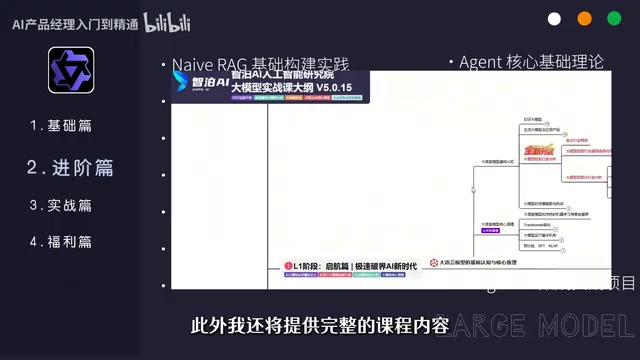
One detail worth mentioning: the course also includes a complete learning roadmap, which is especially important for self-learners — it helps them locate their current stage at any time and avoid getting lost in the vast ocean of knowledge.
Project Practice: Making LLM Knowledge Truly Applicable
The ultimate purpose of technical learning is application. The practice section of this tutorial provides multiple enterprise-level deployment projects, including:
-
Agent Digital Human Project: Digital humans are a typical product of combining Agent technology with multimodal capabilities. They require not only conversational and decision-making abilities from large models but also integration of technologies such as Text-to-Speech (TTS), Automatic Speech Recognition (ASR), and even virtual avatar driving. In scenarios like customer service, live streaming, and education, digital humans are rapidly replacing traditional rule-based interaction solutions.
-
RAG Enterprise Knowledge Base Q&A System: This is currently one of the most mature B2B large model applications. Its core process involves chunking and vectorizing internal enterprise documents (such as product manuals, regulations, technical documentation, etc.), storing them in a vector database, and when an employee or customer asks a question, the system first retrieves the most relevant document fragments, then the large model generates precise answers based on these fragments. Virtually every company with substantial data accumulation has this type of need.
-
Medical Domain LLM Application: Healthcare is one of the most challenging and valuable directions for vertical-domain large models. Due to the extremely high requirements for medical knowledge professionalism and rigor, general-purpose large models are prone to generating incorrect information in medical scenarios. Therefore, professional adaptation through domain-specific data fine-tuning and RAG combined with authoritative medical literature is necessary. This represents the direction of deep application in vertical domains.
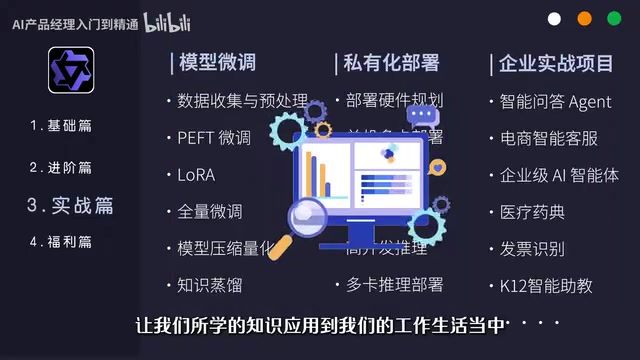
Through complete project practice, learners can connect scattered knowledge points into deliverable capabilities — this is the critical leap from "having studied" to "being able to apply."
How to Rationally Evaluate Compilation-Style LLM Tutorials
Objectively speaking, compilation tutorials that advertise "748 episodes" or "the most comprehensive and detailed" are ubiquitous on platforms like Bilibili, and their marketing flavor often outweighs actual teaching quality. For learners, it's advisable to maintain rational judgment:
- Completeness doesn't equal high quality: More episodes don't mean better content. What matters is whether explanations are thorough and whether examples are reproducible.
- Systematic frameworks have reference value: Even if you don't follow a particular course entirely, its "Fundamentals — Advanced — Practice" roadmap and knowledge point checklist can still serve as reference for building your personal learning plan.
- Hands-on practice is the core: LLM technology updates extremely rapidly, and passively watching videos yields limited results. Only by actually setting up environments and running through projects can you develop solid technical capabilities. The current technology iteration cycle in the LLM field is approximately 3-6 months — RAG was still a cutting-edge concept in early 2023, but by year-end it had become standard practice; in 2024, Agents moved rapidly from proof-of-concept to engineering. This means learners cannot rely solely on fixed course content but need to cultivate the ability and habit of quickly learning new technologies.
For those truly wanting to get started with AI large models, rather than bookmarking massive "save this for later" resource collections, it's better to choose a clear roadmap, settle down starting from Transformer principles, and progressively move toward RAG, Agent, and project practice. The value of technology ultimately manifests in application — only by applying what you've learned to real scenarios in work and life does learning become meaningful.
Key Takeaways
Related articles

Alphabet's $700 Billion Market Cap Wipeout: Is Massive AI Spending Strategic Vision or a Money Pit?
Alphabet's market cap dropped $700B as massive AI spending sparks fierce Wall Street debate. Deep analysis of Google's AI investment surge, divided market views, and the tech industry's AI reckoning.
Qwen3-VL Multimodal Fine-Tuning in Practice: Architecture Deep Dive and Complete LoRA Fine-Tuning Guide
Deep dive into Qwen3-VL vision-language model architecture, covering Vision Encoder alignment, LLM backbone principles, and complete LoRA fine-tuning workflow from setup to training and testing.

Harness Multi-Agent Framework: A Deep Dive into Planner→Builder→Evaluator Three-Agent Collaboration
Deep dive into the Harness multi-agent framework's three-agent paradigm (Planner, Builder, Evaluator), covering Agent Loop design, circular invocation prevention, Sandbox isolation, and A2A vs SubAgent selection strategies.