Qwen3-VL Multimodal Fine-Tuning in Practice: Architecture Deep Dive and Complete LoRA Fine-Tuning Guide
Complete guide to Qwen3-VL architecture and LoRA fine-tuning for multimodal AI tasks.
This article provides a comprehensive breakdown of the Qwen3-VL vision-language model, explaining its core architecture (LLM backbone + Vision Encoder alignment), token alignment mechanisms, and how different modalities are processed. It then walks through the complete LoRA fine-tuning workflow including environment setup, multimodal dataset construction, hyperparameter tuning, and model testing.
Introduction: Why Study Qwen3-VL in Depth
Multimodal large models are becoming the primary battleground for AI deployment. Compared to text-only large language models, Vision-Language Models (VLMs) can simultaneously understand images, videos, and even audio, with applications ranging from object recognition and document parsing to video understanding.
The development of vision-language models can be traced back to OpenAI's CLIP model released in 2021, which mapped images and text into a shared semantic space through contrastive learning, pioneering the vision-language alignment paradigm. Since then, models like Flamingo, BLIP-2, and LLaVA have continuously pushed the boundaries of VLM capabilities. Qwen3-VL is the third-generation vision-language model from the Tongyi Qianwen team, excelling in document understanding, chart parsing, and fine-grained visual recognition. It supports dynamic resolution input and video understanding, representing the cutting edge of Chinese-developed multimodal large models.
This article is based on the practical teaching content from Bilibili creator Chen Bo (who focuses on large model algorithm principles and fine-tuning), systematically covering the complete workflow of Qwen3-VL multimodal large model fine-tuning—from environment setup and data processing to LoRA efficient fine-tuning—while providing an in-depth analysis of its underlying architecture.
Whether you're a developer with NLP or image recognition experience, or a newcomer to large models, understanding the VLM training workflow is crucial—because regardless of whether it's large models, deep learning, or machine learning, the core training process is fundamentally consistent across all these domains.
Core Architecture Analysis of Qwen3-VL Multimodal Large Model
LLM Backbone: The Core Engine of Multimodal Models
To understand Qwen3-VL, you first need to grasp a key fact: there is a dependency relationship between vision large models and large language models. In Qwen3-VL's architecture, the core necessarily includes an LLM (Large Language Model) as the backbone, which inherently understands input text, prompts, or sentences.
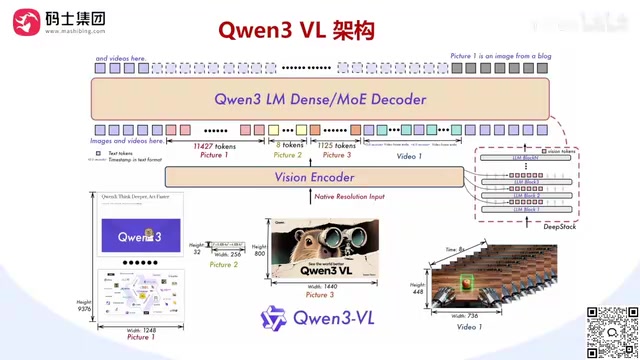
Multimodal capability is essentially a layer built on top of this LLM backbone. The vision large model connects a Vision Encoder in front of the LLM, responsible for converting images—whether portrait, landscape, large, small, or even frame-by-frame video images—into a form that the large language model can understand.
The Token Alignment Mechanism of Vision Encoder
The core work of the vision encoder can be summarized in two words: Alignment or Transformation. It encodes image content and converts it into individual Tokens, then passes them to the underlying large language model for comprehension.
Vision encoders in mainstream VLMs are typically based on the Vision Transformer (ViT) architecture. ViT was first proposed by Google in 2020, with the core idea of splitting an image into fixed-size patches (e.g., 16×16 pixels), flattening each patch, and feeding it as a token into a Transformer encoder. Qwen3-VL makes significant improvements on this foundation by adopting a Dynamic Resolution mechanism that no longer forces all images to a fixed size. Instead, it flexibly splits patches based on the original image's aspect ratio, preserving more detail information. This design enables the model to efficiently handle image inputs of various sizes, from small icons to high-resolution document scans.
There's a key point that's easily misunderstood here: the Vision Encoder doesn't merely convert images into computer-readable numerical values—its more important role is to transform visual information into Tokens that the large language model can understand. Therefore, this encoder requires pre-training.
The technical implementation of token alignment typically relies on a Cross-modal Projector. In BLIP-2, this projector is called Q-Former, which uses a set of learnable query vectors to extract information from visual features that aligns with language semantics. In the LLaVA and Qwen-VL series, the projector typically adopts a simpler MLP (multilayer perceptron) or linear projection approach. Its core objectives are solving two problems: dimension matching and semantic alignment. The visual encoder's output feature dimensions may differ from the LLM's embedding dimensions, requiring transformation through the projector; simultaneously, visual features and text tokens exist in different semantic spaces, and the projector needs to learn during pre-training how to "translate" visual representations into semantic representations the LLM can understand.
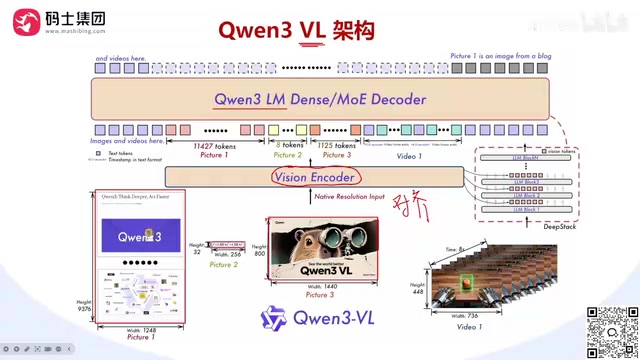
Fundamentally, this is a form of spatial alignment—mapping visual representations into a semantic space comprehensible to the large language model. This also explains why open-source multimodal large models must train the front-end Encoder in addition to the internal large language model during training.
How Audio Input Is Handled
A viewer asked: what if the input is audio? The answer is clear—simply replace the Vision Encoder with a Speech Encoder, encode the sound into Tokens, and pass them to the large language model in the same way.
Representative implementations of speech encoders in multimodal large models include OpenAI's Whisper and Meta's HuBERT. Whisper uses an encoder-decoder architecture that can convert audio signals into high-dimensional feature representations. In the Qwen series, Qwen2-Audio and Qwen-Omni have already implemented speech modality integration using dedicated audio encoders to convert audio signals into token sequences. This plugin-style "modality encoder + LLM" architecture is extremely extensible—theoretically, as long as you can train an appropriate encoder for a given input modality and complete alignment with the LLM, you can "plug in" new perceptual capabilities to the large language model. This is why the industry is seeing more and more Omni models, such as GPT-4o and Gemini, all of which fundamentally follow this architectural paradigm.
It's worth clarifying that tools like FFmpeg are not sufficient—it's merely a library for reading audio data, handling data reading and preprocessing. The real Encoder is a pre-trained neural network module responsible for semantic alignment.
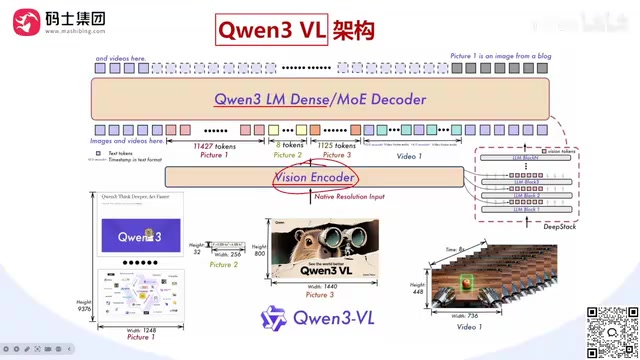
Today's mainstream multimodal large models essentially all follow this architectural paradigm: an internal large language model with different Encoders connected in front based on input type. The vision Encoder processes images and videos, the speech Encoder processes audio, each converting their input into Tokens before feeding them to the LLM.
Key Decisions in LoRA Fine-Tuning Practice
Which Module to Fine-Tune?
When fine-tuning for specific tasks (such as specialized object recognition), you face a core decision: should you fine-tune the large language model at the back, the Encoder at the front, or both?
This depends entirely on your code implementation and task requirements. You can:
- Fine-tune only the large language model portion
- Fine-tune only the vision encoder portion
- Fine-tune both parts
- Even precisely specify training only certain layers or modules within a specific part
This flexibility is exactly where the value of efficient fine-tuning techniques like LoRA lies—it allows us to adapt to specific visual tasks at minimal cost while freezing most parameters.
LoRA (Low-Rank Adaptation) was proposed by Microsoft Research in 2021 and is one of the most influential Parameter-Efficient Fine-Tuning (PEFT) methods. Its core insight is that the weight update matrix during fine-tuning exhibits low-rank properties, so the weight update can be decomposed into the product of two small matrices (A×B), where the rank of A and B is much smaller than the dimensions of the original weight matrix. For example, for a 4096×4096 weight matrix, LoRA might only need to train two matrices of size 4096×16 and 16×4096, reducing trainable parameters from approximately 16 million to about 130,000. In multimodal fine-tuning scenarios, LoRA is especially valuable because VLMs typically have larger parameter counts (including both the vision encoder and LLM), making full-parameter fine-tuning extremely costly in terms of memory and compute. With LoRA, developers can complete fine-tuning tasks on consumer-grade GPUs.
Key Points for Multimodal Dataset Construction
Data processing for multimodal fine-tuning is more complex than pure text, requiring focus on several aspects:
- Dataset Format: Multimodal data needs to be structured into model-recognizable conversation formats, i.e., message bodies containing both images and text
- Data Cleaning: Identifying and handling dirty data is a prerequisite for ensuring training quality
- Prompt Design: Configuring reasonable prompts for the model
- Construction Standards and Keywords: Following Qwen3-VL's specific dataset construction standards and field conventions
Core Hyperparameters and Complete Training Pipeline
The complete LoRA fine-tuning pipeline includes: environment configuration and installation, model downloading and loading, data preprocessing, multimodal message body construction, core hyperparameter tuning, training execution, and post-training model testing. The entire workflow is highly consistent with traditional deep learning training paradigms, which is why developers with relevant backgrounds can get started quickly.
VLM Inference Engines: Algorithm or Application?
Regarding the classification of VLM inference engines (such as vLLM), the creator offers a dialectical perspective:
- If explaining their principles and underlying optimization mechanisms, it falls under the large model algorithm domain
- If explaining their usage methods, it falls under application development
vLLM is a high-performance large model inference framework developed by UC Berkeley, with PagedAttention as its core innovation. Traditional LLM inference causes significant memory fragmentation and waste when handling KV Cache (key-value cache). PagedAttention draws on the paging management concept from operating system virtual memory, dividing KV Cache into fixed-size blocks that are allocated and reclaimed on demand, improving memory utilization by 2-4x. For multimodal model inference scenarios, vLLM's advantages are even more pronounced because visual tokens typically increase sequence length significantly (a single high-resolution image may produce hundreds or even thousands of tokens), making efficient memory management directly impact inference throughput and concurrency capabilities.
In reality, as technology evolves, the boundaries between algorithm and application development roles are blurring. Modern large model application development increasingly requires understanding underlying principles, and knowledge from both directions is converging. This suggests to learners: don't be overly fixated on classification labels—mastering the complete capability chain from principles to deployment is what matters.
Summary
As a representative vision-language model, Qwen3-VL's "LLM backbone + Vision Encoder alignment" architecture represents the mainstream paradigm of current multimodal large models. Understanding the Encoder's pre-training mechanism, Token alignment logic, and module selection strategies during fine-tuning are the core elements of mastering multimodal fine-tuning in practice.
For developers who want to dive deeper into this field, the recommended progression is: "Architecture Understanding → Environment Setup → Data Construction → LoRA Fine-Tuning → Model Testing," while supplementing with inference optimization knowledge to form a complete technical loop.
Key Takeaways
Related articles

Gemini Responses Starting with "Sff": When AI's Internal Reasoning Accidentally Leaks
Google Gemini unexpectedly displays "Sff" and internal reasoning text in responses. This article explains the technical causes, including chain-of-thought leaks and delimiter parsing failures.

Has the First 26 Years of the 21st Century Seen Unprecedented Technological Change? The Truth Is More Complicated Than You Think
The 21st century has seen the internet, mobile, autonomous driving, and AI in just 26 years. Is this pace truly unprecedented? A deeper look at application booms vs. foundational science reveals surprising nuances.

GitHub Daily · August 29: In-Browser Code Intelligence and the Rise of Native PHP Compilation
GitHub Trending highlights: GitNexus brings code knowledge graphs to the browser, tailcat drops the control plane for encrypted networking, and typephp compiles PHP to native binaries.