AI Live-Action Short Drama Production in Practice: How Cdance 2.0 Is Disrupting Traditional Production Workflows
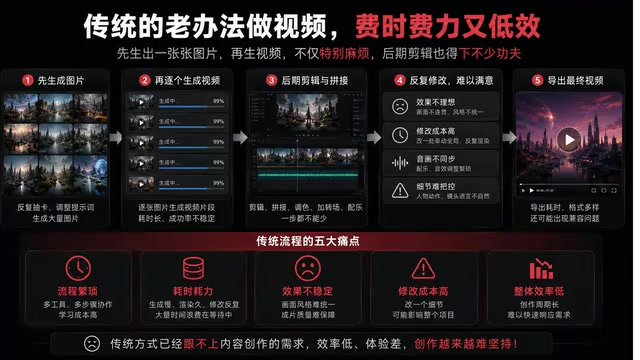
Cdance 2.0 revolutionizes AI short drama production with one-shot coherent video generation.
AI short drama production is undergoing a paradigm shift from frame-by-frame stitching to one-shot coherent generation. Traditional workflows suffer from low efficiency, poor visual continuity, and crude motion comic aesthetics. Released in 2025, the Cdance 2.0 video model leverages temporal diffusion model technology to deliver five core breakthroughs: one-shot complete video generation, automatic dubbing with sound effects, cross-shot character consistency, improved visual stability, and dramatically lower prompt engineering barriers — fundamentally restructuring AI short drama production methodology.
Introduction: The AI Short Drama Space Is Reshuffling Fast
If you're still using the old workflow of "generate images → write prompts → generate video frame by frame → edit and dub" to produce AI short dramas, frankly speaking, you've probably already fallen behind. The iteration speed of AI video generation technology far exceeds most people's expectations — production methods that were mainstream just a few months ago may already be completely obsolete today.
There are profound technical reasons behind this. AI video generation has undergone a major paradigm shift from GANs (Generative Adversarial Networks) to Diffusion Models. Early video generation relied on frame-by-frame image synthesis, where each frame required independent inference, resulting in extremely poor temporal coherence. After 2023, temporal diffusion models represented by Stable Video Diffusion and Sora began treating video as a spatiotemporal continuum, capable of simultaneously modeling motion relationships across multiple frames in Latent Space — this is what made "generating coherent video clips in one shot" possible. It's precisely this leap in underlying technology that has fundamentally restructured the entire production methodology for AI short dramas in just a few months.
This article will help you understand the latest technical approaches to AI live-action short drama production, with a focus on what tangible efficiency improvements Cdance 2.0 actually brings, and how to navigate the inevitable pitfalls in the production process.
Pain Points of Traditional AI Short Drama Production Workflows
Multi-Step Pipelines with Low Efficiency
The traditional AI short drama production workflow generally looks like this:
- Use AI tools to generate individual character or scene images
- Write detailed video prompts for each image
- Generate short video clips segment by segment based on images and prompts
- Manually stitch all clips together in editing tools like CapCut
- Separately add subtitles, voiceover, and background sound effects
Going through this entire pipeline is not only time-consuming and labor-intensive, but the final results are often mediocre at best. Visual continuity from stitching multiple images together is poor, dubbing requires separate processing, and the output frequently deviates from expectations.
The Motion Comic Approach Has Hit a Dead End
Before Cdance 2.0 appeared, many creators opted for a "motion comic" approach to AI short dramas. Essentially, this meant applying simple panning and zooming to static images and calling it done once voice audio was added.
From a technical standpoint, the motion comic approach is essentially applying Affine Transformations to static images — including translation, scaling, and slight rotation — combined with the Ken Burns effect (a slow pan-and-zoom technique commonly used in documentaries) to create a sense of movement. This approach involves no actual motion generation whatsoever; character limbs don't produce realistic skeletal movement, so the viewing experience differs drastically from real video. The generated videos have stiff character movements, with frames switching slowly like a PowerPoint presentation — the overall feel is quite rough.
As audiences' aesthetic expectations for AI video content have rapidly risen, this cheap-looking "pseudo-motion" is increasingly unacceptable. The market space for motion comic-style AI short dramas has shrunk significantly. If you're still producing content this way, you essentially have no competitive edge in the battle for traffic.

What Cdance 2.0 Brings: A Paradigm Shift in AI Short Drama Production
Five Core Advantages Broken Down
The Cdance 2.0 video model, released in February 2025, achieved qualitative leaps across multiple key aspects of AI live-action short drama production:
One-shot generation of complete video clips: Say goodbye to the era of frame-by-frame stitching. The model can directly output coherent video containing complete dramatic actions, eliminating a massive amount of post-production assembly work.
Automatic sound effects and character dialogue matching: The model can identify character features in the frame and automatically generate voice tones that match the character's appearance, while simultaneously layering in environmental sound effects. The dubbing step that used to be the most time-consuming can now essentially be done in one go.
Character consistency is now guaranteed: Through first/last frame control and the omnireference feature, the same character can maintain highly consistent appearance across different shots, eliminating the embarrassing "face swap" problem. The principle behind First/Last Frame Control is encoding user-provided reference images as condition vectors and continuously injecting this condition signal during the diffusion model's denoising process, constraining generated content to converge toward the visual features of the reference image — similar to how ControlNet works in image generation, but extended to the temporal dimension. The "omnireference" feature further allows users to provide multiple reference images simultaneously (e.g., character front view, side view, clothing details), using a multi-condition fusion mechanism to improve cross-shot appearance consistency, fundamentally solving the "same character, different face" problem that plagued early AI video.
Significantly improved visual stability: Generated videos no longer suffer from the old problems of frame collapse and sudden style shifts.
Dramatically lower prompt engineering barrier: No need to rack your brain writing complex English prompts — a few simple sentences in Chinese can generate decent quality video. Behind this change is the continued improvement in semantic understanding capabilities of next-generation Multimodal Large Language Models (MLLMs) — the model can automatically infer creative intent from natural language descriptions and internally convert them into structured instructions, so users no longer need to master specific "incantation syntax."

A Brand New Image-to-Video Workflow
Cdance 2.0 also introduces an interesting new approach: you can prepare a single reference image containing multiple scenes, and the model can understand the multiple scenes within it and transform them all into coherent video content.
This is fundamentally different from the traditional "one image generates one video clip" approach.
Related articles
 Product Reviews
The Programmer's Desk Setup Guide: Building a Workspace That Feels Like Home
Discover how programmers build productive, comfortable workspaces. From multi-monitor setups to ergonomic design, explore the desk philosophy that drives focus and flow.
 Product Reviews
Qoder vs Cursor Real-World Comparison: Which $20/Month AI IDE Is Better?
Hands-on comparison of Qoder vs Cursor AI IDEs: Agent autonomy, human interaction count, and architecture decisions. Qoder needed only 2 interactions vs Cursor's 8.
 Product Reviews
Cursor Cloud Agent Demo: Eliminating Bottlenecks Across the Entire Software Development Lifecycle
Deep analysis of Cursor's Cloud Agent demo showing how cloud VMs, automated test artifacts, and a full-chain control plane systematically eliminate human bottlenecks across the software development lifecycle.