AI Lù Xiǎofēi Hands-On Review: Building an HR Resume Screening Tool with Plain English — No Coding Required

AI Lù Xiǎofēi lets anyone build working business tools by describing needs in plain language — no coding required.
AI Lù Xiǎofēi is an AI product built around natural-language-driven development, created by a team with over 50 combined years of programming experience. Its goal is to let non-coders generate runnable business applications simply by describing what they need. A live demo showed an HR resume screening workbench built in minutes — from requirement description to UI generation and logic assembly — with no coding involved. The tool is positioned as an "information organizer and decision aid" that helps HR quickly map candidate fit and flag open questions, rather than replacing human judgment. The product is now in its launch phase with a low-cost entry offer, though performance on complex requirements, data security, and generation stability still awaits real-world validation.
No Coding Skills? No Problem: What AI Lù Xiǎofēi Is All About
AI Lù Xiǎofēi was built by a team with over 50 combined years of programming experience across Java, Python, C, C++, Go, and more. For the past year, they've been laser-focused on one question: how can someone with zero development background — no coding knowledge whatsoever — describe what they need in plain language and walk away with a working, even commercially viable product?
The team positions this product as "the world's first all-in-one programming agent suite." The concept is straightforward: you describe your product requirements in natural language, and AI Lù Xiǎofēi handles the building, running, refining, and delivery of a first working version. In other words, describing what you want replaces writing code.
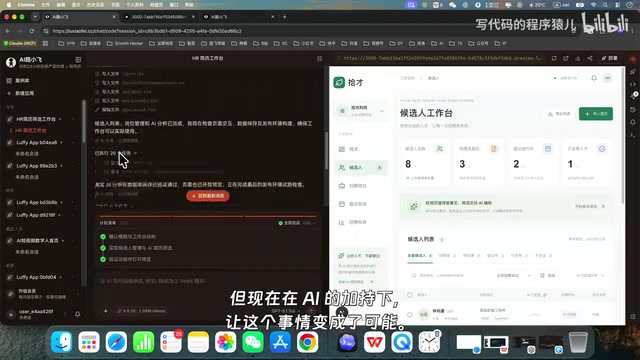
Many people see the word "programming" and immediately assume it has nothing to do with them — that's a developer's job. But the team highlights a widely overlooked truth: almost any business need can be addressed through software. From HR resume screening to sales data organization to personal productivity tools, these are all fundamentally software features. The barrier has simply been the requirement to engage a product manager, find a developer, and endure lengthy back-and-forth communication.
Live Demo: Building an HR Resume Screening Workbench from Scratch
The most compelling part of the demo video is the live build. Rather than staying at the conceptual level, the team directly constructed an HR resume screening workbench — entirely through natural language descriptions.
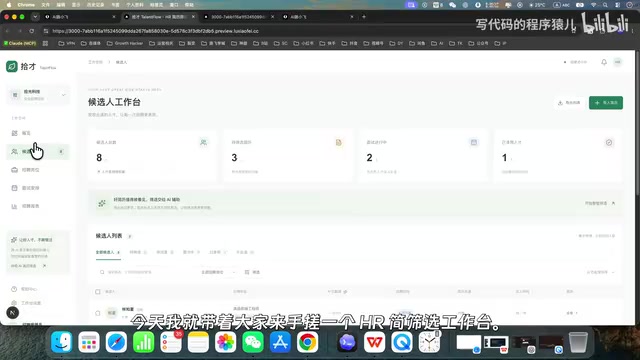
In the traditional approach, creating even a simple HR tool means finding a product manager, lining up a developer, and going through repeated rounds of requirement clarification — a process that can take days or even weeks. With AI Lù Xiǎofēi, the operator simply describes the need: "Build a resume screening tool — job requirements on the left, candidate resume on the right, automatically organize matching points, include confirmation checkboxes, and generate interview follow-up questions."
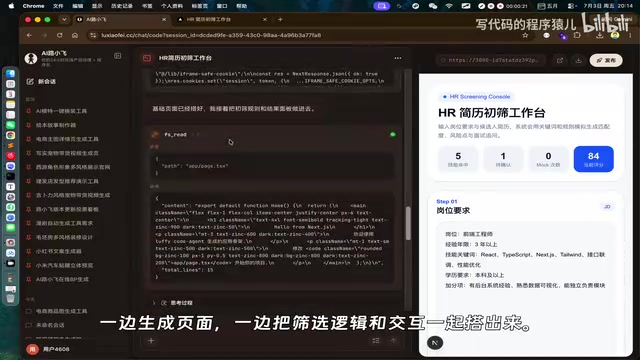
Once submitted, AI Lù Xiǎofēi simultaneously generates the page interface while assembling the screening logic and interactions. Within minutes, a fully functional workbench is ready to use — no code written at all.
The Real Capability Boundaries: Assistance, Not Replacement
Once the tool is generated, using it is intuitive: paste the job requirements and candidate resume into their respective sections, and the system presents the candidate's experience, skills, and project history side by side with the requirements — then provides a match score and interview recommendations based on the demo data.
Worth noting is its dynamic response capability. Swap in a different resume, and the score updates to reflect the differences between the job requirements and the new candidate's background, while flagging which key criteria need further verification.
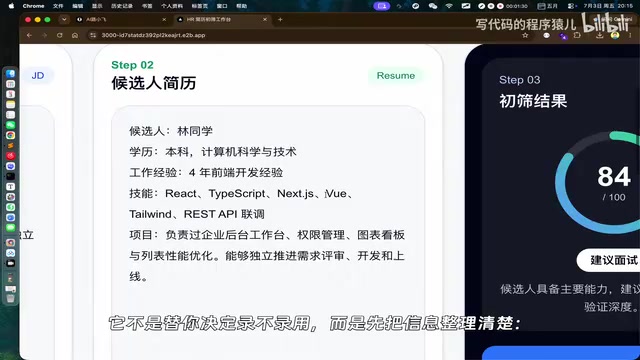
Here the team offers a grounded clarification of scope: the tool doesn't make the hiring decision for HR — it first organizes the information clearly, showing which criteria are matched and which need follow-up. This positioning actually aligns well with how recruiting really works. When HR communicates with hiring managers, they need to quickly articulate why a candidate is worth considering. A tool that clearly lays out matching points and open questions directly addresses that communication efficiency gap.
This "information organization + decision support" approach is far more pragmatic than claiming "AI automates hiring" — and far more likely to be adopted in real enterprise environments.
What This Means for Everyday Users
This demo illustrates the core value AI Lù Xiǎofēi is trying to deliver: lowering the barrier to software development from "knowing how to code" to "knowing how to describe what you need." The HR resume screening tool is just one example — the team encourages users to bring any business scenario they're currently handling manually, whether that's a travel assistant or other repetitive workflow, and let AI generate a custom tool for it.
That said, a single demo isn't enough to assess performance on complex requirements, long-term maintenance, or data security. The HR tool in the demo runs on sample data; parsing accuracy on real-world resumes and the interpretability of the scoring logic still need to be validated through actual use.
The product is currently in its launch and promotion phase. New registered members can get 200,000 tokens for just one cent (approximately $0.14), which the team says is sufficient to build several tools of similar complexity. For users who want to experiment with "building tools through plain language" at minimal cost, this is a low-barrier entry point.
Takeaway
AI Lù Xiǎofēi represents one approach to "agentification" in the low-code/no-code space: instead of dragging and dropping components, you describe your complete requirements in natural language, and AI generates a runnable application end to end. The live demo proves that basic business tools can genuinely take shape within minutes — but the true capability ceiling, the stability of generated products, and their commercial reliability all require validation across more real-world scenarios. For professionals bogged down by repetitive tasks, it at least offers a new option worth trying.
Background context: Low-code/no-code platforms are not a new concept — Salesforce, OutSystems, Microsoft Power Apps, and others have served the enterprise market for years, with visual drag-and-drop replacing hand-written code as the core paradigm. "Agentification" is a newer path that emerged over the past two years alongside the maturation of large language models. Instead of requiring users to piece together interfaces from a preset component library, an AI agent understands natural language intent, autonomously plans the approach, calls tools, generates code, and executes — with almost no manual intervention in the intermediate steps. The fundamental difference: the former lowers coding barriers but still requires users to understand software structure, while the latter aims to require only the ability to "describe a business problem." Tokens are the basic unit large language models use to measure text processing volume; in Chinese, one character corresponds to roughly 1.5–2 tokens. 200,000 tokens can theoretically support tens of thousands of characters of input and output interaction — sufficient, in principle, to generate several moderately complex business tools.
Related articles

Felix Rieseberg Personal Homepage
Felix Rieseberg's personal homepage sparks attention on Hacker News. This article covers the Slack engineer's technical background, the rise and fall of nativefier, and the value of a developer homepage as a tech calling card.

@ai-sdk/vue 3.0.306 Patch Release Syncs with [email protected] Update
@ai-sdk/vue 3.0.306 released, synced with [email protected]. A routine patch release for the Vercel AI SDK ecosystem with no public API changes; the Vue adapter layer stays version-aligned with the core package.

Gemini 4 Argon API Launches: The Era of Million-Token Output Begins
Google launches Gemini 4 Argon with sparse MoE architecture, up to 1M output tokens, and a 68.90% Vals Index score, available across API, AI Studio, and the Gemini app.