AI Model 'Performance Degradation' Concerns: How to Detect, Document, and Seek Recourse

How to detect AI model nerfing with baselines and what EU law says about it.
A Reddit developer shares their experience with Opus 5.5 appearing to degrade after launch, proposing a practical "nerf tracker" methodology: save exact prompts and outputs as a baseline on day one, re-test periodically, and chart quality against response speed. The post also analyzes whether quietly adjusting a model mid-subscription constitutes non-conformity under the EU Digital Content Directive, and points to broader industry questions around AI service transparency.
When a large model wows you at launch but feels noticeably "dumber" a week or two later — a phenomenon users call "nerfing" — it's becoming an increasingly hot topic among paid subscribers. A Reddit developer shared their firsthand experience with Opus 5.5, exploring how to quantitatively measure such changes, recognize the warning signs, and what recourse consumers may have under EU law.
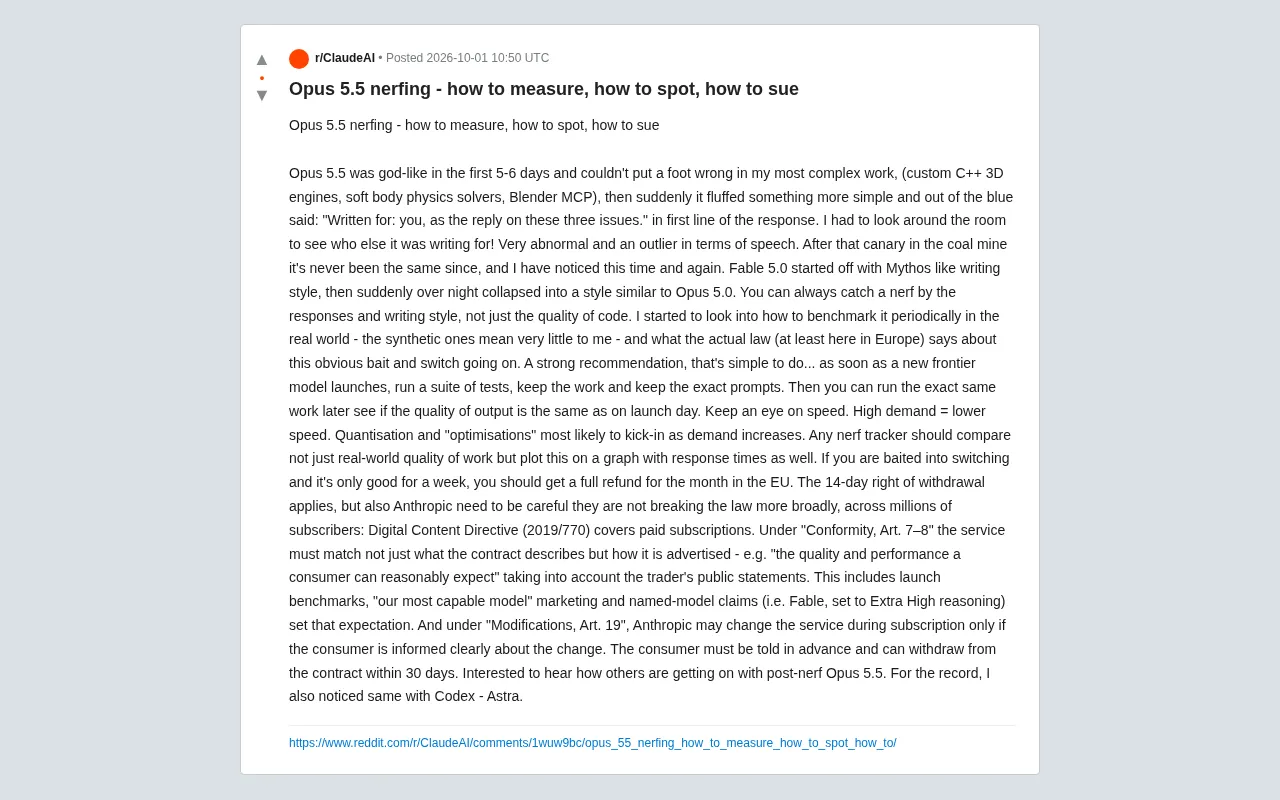
From "Godlike" to "Off the Rails": One Developer's Observations
This user's work environment is decidedly hardcore: a custom C++ 3D engine, soft-body physics solver, and Blender MCP integration. By their account, Opus 5.5 was "godlike for the first 5–6 days after release — zero mistakes on my most complex work."
The turning point came abruptly. While handling a relatively simple task, the model not only made errors but produced a bizarre opening line: "Written for: you, as the reply on these three issues." The user described "looking around to see who it was writing to" — this strange, contextually inappropriate phrasing became what they called a "canary in the coal mine," signaling a change in the model's behavior.
After that point, they say the model "never came back." They offered another example: Fable 5.0 initially had a "Mythos"-like writing style that collapsed overnight into something closer to Opus 5.0. In their view, judging a degradation isn't just about code quality — the wording and writing style of responses are often more sensitive indicators.
It's worth noting that these are one user's subjective impressions, unconfirmed by third-party benchmarks or any vendor statements.
How to Measure It: Building Your Own "Nerf Tracker"
This developer is skeptical of synthetic benchmarks — "they don't mean much to me" — preferring detection based on real workloads. The methodology they outline is actually quite practical:
The Core Approach: Lock in a Baseline
- Run your test suite the moment a new model launches: Execute a set of tasks as soon as a frontier model goes live.
- Save all outputs and prompts in full: Preserve your work results and exact prompts as a reference baseline.
- Re-test periodically: Run the same tasks with the same prompts later and compare whether output quality matches launch day.
Include Response Speed in Your Monitoring
They particularly emphasize the speed dimension: "High demand = lower speed." They suspect quantization and various "optimizations" are most likely to kick in when demand rises. A proper nerf tracker, therefore, shouldn't just log real-world quality — it should plot quality alongside response time to observe whether the two are correlated.
The value of this approach is that it transforms what could easily become a subjective "vibe" into recordable, comparable, presentable data. Whether or not it ultimately proves that degradation occurred, establishing a baseline is a healthy habit for any developer who seriously relies on LLMs.
Quantization refers to the technique of compressing the weight parameters in a neural network from high-precision formats (e.g., 32-bit or 16-bit floating point) down to lower-precision formats (e.g., 8-bit or even 4-bit integers). This compression can dramatically reduce VRAM requirements and inference computation, allowing more concurrent users to be served on the same hardware at lower per-inference cost. The trade-off is some loss of accuracy on certain tasks — particularly those sensitive to subtle linguistic style and complex reasoning chains. Large AI providers under rapid user growth will often quietly introduce quantized versions to handle compute pressure without any public announcement. This is precisely why response speed can serve as an indirect signal: when a server switches to a quantized model, inference typically speeds up (less computation), but output quality may simultaneously decline — the crossing point of those two curves may correspond to when the "nerf" occurred.
An EU Legal Perspective: Does This Count as "Bait and Switch"?
The most informative section of the post is the author's breakdown of EU consumer protection law. They argue that if users are subjected to a "bait and switch" — where service quality is good only for the first week — EU residents may be entitled to a full refund for that month.
They cite several specific legal grounds:
The 14-Day Right of Withdrawal and the Digital Content Directive
- The 14-day right of withdrawal applies to such transactions.
- The Digital Content Directive (2019/770) covers paid subscription services.
The Directive on Digital Content and Digital Services (Directive 2019/770, or DCDS) is EU consumer protection legislation passed in 2019 and transposed into member state law in 2022, specifically targeting the sale of digital products and services. Prior to this, EU consumer protection law largely covered physical goods, leaving digital subscriptions in a legal grey area. DCDS's core contribution is introducing the concept of "conformity" into the digital realm: operators must provide digital content that not only meets contractual specifications but also meets the quality standards consumers can reasonably expect based on public marketing materials. For AI subscription services, this means that launch demos, official benchmark figures, and marketing claims like "our most powerful model" could constitute implicit legal commitments to service quality. DCDS also requires that if an operator needs to make a substantial modification to a service, they must notify consumers in advance via a durable medium (e.g., email) and provide at least a 30-day window to withdraw from the contract.
Conformity Requirements (Articles 7–8)
As the author interprets them, services must conform not only to the contract description but to how they are advertised — that is, "the quality and performance which the consumer can reasonably expect," taking into account the operator's public statements. They argue that launch-day benchmarks, marketing language like "our most powerful model," and named model declarations (e.g., Fable set to Extra High reasoning) all contribute to that expectation.
Modification Clause (Article 19)
The author contends that Anthropic may only modify a service during a subscription period if it explicitly notifies consumers. Consumers must be informed in advance and allowed to withdraw from their contract within 30 days.
They conclude with a warning: with millions of subscribers, providers need to be careful when "optimizing" models to avoid running into broader legal exposure.
A reminder: these are the author's personal legal interpretations, not formal legal advice. Whether fluctuations in model performance constitute "non-conformity" in a legal sense, and whether quantization optimizations qualify as "modifications" requiring notification, involves significant unresolved ambiguity.
Not Just One Model: Industry-Wide Skepticism
The author closes by noting they've observed the same phenomenon with Codex - Astra, and invites others to share their experiences with a "post-nerf Opus 5.5." This reflects a broader community sentiment: as large models transition from "launch showcase" to "scaled service," dynamic scheduling and quantized deployment under inference cost and compute pressure are almost inevitable choices — and this creates a natural tension with users' expectation that "I paid for the model as it was on launch day."
Whether or not "nerfing" is real or rigorously provable, this conversation points to a question the industry needs to take seriously: transparency in AI services. When the core capabilities of a subscription product can shift with time and load, how providers communicate those changes to users — and how consumers can protect themselves — will likely remain an ongoing topic for quite some time.
Final Thoughts
For everyday users, the most actionable takeaway from this post is the simple methodology: establish a baseline when a new model launches, save your prompts and outputs, re-test periodically, and log response speed. It helps you produce evidence when a model feels like it's gotten worse, and gives you something concrete to stand on if you ever need to pursue recourse. Whether the legal route is viable will depend on your specific jurisdiction and circumstances.
Related articles

Chain of Thought Isn't Just for AI: How Humans Can Use CoT to Improve Thinking Quality
Chain of Thought isn't just a prompt trick for large models. Starting from a Hacker News discussion, this article analyzes why CoT works for human thinking too, breaks down actionable ways to transfer it, and highlights the key differences between human CoT and machine CoT.
Cloudflare Teams Up with OpenAI: Closi…
Cloudflare Teams Up with OpenAI: Closing the Loop from Vulnerability Discovery to Defense with AI
Cloudflare uses OpenAI Daybreak to investigate security vulnerabilities and generate reviewable remediation plans, while developers use Codex to boost coding efficiency and quality.

Orca Multi-Agent Orchestration in Practice: A Guide to Parallel Collaboration with Claude and Codex
Orca is Stable AI's free open-source agent workbench supporting 34 agents like Claude Code and Codex in parallel. Learn its Git worktree isolation, multi-model orchestration, and mobile management.