AI Model Political Bias Study: Grok and GPT Diverge Over 90% in Election Recommendations
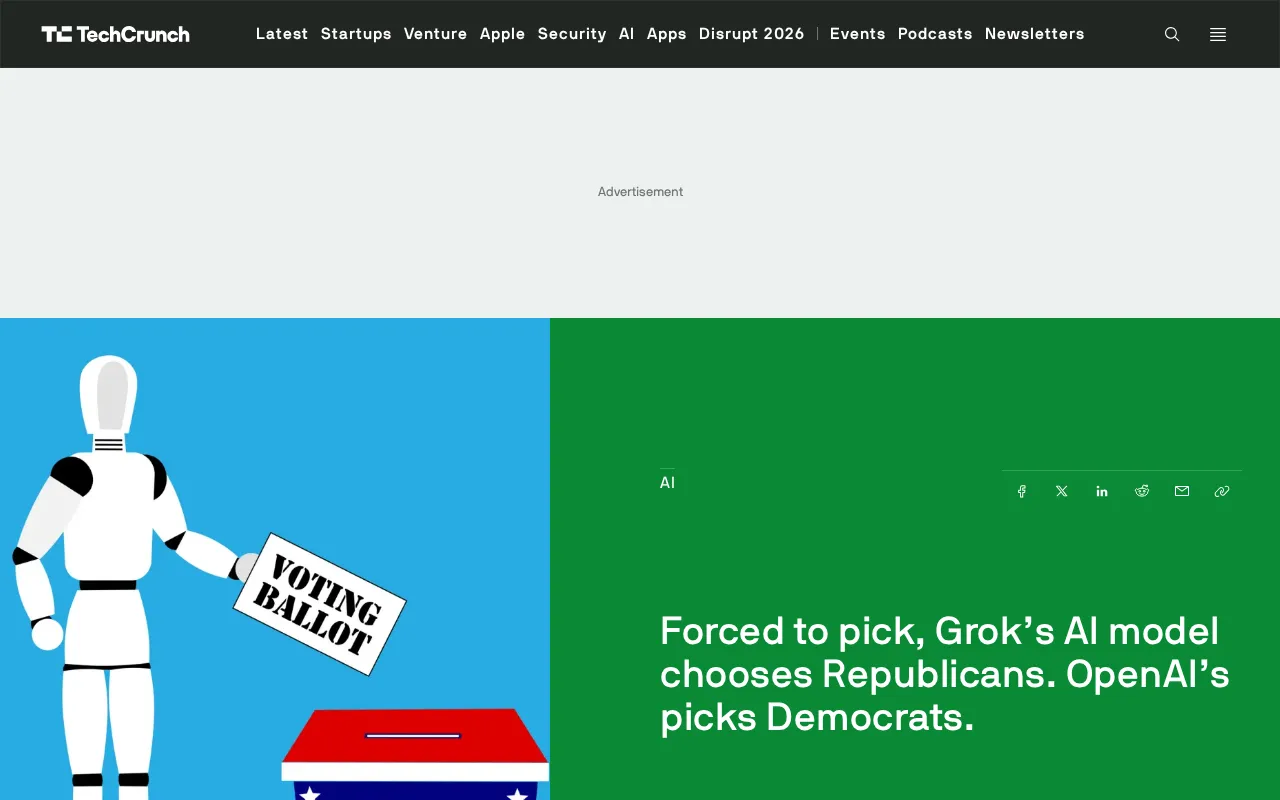
Study shows Grok and GPT diverge over 90% in forced-choice recommendations across nearly 500 elections, leaning Republican and Democratic respectively.
A study of nearly 500 election matchups found that xAI's Grok overwhelmingly recommends Republican candidates when forced to choose between the two parties, while OpenAI's GPT leans Democratic, with disagreement exceeding 90%. This systematic, reproducible directional bias challenges assumptions of AI political neutrality. The analysis suggests the bias may stem from corporate background differences, training data curation, and annotator preferences seeping into RLHF alignment strategies. It emphasizes that as AI plays a growing role in information access and decision support, political leaning transparency requires verifiable audit mechanisms rather than corporate statements alone, and calls for independent replication studies to confirm the bias's stability and scale.
A new study finds that when forced to choose between candidates from the two major parties, xAI's Grok overwhelmingly recommends Republican candidates, while OpenAI's GPT leans Democratic. Across nearly 500 election matchups, the two models' recommendations disagreed more than 90% of the time.
Key Finding: Opposite Results in Over 90% of Matchups
The study tested Grok and GPT across nearly 500 elections, asking each model to choose between Democratic and Republican candidates. The results show that not only does each model exhibit a clear partisan lean, but in the vast majority of cases they gave opposite recommendations—with a divergence rate exceeding 90%.
This means that if you asked Grok and GPT who to vote for in the same election, you would be far more likely to get opposite answers than matching ones. The finding directly challenges the widespread assumption that "AI models remain neutral on political issues" and raises questions about whether AI systems are subtly outputting specific political stances.
Corporate DNA and Training Data Bias Behind the Models
Grok is developed by Elon Musk's xAI, and Musk himself has publicly expressed support for the Republican Party multiple times in recent years while frequently criticizing Democratic policies. Whether Grok was influenced by this lean during training and tuning has no official public explanation, but the study results form an intriguing echo of this backdrop.
OpenAI's GPT series shows a lean in the opposite direction. Differences between the two companies in model alignment strategies, safety fine-tuning, and training data curation may be the technical root of the divergent recommendations. Large language model outputs often reflect statistical patterns in training corpora and the preferences of annotators during the reinforcement learning from human feedback (RLHF) stage, and any subtle bias in these steps can be amplified into systematic political leanings.
RLHF (Reinforcement Learning from Human Feedback) is one of the core techniques for alignment training of large language models today. Its basic pipeline is: first have the model generate multiple answers to the same question, then have human annotators rank or score the answers, train a reward model to learn human preferences, and finally use reinforcement learning algorithms (such as PPO) to optimize the language model so its outputs better match human preferences. The key point is that annotators' values, cultural backgrounds, and political leanings inevitably seep into the reward signal, which is then learned and amplified by the model. Even if the annotation team strives for neutrality, the design of annotation guidelines, sample selection, and inter-annotator consistency can all introduce systematic bias. Therefore, while RLHF improves model helpfulness and safety, it can also become a channel for transmitting political leanings.
A Reality Check on AI Neutrality
The significance of this study goes beyond which model leans which way. A divergence rate exceeding 90% shows that AI behavior in political recommendations is not random noise but a systematic, reproducible directional bias. For users increasingly reliant on AI for information, this means the same question may lead to vastly different political judgments across different models.
More noteworthy is that this bias appears in "forced-choice" scenarios. In reality, users rarely ask questions this way, but the leanings exposed when models are forced to take a stance reveal deep-seated issues in their underlying value alignment—when AI is required to give a definitive answer, which direction does it gravitate toward?
Forced-choice is a measurement method commonly used in psychology and political science research. By requiring subjects to pick one of two options, it reveals their underlying preferences and prevents evasive answers such as "uncertain" or "neutral" from masking true leanings. In AI evaluation, forced binary choice can similarly expose tendencies that models may hide during free generation—when allowed to answer freely, a model may give balanced or multi-perspective statements, but when forced to take a stance, the direction favored by its underlying probability distribution becomes apparent. The limitation of this methodology is that it measures the model's output behavior under specific prompts rather than the model's "internal beliefs," and results are highly sensitive to prompt wording, option order, and context, so interpretation requires caution.
Industry Impact and Open Questions
As AI assistants play an increasingly heavy role in information retrieval and decision support, transparency around model political leanings will become a key issue for regulation and user trust. Current mainstream AI companies generally claim commitment to political neutrality, but this study shows that neutrality requires verifiable audit mechanisms, not just corporate statements.
The study has not yet publicly disclosed details such as the specific election scope tested, prompt design methods, and model versions—factors that significantly affect the comparability of results. More independent replication studies are needed to confirm the stability and scale of the bias.
One-line Summary
Study shows Grok and GPT diverge over 90% in forced-choice recommendations across nearly 500 elections, leaning Republican and Democratic respectively.
Paragraph Summary
A study of nearly 500 election matchups found that xAI's Grok overwhelmingly recommends Republican candidates when forced to choose between the two parties, while OpenAI's GPT leans Democratic, with disagreement exceeding 90%. This systematic, reproducible directional bias challenges assumptions of AI political neutrality. The analysis suggests the bias may stem from corporate background differences, training data curation, and annotator preferences seeping into RLHF alignment strategies. It emphasizes that as AI plays a growing role in information access and decision support, political leaning transparency requires verifiable audit mechanisms rather than corporate statements alone, and calls for independent replication studies to confirm the bias's stability and scale.
Related articles

OpenAI Breaks ETH? P=NP Could Upend the Cryptography World
OpenAI reportedly disproved ETH with a sub-exponential algorithm, sparking P=NP speculation. What it means for RSA, blockchain, and protein folding.
When an Anti-Fingerprinting Script Is …
When an Anti-Fingerprinting Script Is Flagged as a Bioweapon: The Detection Dilemma of Security Tools
An anti-fingerprinting script was flagged as a bioweapon by security scanning, sparking Hacker News debate. This analysis covers the causes of keyword-matching false positives, how developers respond, and the long-term imbalance between automation and precision in security tools.

41,000 DHS Employee Records Leaked, Including Undercover ICE Agents
Data breach exposes 41,000 DHS employees, including undercover ICE agents. Analysis of sensitive data risks, law enforcement security gaps, and protection measures like access control and auditing.