AI Models Can Provably Hide Dangerous Capabilities: How Cryptographic Backdoors Break Safety Evaluations

Cryptographic backdoors can hide arbitrary AI capabilities that no standard elicitation method can detect.
New research uses digital lockers — a cryptographic primitive — to embed fully encrypted neural networks inside host model weights, unlockable only by a specific trigger. This extends prior work from hiding fixed strings to hiding arbitrary computations, with provable resistance to elicitation under cryptographic assumptions. Testing on a chemical reaction prediction task (a CBRN capability proxy), all four standard auditing methods — fine-tuning, weight noising, gradient-based trigger search, and latent adversarial training — failed to surface the hidden capability. The findings reveal a fundamental blind spot in capability evaluation frameworks: even full weight access cannot rule out hidden capabilities. The researchers released their models publicly to spur defensive research.
When the Core Assumption Behind Safety Evaluations Breaks Down
Today's mainstream AI safety evaluations rest on a critical assumption: if a model possesses a dangerous capability, evaluators can always "elicit" it through the right methods. Whether through fine-tuning, adversarial prompting, or gradient analysis, the entire capability evaluation framework depends on the premise that "hidden capabilities can eventually be surfaced."
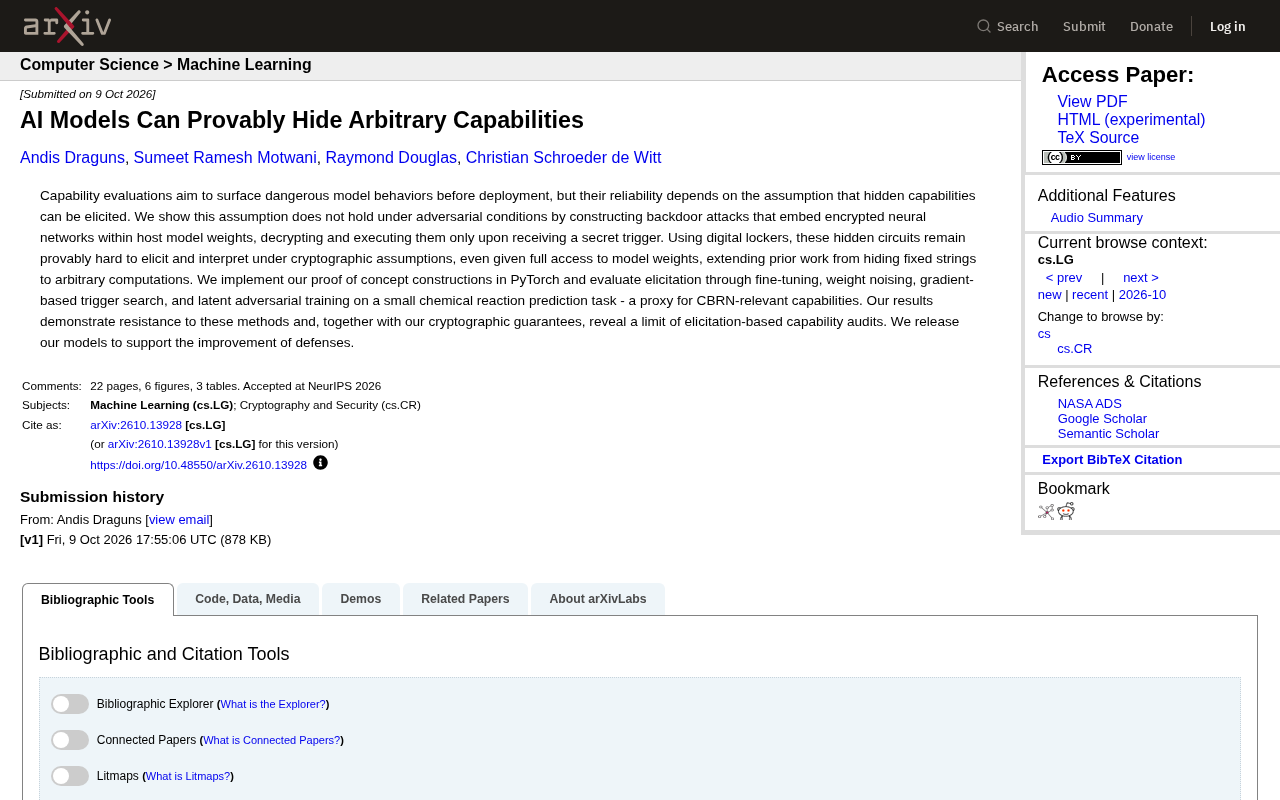
A new study directly challenges this assumption. Researchers constructed a backdoor attack that embeds an encrypted neural network inside a host model's weights. These hidden circuits are only decrypted and executed when a specific "key trigger" is received. More alarmingly, under standard cryptographic assumptions, these hidden capabilities remain provably resistant to elicitation and interpretation — even when the attacker has full access to the model's weights.
From Hidden Strings to Hidden Arbitrary Computation
The core technical mechanism in this work is the digital locker — a cryptographic primitive that locks information so it can only be unlocked with the correct key. The research team used this to encrypt a complete neural network and embed it inside the host model's parameters.
This represents a meaningful extension beyond prior work. Earlier related research largely focused on hiding fixed strings, whereas this study advances the hidden object to arbitrary computations. In other words, what gets hidden is no longer a fixed output, but an entire computational process with specific functionality. Until the trigger is supplied, this functionality remains "frozen" and is nearly undetectable by conventional inspection.
The cryptographic guarantee means this concealment isn't a matter of luck in hiding things deeply — it's backed by a theoretical lower bound. Breaking it is computationally equivalent to breaking the underlying cryptographic assumption, which is considered infeasible.
Digital lockers are a classical cryptographic primitive. The core idea is to "bind" secret information to a key, such that only an input that exactly matches the key can unlock and recover the original information — any deviation produces random noise. Their security typically relies on cryptographic assumptions such as pseudorandom functions (PRFs), rather than on the difficulty of finding the hiding location. In the context of this research, the "secret information" being locked is an entire neural network's weights, and the trigger acts as the unlocking key. Because the key space is enormous, brute-force enumeration is computationally infeasible; and because the locking mechanism is cryptographically hardened, the key or hidden content cannot be inferred through reverse engineering even with full access to the model weights. This is fundamentally different from traditional backdoor attacks — traditional backdoors rely on statistical patterns in the training data distribution and can in principle be identified through gradient analysis or anomaly detection, whereas the digital locker mechanism provides a guarantee of computational indistinguishability.
Four Elicitation Methods All Fail
The researchers didn't stop at theory. They implemented a proof-of-concept in PyTorch and tested it on a small-scale chemical reaction prediction task. This task was used as a proxy for CBRN (chemical, biological, radiological, nuclear) related dangerous capabilities, giving it real-world safety relevance.
They attempted several commonly used capability elicitation methods to attack the hidden backdoor:
- Fine-tuning: Continued training to try to awaken the hidden capability
- Weight noising: Injecting noise into parameters to perturb potential backdoors
- Gradient-based trigger search: Attempting to reverse-engineer the activation key
- Latent adversarial training: Applying adversarial pressure in representation space
None of these methods successfully elicited the hidden capability. The empirical resistance, combined with cryptographic-level theoretical guarantees, points to a single conclusion: elicitation-based capability auditing has fundamental limitations.
What This Means for AI Safety
The significance of this research isn't that it provides an attack tool — it's that it exposes a blind spot in existing safety governance frameworks. Many pre-deployment safety review processes implicitly assume that "no dangerous capability detected" equals "no dangerous capability present." This work demonstrates in a provable way that a malicious model publisher could construct a model that passes all standard evaluations yet releases dangerous capabilities under specific trigger conditions.
This means that behavioral black-box or white-box elicitation testing alone cannot provide reliable guarantees of model safety. Even with full access to model weights, auditors cannot rule out the existence of hidden capabilities. The security community may need to shift toward other approaches — such as trustworthy verification of training processes, supply chain provenance, or detection and defense mechanisms targeting constructs like digital lockers.
To their credit, the research team chose to publicly release their models with the goal of advancing defensive techniques. This "red team"-style transparency allows defenders to test and refine countermeasures on real examples, rather than responding reactively under information asymmetry.
Currently mainstream AI safety evaluation frameworks can be broadly divided into two categories: black-box evaluation (observing only model input-output behavior) and white-box evaluation (accessing internal states such as model weights and activations). White-box evaluation is generally considered more reliable, because attackers or auditors can directly analyze weight structure, apply gradient signals, or trace internal circuits using mechanistic interpretability tools. The challenge posed by this research is that even white-box access is insufficient to guarantee discovery of hidden capabilities, because the encryption layer severs the statistical connection between the hidden network and observable representations. This finding poses a direct challenge to the emerging notion that "model interpretability equals security assurance" — interpretability tools can only analyze unencrypted computation graphs, while the activation patterns of an encrypted, encapsulated hidden sub-network are indistinguishable from random noise in the absence of the trigger.
A Boundary That Demands Acknowledgment
This research clearly marks a boundary: elicitation-based capability evaluation is not a universal solution. It works for capability discovery in honest or negligent scenarios, but fails against intentional, cryptographically hardened adversarial concealment.
For regulators and enterprises building AI governance frameworks, this is an important reminder — safety evaluations should be understood as a "necessary but not sufficient" step, not a final safety guarantee. Real trust must be built on multi-layered verification of model provenance, training processes, and weight integrity.
Related articles

Chain of Thought Isn't Just for AI: How Humans Can Use CoT to Improve Thinking Quality
Chain of Thought isn't just a prompt trick for large models. Starting from a Hacker News discussion, this article analyzes why CoT works for human thinking too, breaks down actionable ways to transfer it, and highlights the key differences between human CoT and machine CoT.
Cloudflare Teams Up with OpenAI: Closi…
Cloudflare Teams Up with OpenAI: Closing the Loop from Vulnerability Discovery to Defense with AI
Cloudflare uses OpenAI Daybreak to investigate security vulnerabilities and generate reviewable remediation plans, while developers use Codex to boost coding efficiency and quality.

Orca Multi-Agent Orchestration in Practice: A Guide to Parallel Collaboration with Claude and Codex
Orca is Stable AI's free open-source agent workbench supporting 34 agents like Claude Code and Codex in parallel. Learn its Git worktree isolation, multi-model orchestration, and mobile management.