AI Models Compete on More Than Capability: GPT-6.2 Astra and Gemini 4 Neon Lead the Cost-Saving Race
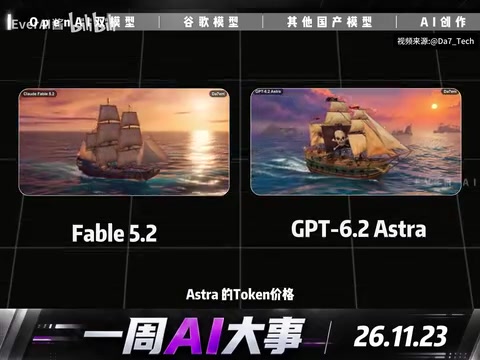
This week's new models push per-task cost and efficiency to the forefront, as the AI race shifts to a multi-dimensional balance of capability and cost.
Models released in quick succession this week show AI competition shifting from pure capability to efficiency and per-task cost. OpenAI pairs GPT-6.2 Astra and Soul: Astra's token price drops 20%, and Soul costs one-fifth of Astra. Google Gemini 4 Neon tops the AA Coding Agent leaderboard at 58.6, three times Carbon's speed at only 60% cost. Alibaba Qwen 4 Max uses 35% fewer tokens and cuts per-task cost ~60%; Tencent Member 4S targets low-cost office work at one-thirteenth the cost of its predecessor. Meanwhile, AI creation tools push image quality toward 4K/8K. The article argues that once capability reaches a certain level, per-task cost constrains scale, and model selection should shift to finding the optimum between capability and cost based on task complexity.
Title
AI Models Compete on More Than Capability: GPT-6.2 Astra and Gemini 4 Neon Lead the Cost-Saving Race
The competitive winds in AI models are shifting in a subtle but crucial way. In the past, we were used to checking benchmark leaderboards to see who was smarter, but several models released in quick succession this week have put "saving money" on equal footing with "capability." From OpenAI's GPT-6.2 Astra to Google's Gemini 4 Neon, and on to Alibaba's Qwen 4 Max and Tencent's Member 4S domestically, an efficiency race centered on per-task cost has begun.
OpenAI's Dual-Model Strategy: Astra for Professional Work, Soul for Everyday Tasks
OpenAI served up two models this week, GPT-6.2 Astra and Soul, forming a high-low pairing. Astra is positioned as the flagship, focused on complex professional tasks, directly targeting [competitor] 5.2, and taking first place with 1318 points in 3D scene evaluation. But more noteworthy is that its token price is 20% lower than the previous generation. This means that while maintaining top-tier capability, the barrier to use is coming down.
Soul, responsible for everyday tasks, pushes cost-effectiveness to another extreme. According to a Bilibili video, Soul's scores on some coding tests approach Astra's, yet its cost is only one-fifth of the latter. This "flagship + lightweight" combination punch is effectively telling the market: not every task needs the most expensive model, and scenario-based matching is the key to efficiency.
Google Gemini 4 Neon: Trading Speed for Cost, Topping the Coding Agent Leaderboard
Google's Gemini 4 Neon is positioned between Carbon and Hydrogen. It is not the smartest in the family, yet it topped the AA Coding Agent leaderboard with 58.6 points. This result shows that for specific task types, "smart enough" plus "fast and cheap enough" may have more practical value than "the smartest."

According to Google's tests, Neon's task completion speed is about three times that of Carbon, while its cost is only 60%. This combination is quite attractive to developers who need high-frequency calls to coding agents—higher speed means shorter waits and higher throughput, while lower cost directly improves unit economics.
In the AA Coding Agent leaderboard, "AA" refers to Artificial Analysis, an independent third-party AI model evaluation organization that maintains multiple leaderboards covering dimensions such as overall capability, coding agents, and inference cost. Unlike vendor self-testing, AA's leaderboards are based on standardized tasks and a unified evaluation process, so developers often use them as a reference for horizontal comparison. The coding agent leaderboard especially focuses on a model's end-to-end performance in real code tasks, including understanding requirements, calling tools, writing and debugging code, with scoring combining task completion rate and efficiency. This is why Neon topping the list with 58.6 points is worth noting—it shows that in the specific scenario of coding, optimizations in speed and cost can directly translate into leaderboard competitiveness.
Domestic Models Follow Suit: Qwen 4 Max and Member 4S Each Play Their Own Game
Alibaba's Qwen 4 Max has risen to the front ranks of domestic models on the Arena Agent leaderboard, performing strongly in coding, tool calling, and complex tasks, and can also assist with 3D modeling, game development, and AI video storyboard creation. According to Alibaba's internal tests, it uses 35% fewer tokens than the previous generation, with per-task cost reduced by about 60%.

Tencent's Member 4S model focuses on low-cost office work, targeting high-frequency office scenarios such as PPT processing, document editing, and spreadsheet handling. According to Tencent's internal tests, its per-task cost is only one-thirteenth of Member 4 Billion Blue Edition. This figure means that for repetitive tasks such as office automation, cost has been pushed down to an almost negligible level.
"Agent" refers to an AI system capable of autonomously planning steps, calling external tools, and completing multi-step tasks, rather than merely doing single-turn Q&A. In agent scenarios, the model needs to repeatedly reason, call tools, observe results, and adjust strategies; a single task often generates multiple rounds of interaction, with token consumption far higher than ordinary conversation. Therefore, rankings on agent leaderboards not only reflect how "smart" a model is but also its planning efficiency and tool-calling accuracy in multi-step tasks. Qwen 4 Max's performance on the Arena Agent leaderboard shows that it has strong practical capability in tasks requiring multi-step collaboration, such as coding and tool calling, and such capabilities are especially critical for complex workflows like 3D modeling assistance and game development.
Efficiency and Cost Become New Competitive Dimensions
Putting these pieces of information together, a clear trend emerges: the arena of model competition is no longer focused solely on "who is smarter"; efficiency and per-task cost are becoming equally important evaluation dimensions.

There is a practical logic behind this shift. Once model capability reaches a certain level, what constrains large-scale commercial adoption is often not "whether it can do it" but "how much it costs to do it once." Metrics such as token price, task completion speed, and per-task cost directly determine whether an AI application can achieve a viable commercial loop. OpenAI uses Astra and Soul for tiering, Google uses Neon to balance speed and cost, and Alibaba and Tencent lower costs in their respective advantage scenarios—essentially different plays in the same competition.
For developers and enterprises, the logic of model selection also needs to adjust accordingly: no longer fixating only on the strongest model, but finding the optimal solution between capability and cost based on task complexity and call frequency.
"Per-task cost" is not simply the token unit price, but the total expense consumed to complete a typical task, equal to the token unit price multiplied by the number of tokens required for the task. Even if two models have the same unit price, if one uses fewer tokens due to more efficient reasoning and more concise output, its per-task cost will be lower. This is precisely the significance of Qwen 4 Max's "35% fewer tokens" being cited alongside "60% lower cost"—the former is an efficiency metric, the latter an economic result. For high-frequency call scenarios, small differences in per-task cost are amplified by call volume and directly determine whether an application can be profitable, so it reflects commercial value better than benchmark scores.
AI Creation Tools Also Push Toward High Image Quality
Beyond the efficiency race at the model layer, the AI creation world this week also entered the era of film-grade high quality. The 4K mode API of AI video tool Seedance 2.5 is fully open, while AI image generation has been pushed to 8K ultra-high definition, with Kelin Image 4.0 released this week. The upper limit of image quality for creation tools keeps being raised, complementing the cost decline at the model layer—making generation cheaper on one hand and output more refined on the other.
This week's updates send a signal: competition in the AI industry is shifting from single-point capability breakthroughs to a multi-dimensional balance of capability, efficiency, and cost. Whoever can push costs to the lowest at a sufficient level of intelligence may seize the initiative in the next stage of large-scale application.
Related articles

The Complete Codex Tutorial: From Installation to Real-World Practice — Build an All-Purpose AI Assistant from Zero
A beginner-friendly Codex guide based on an in-depth Bilibili tutorial — covering installation, account setup, projects and conversations, permission modes, plugins and skills, automation, worktrees, browser and computer control, AGENTS.md rules, and a complete website build-and-deploy practice.
Ternary Bonsai 2.5 27B: A Ternary Quantized Model Sparks Discussion
PrismML releases Ternary Bonsai 2.5 27B, a ternary quantized model that sparked 296 points on Hacker News. We analyze its technical traits, community reaction, and significance for local deployment.
FinCEN Discloses Cybersecurity Incident: Some Systems Suffered Unauthorized Access
FinCEN, under the U.S. Treasury, discloses a cybersecurity incident, confirming unauthorized access to some systems. This article analyzes the disclosure details, the sensitivity of FinCEN data, and the potential impact on financial institutions.