AI Models Don't Have to Be Products, But They're the Prime Mover Behind Everything

AI models don't have to be products themselves, but they're the irreplaceable prime mover driving all applications.
This article explores a core question in AI business models: models are powerful enough to recede into the background as infrastructure, yet they determine the ceiling of the entire application ecosystem. The real commercial value lies in the application layer built around models — including product experience, data flywheels, and glue-layer engineering like RAG. Winners in the AI era must simultaneously understand model capability boundaries and build exceptional product experiences.
A Deep Reflection on AI Business Models
Recently, a widely discussed tweet put forward a seemingly contradictory yet remarkably insightful observation: Precisely because AI models are good enough and continuously improving, they don't have to be products themselves — but the model is the true prime mover.
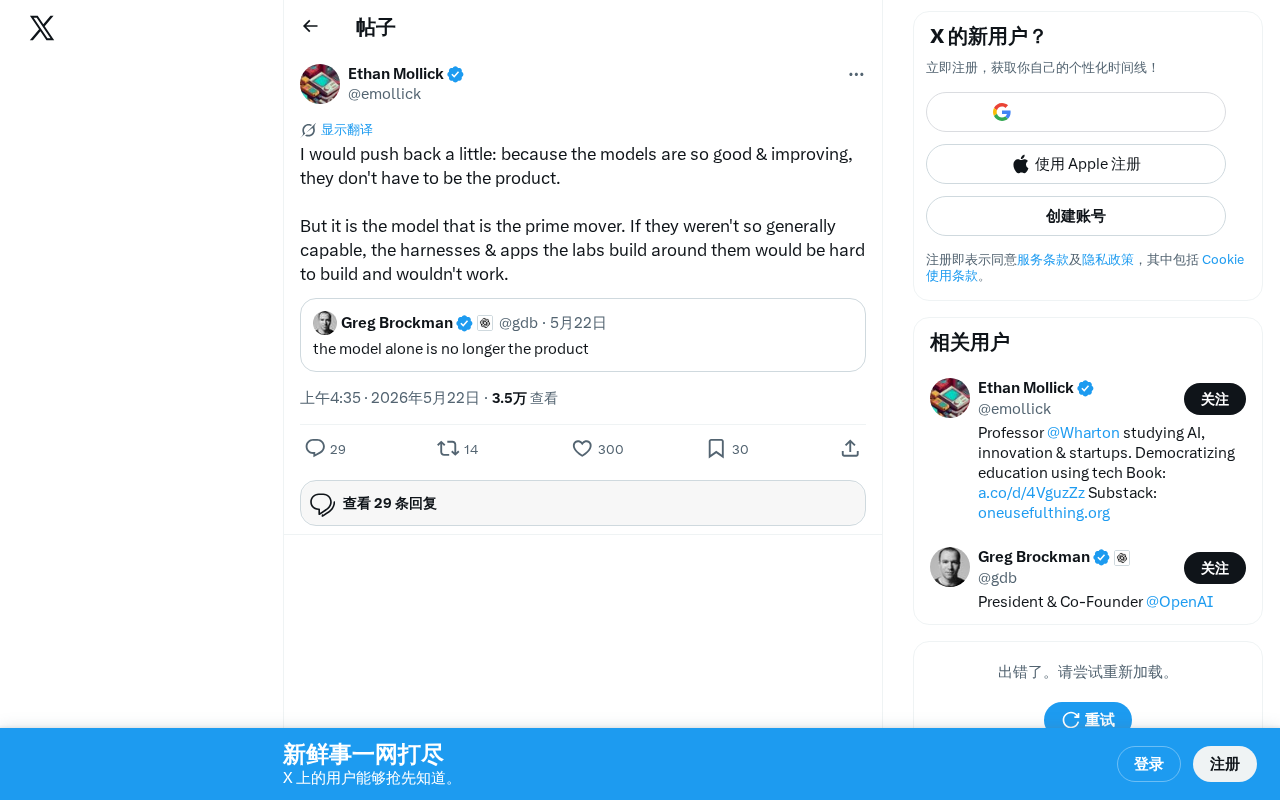
This brief comment touches on one of the most critical strategic questions in today's AI industry: In an era of rapidly advancing large models, where does the real value lie? Is it in the models themselves, or in the applications and tools built around them?
Models Don't Have to Be Products, But Without Models There Are No Products
The elegance of this perspective lies in its simultaneous acknowledgment of two seemingly opposing facts:
First, models can recede into the background. Once a large model's general capabilities reach a certain level, it becomes like electricity or the internet — a form of infrastructure. Users don't need to care whether GPT-4, Claude, or Gemini powers things behind the scenes; they care about whether the final product solves their actual problems. This means AI labs don't necessarily have to sell models directly as consumer-facing products.
It's worth noting that the "infrastructure-ization" of large models is not the same as "commoditization." Infrastructure-ization means technology becomes the underlying support for how society operates, without users needing to perceive its existence; commoditization means the differences between technology providers disappear, and price becomes the only competitive dimension. Electricity is infrastructure, but enormous technical barriers and cost differences still exist between power generation technologies (nuclear, hydroelectric, solar). Understanding this distinction is crucial for assessing the long-term commercial value of AI large models — current leading models still show significant differences in reasoning capabilities, multimodal understanding, context windows, and other dimensions, remaining far from true "commoditization."
Second, the model is the irreplaceable prime mover. If the underlying models lack sufficiently powerful general capabilities, the various frameworks, toolchains, and applications built around them will be difficult to develop, and even if forced into existence, they won't function properly. In other words, the capability boundaries of large models determine the ceiling of the entire AI application ecosystem.
The "Harness" Mindset: The Real Competitive Edge in the AI Application Layer
The original text uses a very interesting word — "harness." The metaphor is apt: the model is a powerful horse, and the harness is the critical equipment that enables the horse to pull a carriage and serve human needs.
This is exactly the AI industry trend we're seeing in 2024-2025:
- OpenAI has shifted from being a pure model provider to building consumer and enterprise products like ChatGPT, the GPTs ecosystem, and Operator
- Anthropic has launched application-layer capabilities like Claude's Computer Use and the MCP protocol
- Google has deeply integrated Gemini into its existing product matrix including Search, Workspace, and Android
Among these, Anthropic's MCP (Model Context Protocol), introduced in late 2024, deserves particular attention. MCP is an open standard designed to standardize how AI models interact with external tools and data sources. Analogous to how USB unified hardware connection standards, MCP attempts to establish a unified protocol layer for AI "tool calling." The strategic significance of this move is clear: once MCP becomes an industry standard, Anthropic secures a key position in the infrastructure layer of the application ecosystem, rather than being merely a model provider. This is a textbook example of the "harness" mindset — expanding the model's application boundaries by defining connection specifications, extending competition from the model itself to the entire tool ecosystem.
These AI labs are all doing the same thing: building differentiated application layers on the foundation of powerful models. The model is the engine, but what users buy is the whole car.
Practical Insights for AI Entrepreneurs and Developers
This perspective offers direct guidance for entrepreneurs and developers in the AI space:
Don't Underestimate the Leverage Effect of Large Model Capabilities
Many AI applications that were infeasible two years ago failed not because nobody thought of them, but because model capabilities weren't sufficient. As large models continue to advance, previously "impossible" application scenarios will keep getting unlocked. Entrepreneurs should maintain sensitivity to the frontier of model capabilities and position early for application directions that are "about to become feasible."
But Don't Bet Everything on the Model Either
Since models don't have to be products, building moats purely based on model capability differences is dangerous. True competitive advantages come from: deep understanding of specific domains, quality data flywheels, excellent product experience design, and systems engineering capabilities built around models.
The Data Flywheel is one of the hardest moats to replicate. The logic is: increased product usage → more user data accumulated → used to improve models or personalize experiences → better product → attracts more users, forming a positive feedback loop. Take GitHub Copilot as an example: Microsoft continuously optimizes code generation quality through massive amounts of real code completion accept/reject feedback data. This kind of data accumulation based on real usage scenarios is something competitors relying purely on foundation model capabilities find hard to match. For AI entrepreneurs, establishing your own data flywheel early often holds more strategic value than chasing model capabilities themselves.
Pay Attention to the Commercial Value of the "Glue Layer"
Between large models and end users, there's an enormous amount of "glue layer" work: prompt engineering, RAG architecture, safety filtering, result post-processing, multi-model orchestration, and more. These seemingly unglamorous engineering tasks often determine an AI product's actual performance and user retention.
Take RAG (Retrieval-Augmented Generation) as an example — it's one of the most important engineering paradigms in the current AI application layer. The core idea is: before querying a large model, first retrieve relevant document fragments from an external knowledge base, then feed these fragments as context along with the query, enabling the model to answer questions beyond its training data while significantly reducing "hallucination" phenomena. The quality of RAG architecture — including vector database selection, chunking strategies, retrieval algorithms, and re-ranking mechanisms — directly determines the practical usability of enterprise AI applications. A product with finely-tuned RAG engineering can often achieve user experiences far surpassing competitors on the same underlying model, which perfectly illustrates the commercial value of the "glue layer."
AI Business Model Evolution Through the Lens of Technology History
If we zoom out, this discussion actually reflects a pattern that repeatedly appears throughout technology history: the tension between the value of foundational technology and the value of the application layer.
Semiconductor chips are the prime mover of computing, but Intel's market cap is far less than Apple's. Behind this comparison lie deep structural reasons: Intel's customers are OEM manufacturers, competing on performance/watt and manufacturing process; Apple's customers are end consumers, competing on experience, brand, and ecosystem lock-in. Intel's market cap in 2024 was approximately $100 billion, while Apple's exceeded $3 trillion — the essence of this enormous gap is the fundamental difference in business models between B2B infrastructure suppliers and B2C ecosystem builders. Relational databases are the cornerstone of enterprise software, but Oracle's influence doesn't match Salesforce's contribution to enterprise digitization. In every technology revolution, the foundational layer provides possibility, while the application layer captures most of the commercial value.
Will AI replay this pattern? For now, the answer is uncertain. Unlike previous eras, AI large models possess extremely strong generality and autonomy, making the boundary between "foundational layer" and "application layer" more blurred than in any previous technology. OpenAI is both a model provider and an application developer; the same ambiguity exists for Google, Meta, and others. More critically, these companies simultaneously play the dual roles of "Intel" and "Apple," attempting to establish moats at both the foundational and application layers — something virtually unprecedented in technology history, with the ultimate value distribution still awaiting market validation.
Conclusion: The Winning Logic of the AI Era
"Models don't have to be products, but models are the prime mover" — the value of this statement lies in avoiding two extremes: it neither falls into the technological worship of "the model is everything," nor into the simplistic narrative of "models will be commoditized." It reminds us that in the AI era, the true winners will be teams that both deeply understand the capability boundaries of large models and can build exceptional product experiences on that foundation.
Key Takeaways
- AI models are powerful enough that they don't need to be direct products, yet they remain the core prime mover driving all applications
- The "infrastructure-ization" of models is not equivalent to "commoditization"
Related articles
Meta Muse Hits 900K Downloads in Six D…
Meta Muse Hits 900K Downloads in Six Days: The AI Agent Era Has Officially Arrived
Meta's AI agent Muse hit 902K downloads in 6 days, topping US App Store and Google Play charts above ChatGPT and Claude. A deep dive into Muse's capabilities and the AI Agent race.
 Industry Insights
IRS Fully Embraces Claude AI, Accelerating Federal Government's AI Adoption
The IRS is recruiting staff with 24/7 Claude AI access, marking Anthropic's breakthrough into the federal government. Explore the strategic implications and tax use cases.
 Industry Insights
The IRS Mobile App Debate: A Trust Crisis in Government Digital Transformation
The IRS's proposed mobile app has sparked heated debate. This article analyzes the core arguments, exploring data security, privacy, and the trust crisis in government digital transformation.