AI Morning Brief: Chinese GLM Model Tops Cursor's Open-Weights Leaderboard, Claude Outage Lasts 15 Minutes

GLM-5.3 tops Cursor's open-weight leaderboard, Codex ships a patch, and Claude has a brief outage, pointing to replaceability and redundancy in AI coding tools.
This article rounds up three developments in AI coding tools: Zhipu's GLM-5.3 launched in Cursor and took the top score of 42.6% in open-weight model evaluations, and developers can add it to their candidates for A/B comparison; OpenAI released Codex 0.16.0.1 to fix occasional failures when connecting to external tools on Windows, while also making default-off text watermarking available to API users; and Anthropic's Claude service suffered an outage of about 15 minutes that also affected Claude Code. The three stories correspond to model optionality, tool stability, and service redundancy. The author suggests developers immediately compare and test GLM-5.3 in Cursor, upgrade Windows Codex, and prepare backup models or providers for critical automation workflows to avoid single-point dependency.
According to the AI morning brief from Bilibili creator "Xiao Tang AI Programming," the latest version of the Chinese large model GLM series has taken first place among open-weight models in Cursor's coding evaluation. That said, OpenAI and Anthropic also had their own updates: Codex released a small patch, and Claude experienced a brief outage. The three stories appear independent, but together they point to one trend — AI coding tools are moving from "usable" to "good to use and replaceable."
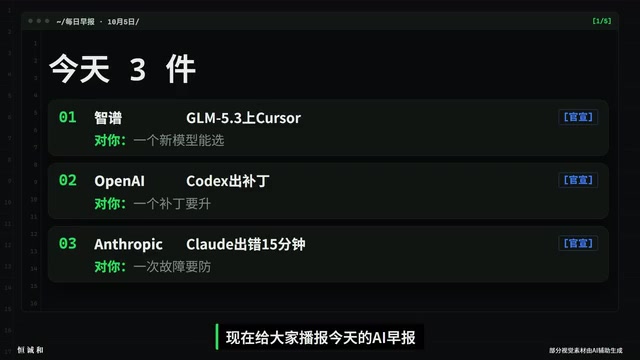
Chinese Model GLM Tops Cursor's Open-Weights Leaderboard
Zhipu, the company behind the GLM large models, has launched its new model GLM-5.3 in Cursor. In Cursor's own tests, GLM-5.3 scored the highest at 42.6% in the category of "downloadable, self-deployable open-weight models." This result comes from a relay by domestic media, and the creator also specifically noted that "so when you write code in Cursor, you can add it to your candidates, compare it with what you commonly use, and then decide."
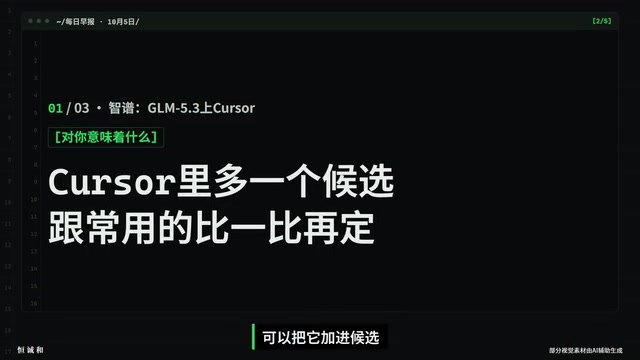
The number 42.6% itself should not be overinterpreted — it is a relative score under Cursor's specific test set, not proof that it is far ahead on all coding tasks. But the signal it sends is clear: the competitiveness of open-weight models in coding assistance scenarios is being recognized by mainstream tools. For developers, the most practical action is to add GLM-5.3 to Cursor's model selection, run it on your own real projects, do an A/B comparison with the model you commonly use, and then decide whether to switch your main model.
Open-weight models refer to models whose trained parameter weights can be publicly downloaded, self-deployed, and fine-tuned, as opposed to closed-source models that can only be called through vendor APIs (such as the GPT series and Claude). Open weights are not the same as open source; training data and code may not be public, but users can run the model locally or in a private cloud, thereby controlling costs, keeping data within their domain, and fine-tuning as needed. Zhipu's GLM series, Meta's Llama, and Alibaba's Qwen all belong to this camp. As a mainstream AI coding tool, Cursor offers both closed-source and open-weight models in its model selection list and ranks the latter separately in its official tests, reflecting that open-weight models are now capable of competing on the same stage as commercial models.
OpenAI's Dual Updates: Codex Patch and Text Watermarking
OpenAI has two developer-related updates. First, its coding command-line tool Codex released patch 0.16.0.1, fixing only one small issue: on Windows computers, Codex occasionally failed to connect to external tools. The fix is narrow in scope but hits a pain point for Windows users, and the creator's advice is straightforward — just upgrade if you use Codex.
Second, OpenAI has made text watermarking available to API users. It is off by default and must be manually enabled.
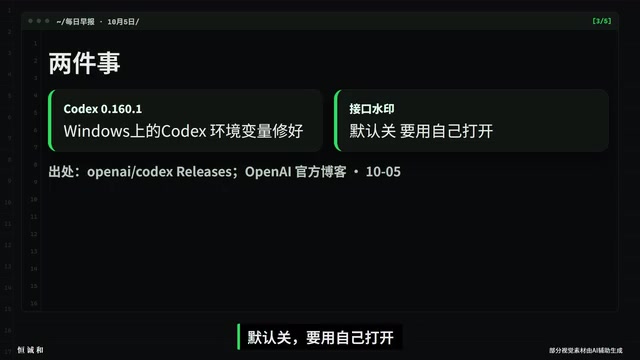
For developers generating content through the API, text watermarking means an additional means of content provenance and compliance, but the default-off design shows that OpenAI leaves the choice to users. Whether to enable it depends on whether your application scenario has requirements for marking AI-generated content.
Text watermarking is a technology that embeds detectable markers in AI-generated text, usually by adjusting the probability distribution of token selection so that the text carries patterns in its statistical features that can be identified by specialized algorithms without noticeably affecting readability. It is mainly used for content provenance and compliance, helping platforms or regulators determine whether a piece of text was generated by AI, in order to address issues such as misinformation and academic integrity. It should be noted that watermarks are not absolutely reliable: they may fail after rewriting, translation, or manual polishing. OpenAI has set it to off by default, meaning developers need to proactively assess whether their application scenarios require marking AI-generated content before deciding whether to enable it.
Claude Outage Lasts About 15 Minutes, Exposing Single-Point Dependency Risk
Anthropic, the company behind Claude, experienced a service outage shortly after 6 a.m. that lasted about 15 minutes. Claude Code, used for coding, was also affected and recovered by 6:21. Requests sent during the outage returned errors and could be retried.
The information in this story itself is not substantial, but the creator's reminder is worth noting: do not connect critical automated workflows to only one provider; add models and leave room for switching.
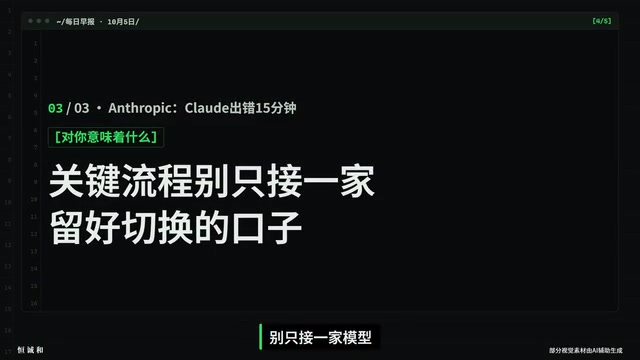
When a team's CI pipeline, code review, or automation scripts are deeply tied to a single AI service, a 15-minute outage is enough to interrupt the entire chain. Multi-model backups and rapid switching during failures are becoming basic requirements in AI engineering practice, not optional extras.
Single-point dependency means that a system relies on only one component or provider at a certain stage, and once that stage fails, the entire chain is interrupted. In AI engineering, if a team binds its CI pipeline, code review, or automation scripts entirely to one model service, a vendor's brief outage, rate limiting, or price increase will directly translate into business interruption. Mitigation measures include: abstracting a unified model invocation interface at the application layer, configuring at least one backup provider with authentication and prompt adaptation completed in advance; setting timeouts and automatic retries for critical requests; and enabling rapid switching during failures through canary releases or health checks. Incorporating multi-model backups into architecture design is changing from a "bonus" to a basic requirement for production environments.
The Common Logic Behind the Three Stories
Looking at the three events together: GLM-5.3 gives Cursor another optional open-weight model, Codex is fixing platform compatibility details, and Claude's brief outage reminds us of the fragility of relying on a single service. They correspond respectively to model optionality, tool stability, and service redundancy — precisely the three things developers care about most when moving from "trying things out" to "production use."
For ordinary users and developers, there are three actions that can be implemented directly today: add GLM-5.3 to Cursor's candidates and run comparison tests; Windows Codex users should upgrade to 0.16.0.1; and prepare at least one backup model or provider for critical workflows. At the end of the video, the creator also posed an interactive question: which model do you mainly use for coding now? The answer to that question may say more about the real value of tools than any leaderboard score.
Related articles

Workbuddy for Absolute Beginners: How a Desktop AI Agent Fits Into Real Workflows
A beginner's guide to the Workbuddy desktop AI agent: installation, claiming credits, file management, and building automated workflows—compared with CodeX for fit and cost, helping professionals shift from AI question-askers to AI managers.

OpenAI's New Agent Stack: Computer Use, Decisions API, and Ultra-Fast Workflows
OpenAI Dev Day unveiled a new agent stack: Computer Use outperforms humans, Decisions API delivers ultra-low-latency classification via Luna, Agents API opens the same Computer Use capabilities, and GPT-6.1 Sol costs only one-seventh of Astra. Core updates, benchmark data, and developer insights.

Liang Wenfeng Open-Sources DeepInfo Inference Framework, Takes On U.S. Ban
DeepSeek open-sources its DeepInfo inference framework after its models, featuring GPU/CPU cross-pipelining, small-model prediction with large-model verification, and full Huawei Ascend and NVIDIA chip support—facing the U.S. federal ban head-on. This article analyzes its significance for AI deployment and open-source strategy.