AI-Native Content Management Systems: A Full-Stack Practice Guide for Indie Developers

A solo developer's guide to building an AI-native CMS with trusted knowledge and digital identity systems.
This article explores an AI-native content management system built entirely by a solo indie developer, designed from the ground up to integrate AI capabilities into content management. It covers trusted knowledge base construction, verifiable digital identity and citation systems, Docker containerized deployment with RDS MySQL, enterprise-grade CI/CD practices, and the journey from personal project to commercial service.
Project Background and Core Philosophy
This is an AI-native personal digital space project built entirely by a solo indie developer. It's not just another blog template site — it's a complete product solution spanning content management to public publishing. The core idea is to deeply integrate a traditional Content Management System (CMS) with AI capabilities, building a trusted knowledge management and distribution system.
By "AI-native," we mean that AI capabilities were considered as core architectural elements from the very beginning of the product design, rather than being bolted onto a traditional system after the fact. This philosophy is analogous to how Cloud-Native redefined traditional software architecture — cloud-native requires applications to be designed from the ground up around containerization, microservices, and continuous delivery. Typical characteristics of AI-native products include: data structures inherently suited for AI retrieval and reasoning, AI-assisted capabilities embedded within the content production workflow, and system outputs that can be directly consumed by AI models. Compared to the approach of adding AI plugins to an existing CMS, AI-native architecture can more fully unlock AI's potential while avoiding the additional costs of data silos and interface adaptation.
The system supports unified management of articles, projects, and notes, with all content serving as a trusted knowledge source for both the website and AI systems. In today's era of widespread Large Language Model (LLM) adoption, one of the biggest challenges AI systems face is the "hallucination" problem — models may generate content that seems plausible but actually lacks factual basis. To mitigate this, the industry has proposed the RAG (Retrieval-Augmented Generation) technical approach, which retrieves relevant information from trusted knowledge bases before the AI generates an answer, then reasons based on those retrieval results. This requires every piece of data in the knowledge base to have clear source attribution, timestamps, and authorization boundaries, making AI outputs traceable and verifiable.
This design breaks free from the traditional limitation of CMS as merely a display tool — content is no longer just read by humans, but is accumulated as a structured knowledge base that AI systems can search and cite.
Product Feature Architecture
Visual Editing and Multi-Device Preview
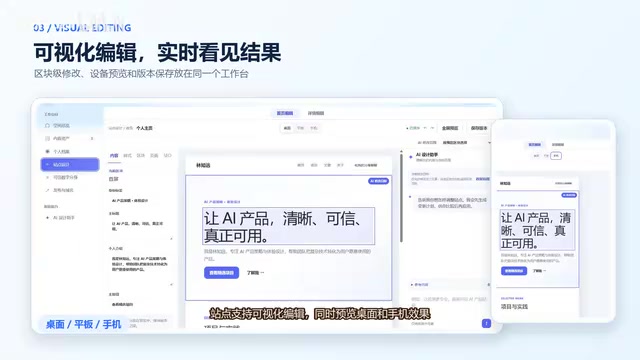
The system provides a visual editor with real-time preview for both desktop and mobile. This WYSIWYG editing experience allows content creators to focus on the content itself without worrying about underlying technical implementation. The editor has built-in responsive design preview functionality, ensuring content renders well across different devices.

Trusted Digital Identity and Citation System
A major highlight of the project is the introduction of the "trusted digital identity" concept. The system allows referencing published content while preserving complete evidence and authorization boundaries. Every piece of knowledge has a traceable origin, providing AI systems with a verifiable knowledge graph.
Verifiable Digital Identity is an important topic in the Web3 and decentralization technology movement. The W3C has published standard specifications for Decentralized Identifiers (DID) and Verifiable Credentials (VC), aiming to enable individuals and organizations to independently manage and prove their identity and data ownership in the digital world. In the content management context, the core value of trusted digital identity lies in solving key questions like "Who created this content? When was it created? Who has the right to cite it?" When AI systems scrape and use internet content at scale, the lack of a trusted identity system leads to ambiguous copyright attribution and unprotected creator rights. By introducing the trusted identity concept into a personal CMS, this project is essentially exploring viable approaches for content rights confirmation and authorization management in the AI era.

In an era of increasingly rampant AI-generated content, this design is particularly valuable. Through explicit authorization boundaries and citation relationships, it both protects the rights of content creators and provides AI systems with high-quality data sources for training and retrieval.
Publishing Workflow and Version Management
The system supports version management, backend builds, and security review mechanisms. Each publication triggers an automated build process with necessary security checks. This engineering-grade publishing workflow is uncommon in personal projects, reflecting the developer's rigorous standards for content quality and system stability.
Technical Architecture and Deployment
Technology Stack Selection
The project adopts a proven, mature technology stack:
- Backend Database: RDS MySQL, providing stable relational data storage
- Containerized Deployment: Docker, ensuring consistency between development and production environments
- Image Registry: GHCR (GitHub Container Registry) private images, safeguarding code security
- Cloud Services: Alibaba Cloud servers, providing a stable runtime environment
Docker is currently the most mainstream containerization technology. By packaging applications and their dependencies into standardized images, it achieves the "build once, run anywhere" deployment philosophy. The core difference between containers and traditional virtual machines is that containers share the host operating system kernel, resulting in faster startup times and lower resource consumption. GHCR is GitHub's container image hosting service, deeply integrated with GitHub Actions CI/CD pipelines. After a developer pushes code, GitHub Actions can automatically build Docker images and push them to GHCR, and the production server then pulls the latest image for deployment. Compared to Docker Hub, GHCR's private image support better protects commercial code, and its native integration with GitHub's permission system simplifies access control management.
This technology stack selection balances cost control with scalability. Using Docker containerized deployment means the project can be quickly migrated to other cloud platforms, effectively avoiding vendor lock-in risks.
Deeper Considerations Behind Database Selection
The choice of RDS MySQL over an embedded database solution reflects forward-thinking about the system architecture's long-term evolution. RDS (Relational Database Service) is a managed relational database service provided by cloud vendors. Taking Alibaba Cloud RDS MySQL as an example, it provides enterprise-grade capabilities such as automatic backups, master-slave replication, and automatic failover, freeing developers from maintaining database servers themselves. In contrast, many personal projects tend to use embedded databases like SQLite — they require no independent deployment and work with zero configuration, but have obvious bottlenecks in concurrent processing, data backup, and scalability. Choosing RDS MySQL means the data layer is completely decoupled from the application layer: even if application containers are destroyed and rebuilt, data remains safely stored in an independent database instance. This architecture offers clear advantages when dealing with container orchestration, rolling updates, and similar scenarios, and also leaves room for future scaling solutions such as read-write separation and database sharding.
Enterprise-Grade Engineering Practices
Even for a personal project, the developer strictly adhered to enterprise-grade engineering standards:
- Version control and CI/CD automated builds
- Containerized deployment and image lifecycle management
- Independent database deployment (RDS) instead of embedded solutions
- Complete publishing review processes and security checks
CI/CD (Continuous Integration/Continuous Delivery) is one of the core practices in modern software engineering. Continuous Integration (CI) requires developers to frequently merge code into the main branch, with each merge triggering automated tests and builds to catch integration issues early. Continuous Delivery (CD) takes it a step further by automatically deploying build artifacts to staging or production environments. For indie developers, the value of CI/CD is especially significant — it automates repetitive build, test, and deployment operations, greatly reducing the risk of human error. A typical CI/CD pipeline includes code static analysis, unit test execution, Docker image building, security vulnerability scanning, and automated deployment. GitHub Actions is one of the most popular CI/CD tools among indie developers, and its seamless integration with GitHub repositories significantly lowers the configuration barrier.
These practices significantly improve the project's maintainability and long-term stability, and lay a solid foundation for subsequent feature iterations.
Commercialization Exploration and Service Positioning
The developer has explicitly stated availability for related development projects, including custom development of AI applications, admin dashboards, websites, and automation tools. The transformation path from personal project to commercial service reflects the indie developer's continuous accumulation of productization capabilities.
The project's value lies not only in its technical implementation but also in its deep understanding of the "AI-native" concept — organically combining content management systems with AI capabilities to build a trusted knowledge system. This product-oriented thinking holds practical reference value for the current AI application development field.
Insights for Indie Developers
This project demonstrates how an indie developer can complete a complex system with limited resources. From product design and technology selection to engineering-grade deployment, every aspect reflects systematic thinking. The following takeaways are worth noting:
- Clear product positioning: Don't build a simple blog system — build a knowledge management platform for the AI era
- Don't compromise on engineering standards: Personal projects can and should adopt enterprise-grade development and deployment practices
- Be pragmatic with technology choices: Prioritize mature and stable technology stacks rather than blindly chasing new concepts
- Prioritize trusted system design: In AI application scenarios, content traceability and authorization boundaries are crucial
In today's rapidly evolving AI landscape, how to make human-created content better understood and used by AI while effectively protecting creator rights is a direction worth continued exploration. This project provides a valuable practical reference.
Key Takeaways
Related articles

DeepCell: One-Click AI Generation of Documents, Spreadsheets, and Slides
DeepCell tops Product Hunt with one-click generation of documents, spreadsheets, and slides, using the .deepcell format for linked updates, designed for System 2 tasks like modeling and sales reviews.

Doneas: 15-Minute Daily Accountability Calls That Keep Indie Developers From Procrastinating
Doneas is a daily accountability tool for indie developers: plan tasks on Monday, join a 15-minute call with five builders each day, and log deliveries on a public progress page. This article analyzes its core mechanics, effectiveness, and potential issues around retention and matching.

Fastlane 2.0: Fully Automated AI Ad Campaigns, From Creative to Optimization
Fastlane 2.0 is an AI ad automation tool: enter your website and it learns your brand, generates video and image ads, and runs and optimizes them on Meta, TikTok, Instagram, and YouTube.