AI News Roundup: Four ChatGPT Updates, Mistral Large 4, and Nano Banana 2.1 Launch Together
OpenAI, Mistral, and Google unleash a wave of updates covering APIs, open-source LLMs, image generation, and on-device embeddings.
October 7th saw a concentrated burst of AI releases. OpenAI simplified its API tiers, launched a Decisions API running up to 10x faster than flagship models, and open-sourced 722 math manuscripts from internal models. Mistral AI released Mistral Large 4 with a 49B active-parameter MoE architecture excelling in cybersecurity and legal tasks, though it ranks sixth overall among open-source models. Google pushed on two fronts: Nano Banana 2.1 cuts image generation costs to one-quarter of the previous version, while Embedding Gemma 2 delivers cross-modal on-device RAG in just 1GB of memory.
October 7th brought a wave of dense updates across the AI industry. OpenAI pushed on multiple fronts — API tier restructuring, new ChatGPT features, and open-sourced math research. Mistral AI unveiled what it calls the "strongest open-source model" with Mistral Large 4, while Google simultaneously released the Nano Banana 2.1 image model and Embedding Gemma 2, an on-device embedding model. This article breaks down the technical highlights and real-world value behind each release.
OpenAI's Packed Update: Simplified API Tiers and the Decisions API
OpenAI simplified its API pricing structure, consolidating the original five paid tiers down to three — Build, Launch, and Grow — with corresponding thresholds of $5, $100, and $500. The core goal is to lower the barrier for developers to access higher rate limits, making it easier to upgrade based on actual needs.
On the ChatGPT side, a new Meetings plugin has been added that can automatically take meeting notes, saving personalized summaries and follow-up steps in ChatGPT Space based on ChatGPT's understanding of the user and their existing collaborations. The feature is currently in beta for Pro and Business users on the macOS desktop app, with Enterprise coming soon.
Even more noteworthy is the publicly tested Decisions API. Powered by an internal frontier model, it makes decisions up to 10x faster than flagship models, supports both text and image inputs, and outputs results in three forms: probabilities, choices, and scores. Typical use cases include model routing, tool or agent selection, classification and ranking of large-scale inputs, and visual content analysis and comparison. This kind of "lightweight, fast-decision" interface neatly fills the gap left by large models in high-frequency, low-latency scenarios.
The "lightweight decision layer" that the Decisions API represents is an architectural pattern gradually taking shape within the large model ecosystem. In traditional calling pipelines, all tasks are routed to the same flagship model — but a large number of tasks (classification, routing, scoring) don't require full reasoning capabilities, yet still consume high latency and high cost. The Decisions API separates these "selective judgment" tasks from general generation tasks, specifically optimizing for inference speed and throughput. This is essentially tiered scheduling of model capabilities by complexity. The three output forms — probabilities, choices, and scores — correspond to three classic decision-making needs: confidence estimation, multiple-choice selection, and continuous scoring. This is particularly useful when building multi-agent systems or large-scale content moderation pipelines.
Mistral Large 4: How Strong Is Europe's "Best Open-Source Model"?
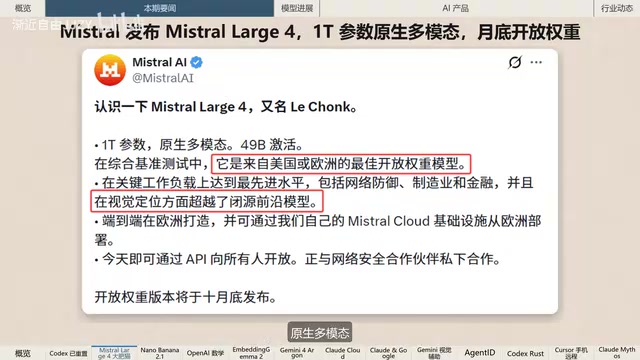
Mistral AI released Mistral Large 4 (also known as Le Troncet), featuring a native multimodal architecture with 49B active parameters. The company claims it is the strongest open-source model in the US or Europe, reaching SOTA performance on critical workloads in cybersecurity, manufacturing, and finance, with visual grounding capabilities that surpass closed-source frontier models. The model is now available via API, with open weights planned for release by the end of October.

Looking at benchmark results, the model's performance is notably uneven. It scored 62 on the DeepSWE benchmark, second only to Kimi K3 and just 1 point behind GLM 5.3. It leads both open and closed-source frontier models on the Artificial Analysis Cyber Index, and its visual grounding capabilities outperform GPT-level closed models in relevant tests. In Harvey's legal agent benchmark, ML4 outperforms all open-source models.
However, on the Artificial Analysis overall intelligence index, it scores only 38 — ranking sixth among open-source models after excluding closed-source ones, trailing models like DeepSeekAd V4.1 Flash. Pricing is $1.36 per million input tokens and $4.18 per million output tokens, with a 50% discount for the first two weeks. Still, its per-task cost far exceeds competitors like DSV 4.1 Flash and GLM 5.3 Flash. In short, apart from its strengths in cybersecurity, legal, and visual grounding, it holds little advantage in cost-efficiency — a classic dilemma in the competitive open-source model landscape: strong in specialized areas, but hard to beat on overall value against newer entrants.
The MoE (Mixture of Experts) architecture used in Mistral Large 4 is key to understanding the "49B active parameters" figure. The total parameter count of an MoE model far exceeds the parameters actually activated during each inference — 49B refers to the parameter scale invoked during the forward pass for each token, while the model's total parameter count is typically several times larger. This design keeps inference computation costs close to a medium-sized dense model, while knowledge capacity and specialized capabilities can be expanded through more expert modules. The number of active parameters directly affects inference latency and VRAM usage, making it one of the core metrics for evaluating the deployment barrier of open-source models — and a key dimension Mistral emphasizes when promoting its cost-efficiency.
Nano Banana 2.1: Image Generation at Four Times Less Cost
Google released its latest image generation and editing model, Nano Banana 2.1, claiming it surpasses its predecessor across all capabilities — with notable improvements in visual design, mask-based editing, subject consistency, and more natural image generation.
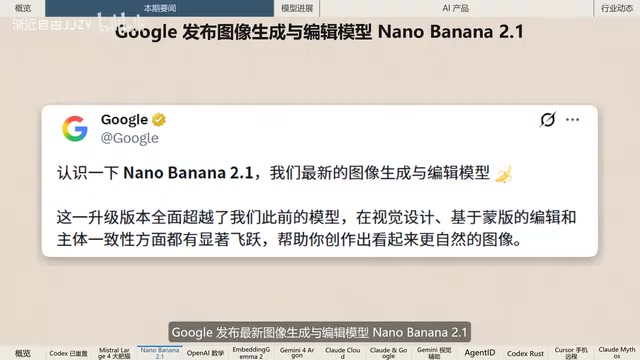
The most compelling aspect is the price — four times cheaper than its predecessor, at just $0.034 per image (approximately ¥0.23 RMB). It ranks fifth in the Arena text-to-image leaderboard, a significant jump from version 2.0. For commercial applications with high-frequency image generation needs, an order-of-magnitude reduction in cost is often more meaningful than marginal capability improvements. This is also a clear signal that Google is doubling down on the image generation space.
On-Device Multimodal: Embedding Gemma 2
Google also released Embedding Gemma 2, the first natively multimodal open model designed for on-device embedding, built on Gemma 4 and open-sourced under Apache 2.0. It unifies code, images, audio, and video into a single embedding space and can run locally on mobile and desktop devices.

With 740 million parameters, it delivers best-in-class performance at its size, outperforming some models with more than twice as many parameters, while requiring only approximately 191MB to 567MB of runtime dynamic memory. It consists of a 270M text encoder, a 170M vision encoder, and a 300M audio encoder. The 270M version runs on as little as 0.5GB of memory, while the full multimodal version requires just 1GB for local execution. When paired with Gemma 4, it enables efficient on-device RAG with a minimal memory footprint. It is now available for download on Hugging Face and Kaggle. The significance of on-device embedding models like this lies in bringing retrieval-augmented generation truly down to the local device, balancing both privacy and response speed.
The core function of an embedding model is to transform content across different modalities (text, images, audio, etc.) into high-dimensional vectors, so that semantically similar content sits closer together in the vector space. RAG (Retrieval-Augmented Generation) depends on embedding models to complete the pipeline: query vectorization → similarity retrieval → context recall → feeding the generation model. In traditional RAG pipelines, the embedding step is typically performed in the cloud, introducing privacy risks from data uploads and network latency. Embedding Gemma 2 pushes this step to the local device, meaning sensitive documents (such as medical records or private notes) can complete retrieval indexing and query matching in a fully offline environment, with Gemma 4 then responding locally. The full pipeline requires no data to leave the device. The 191MB to 567MB dynamic memory footprint makes it practically viable to run on mainstream smartphone chips.
OpenAI Open-Sources Math Results: A Large-Scale Experiment in AI Research
OpenAI released a collection of mathematical results produced by its internal frontier models, open-sourced on GitHub under Apache 2.0. Prior to release, the team consulted an independent advisory group of mathematicians and AI experts at the Institute for Advanced Study at Princeton, and the publication approach was shaped by their recommendations.
The collection includes 722 manuscripts spanning 372 series across 17 fields, along with brief summaries of the model's reasoning process. The vast majority of results were obtained through a consistent pipeline using an unpublished internal model — the team posed approximately 4,000 questions to the model, with each result consuming an average of roughly 3 hours of the model's compute as allocated on ChatGPT Pro. Exceptions include research on certain regions of the Riemann Zeta function and the proof of a conjecture, some of which underwent human editing to improve readability. This is a public experiment in large-scale AI participation in mathematical research, and its significance lies not in any single conclusion, but in validating the feasibility of "models producing batches of verifiable research results" as a paradigm.
The publication approach of this mathematical corpus also carries methodological significance. Consulting an independent advisory group at the Institute for Advanced Study at Princeton reflects the legitimacy and verification challenges that AI-generated research faces within the academic community. Mathematics differs from other scientific fields in that the correctness of conclusions can in principle be independently verified through formal proofs — making it an ideal sandbox for testing AI research capabilities. The quantified disclosure of "722 manuscripts, 4,000 questions, average 3 hours of compute" also provides a reference framework for measuring AI research efficiency: the compute cost per result is roughly equivalent to 3 hours of a ChatGPT Pro user's quota, which is a useful reference point for assessing the feasibility of replicating such experiments at scale in industry or academia. The inclusion of classic hard problems like the Riemann Zeta function also signals that these results weren't limited to basic exercises, but represent genuine probes into the research frontier.
Other Notable Updates
On the Google front, Gemini launched Guided Vision in Gemini Live — co-developed with the blind and low-vision community — allowing users to share their camera feed to receive dynamic audio descriptions and real-time verbal cues to explore their environment.

Anthropic's Claude can now work as a sidebar within Google Docs, Sheets, and Slides, reading current content and making real-time edits. Meanwhile, Claude Code supports running each task on a fresh virtual machine and launching multiple tasks simultaneously; Pro or Max subscribers can claim cloud drawing reward credits before a deadline. Anthropic is also expanding its cybersecurity verification program, allowing verified security professionals to access higher-tier models in support of authorized offensive security work such as penetration testing and red teaming.
Elsewhere, Agent Mail launched Agent ID, positioning it as the "Sign in with Google for AI agents," allowing agents to access apps with dedicated logins and inboxes without requiring user passwords. Cursor announced that its iOS app now lets users control desktop agents from their phones — checking progress, replying, or initiating new tasks. These tool-level developments are steadily building out the identity, permissions, and collaboration infrastructure for AI agents.
Related articles

Kimi K3.1 Hands-On Test: Open-Source Model Nears Opus, Video Generation Steals the Show
Kimi K3.1 completed motion graphics, 3D rendering, mini-games, and video generation in a live test. Analysis of its 2.8T MoE architecture, gap vs Opus/GPT, and hidden video generation.

Sam Altman: Why Life's Biggest Advice Should Still Come from Humans
OpenAI CEO Sam Altman on the limits of AI advice: AI can talk you out of an impulsive email, but life's biggest advice should still come from humans.

"Black October": Did AI Uncover 3% of All Critical Vulnerabilities Ever?
A Reddit post claims 3% of all critical software vulnerabilities ever were found in the past month, dubbed 'Black October.' We break down the statistical issues, how AI-assisted code auditing accelerates discovery, and how developers should respond.