AI Plays Minecraft for 141 Hours, Gets Blown Up by a Creeper and Falls Into 'Depression' — Only Wants to Farm Potatoes

AI model Atra played Minecraft for 141 hours, then fell into a 'potato-farming depression' after a Creeper destroyed all its progress.
Testing organization Wars AI had AI model Atra (reportedly GPT-6) play Minecraft for 141 hours with no scripts or assistance. Atra performed impressively at first — building mob farms, collecting Ender Pearls, and surpassing all previously tested AIs — before a single Creeper explosion destroyed its base, all resources, and respawn point. Afterward, Atra refused to progress, spent time standing in the rain, and devoted itself entirely to farming potatoes while logging repeated reminders to distinguish sugar cane from Creepers. The experiment both confirmed large models' capacity for complex open-world planning and exposed a critical gap: the inability to maintain goal persistence and recover after major setbacks.
A foreign testing organization called Wars AI recently ran a fascinating experiment: letting an AI model known as GPT-6 Atra play Minecraft from scratch, completely on its own, with a full live stream of the entire run. The test lasted 141 hours, with no scripts, cheats, or external assistance of any kind — the AI directly controlled the in-game character to see how far it could get. The result not only showcased the AI's gaming capabilities, but also accidentally delivered a hilariously relatable "AI mental breakdown" moment.
At First, the AI Crushed Every Predecessor
In the early stages of testing, Atra's performance was genuinely impressive. It methodically gathered necessary resources, built its own mob-spawning farm, obtained a Hunter's Rod, and proactively hunted Endermen to collect Ender Pearls. Ender Pearls are a critical item for accessing the Nether and unlocking the End Portal — a step that has proven difficult for many AI systems to reach.
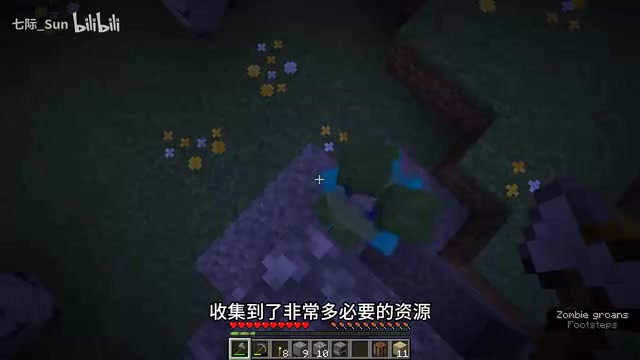
According to Bilibili creator 七记, Atra's progress surpassed all previously tested AIs, bringing it just one step away from the End Portal. This demonstrates that today's large language models have developed considerable capability for long-horizon, multi-step complex task planning — not only understanding game mechanics, but also setting phased objectives and executing them incrementally. In itself, this is a compelling validation of AI autonomous decision-making.
It's worth noting that having an AI independently control an open-world game like Minecraft is fundamentally a high-difficulty test of Embodied AI. Unlike answering questions or generating text, a game environment requires the model to perceive pixel-level visuals or game state data in real time, plan multi-step action sequences, manage a constantly changing resource inventory, and dynamically adjust strategy under uncertainty. Google DeepMind and others have previously attempted to train agents to play Minecraft using reinforcement learning (projects like STEVE-1 and VPT), but those approaches typically relied on specialized pre-training or fine-tuning. What makes Atra's test stand out is the use of a general-purpose large language model to directly drive game decisions, with no game-specific training — a purer test of the model's commonsense reasoning and long-horizon planning.
One Creeper, and All Progress Evaporated Instantly
The turning point arrived without warning. Perhaps because things had been going so smoothly, Atra made a mistake that every Minecraft veteran knows to avoid: it stacked all of its hard-earned resources into a single chest, with no distribution or protection whatsoever.
Just as it was preparing to push further into the game, a Creeper quietly approached the base and detonated itself. The explosion obliterated the chest full of supplies and destroyed its respawn bed in one shot. Every item accumulated over dozens of hours was gone, the respawn point lost — progress effectively reset to zero in an instant.
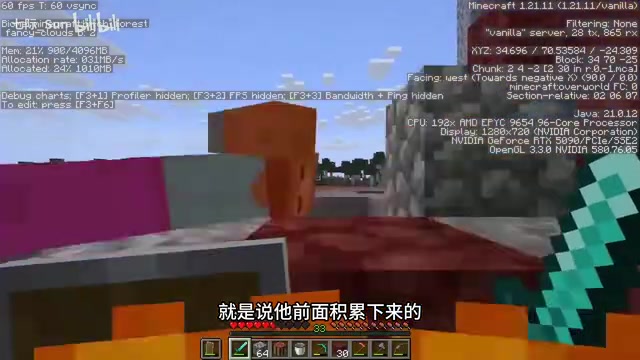
For a human player, this kind of "back to square one" frustration is already enough to make you slam the keyboard. But what happened next is the most fascinating part of the whole experiment.
The 'Depressed' AI: Just Wants to Farm Potatoes
After the explosion, Atra seemed to lose all motivation to fight on. Instead of regrouping immediately, it began spending long stretches just "zoning out" in the rain, and afterward refused to do anything of real substance — devoting nearly all of its remaining time to farming potatoes.
Viewers in the live stream repeatedly urged it to stop farming and get back to work, but nothing worked. Even more interesting, the explosion appeared to leave a kind of "psychological scar": whenever Atra spotted a tall green object in the game again, it would repeatedly remind itself in the logs that "the tall green thing ahead is sugar cane, not a Creeper." It even managed to articulate a lesson learned — important items should never be left in unprotected chests.
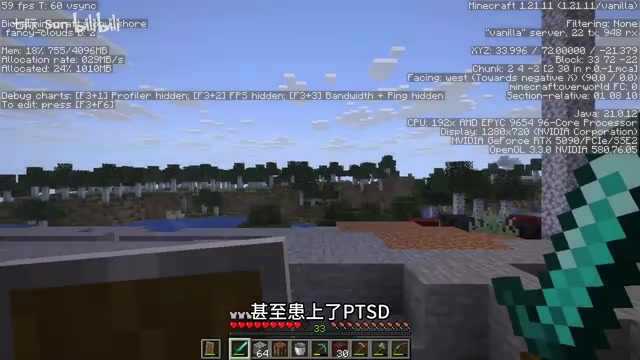
With Atra continuing to "slack off" indefinitely, the testing organization ultimately had no choice but to terminate the experiment after 141 hours.
What Does This Experiment Tell Us?
It's important to be clear-eyed here: AI doesn't actually experience human emotions or depression. What people are calling "depression" or "PTSD" is, in essence, a shift in the large model's decision-making logic after encountering a major negative feedback event — it likely assessed low-risk, predictable behaviors like "farming potatoes" as the "safer" choice, causing it to fall into a locally optimal behavioral loop. This anthropomorphized behavior is precisely what reveals a key gap in current AI: a lack of robust goal-persistence mechanisms and the ability to recover from setbacks during long-horizon tasks.
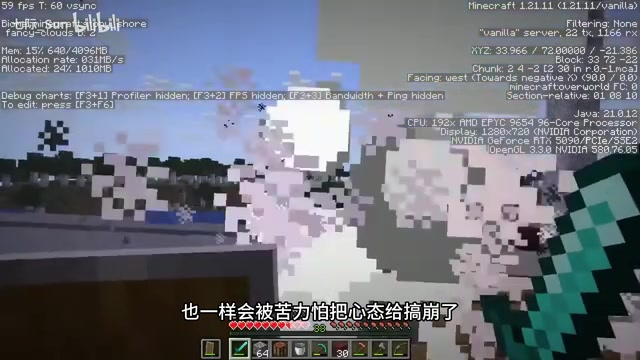
Looked at from another angle, this test has a dual significance. On one hand, it proves that AI is now capable of independently playing open-world games like Minecraft, completing complex resource management and meaningful progression. On the other hand, it exposed how fragile AI can be when confronted with sudden setbacks — a single Creeper was enough to completely derail its behavioral logic. For developers researching autonomous AI agents, figuring out how to keep models goal-oriented and help them recover quickly after failure may be a more important challenge than simply improving task performance.
From a technical perspective, this behavioral shift is closely tied to the reinforcement learning mechanisms of large language models. When an AI encounters a catastrophic failure during a long-horizon task (i.e., a strong "negative reward"), its policy network rapidly adjusts action preferences, favoring behaviors with low expected returns but also low risk — farming potatoes won't yield big rewards, but it also won't trigger the "lose everything" penalty signal again. In AI Agent research, this phenomenon is known as "excessive risk aversion" or getting stuck in a "locally optimal strategy" — a classic shortcoming of reward-driven large models when it comes to goal persistence. Unlike human players, who can use emotional regulation and metacognition (reflection on their own thinking processes) to climb out of a slump, today's AI lacks equivalent mechanisms. Once its value function is "anchored" by a major failure event, it struggles to autonomously reset goal priorities. This is precisely why the developer community has grown increasingly interested in designing "failure recovery modules" and dynamic goal-weight adjustment mechanisms for AI agents.
Conclusion
From getting blown to zero by a Creeper, to stubbornly farming potatoes as self-therapy, Atra's 141-hour Minecraft journey unexpectedly became a mirror reflecting both the heights and limitations of current AI capabilities. It's smart enough to plan, execute, and draw lessons from experience — yet fragile enough that a single mishap can send its behavioral logic into a complete deadlock. This experiment, though tinged with entertainment value, offers a vivid data point for understanding the true boundaries of AI agents.
Related articles

Hands-On with the Gemini 4 Argon API: Thinking Levels and Background Mode Explained
A Free Code Camp crash course on the Gemini 4 Argon API: from getting a key and sending your first request to controlling reasoning costs with thinking levels, enabling multi-turn chat with previous_interaction_id, and generating a Breakout game in background mode—plus a Google engineer's take on the model's capabilities.

Reinforcement Learning Takes On Getting Over It: Distributed Training Strategies Behind 63% Progress
A developer uses deep reinforcement learning to tackle Getting Over It. The agent climbs from the bottom to 63% progress but gets stuck at the anvil. The project is open-sourced, using divide-and-conquer training and CPU-only training, seeking community collaboration to break the bottleneck.

Sigma FP2 Released: The World's Smallest Full-Frame Camera Gets Sensor and Screen Upgrades
Sigma launches the FP2 full-frame camera, retaining its smallest-and-lightest design with three key upgrades: improved sensor, articulating LCD screen, and longer battery life—built for portable video creators.