AI+Playwright Powers Xianyu Monitoring Tool: A Deep Dive into ai-goofish-monitor

Open-source project uses Playwright plus AI for automated Xianyu product monitoring and smart filtering.
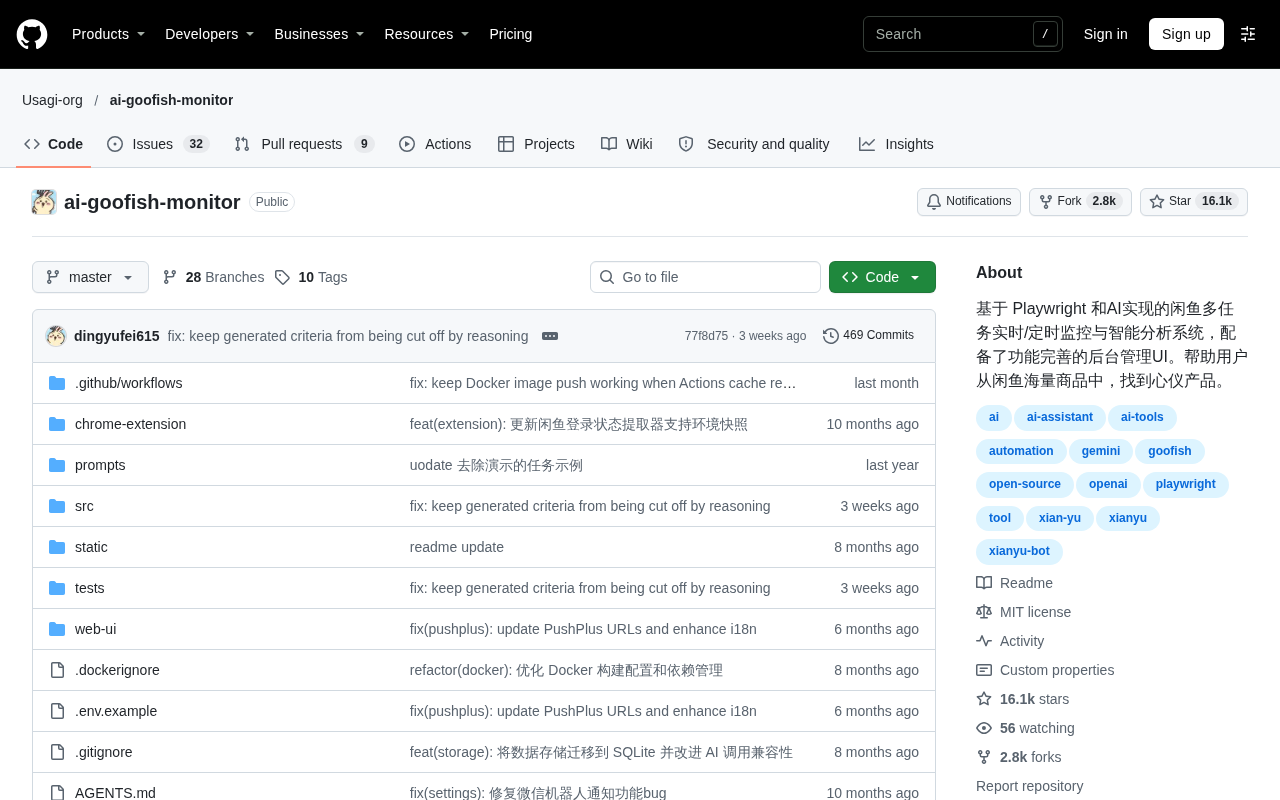
The GitHub open-source project Usagi-org/ai-goofish-monitor uses Playwright browser automation and AI analysis to provide a multi-task real-time/scheduled Xianyu product monitoring solution. It uses Playwright to handle dynamic pages and reliably scrape data; an AI layer intelligently filters and denoises listings, helping users go from "seeing a lot" to "seeing the right ones." It supports multi-task parallelism and dual real-time/scheduled modes, plus a full-featured backend UI. The project has 16,086 stars and 2,817 forks, with 204 new stars in one day. The article also reminds users to follow platform terms and robots protocol, control request frequency, and keep human review of AI results.
Project Overview: When AI Meets Second-Hand Trading
On second-hand trading platforms like Xianyu, good deals often disappear in an instant—manual refreshing is not only time-consuming but also easy to miss the best window to buy. An open-source project on GitHub named Usagi-org/ai-goofish-monitor attempts to solve this pain point with automation and AI. Built on Playwright and AI technology, the project implements multi-task real-time/scheduled monitoring and intelligent analysis for Xianyu, and comes with a full-featured backend management UI to help users efficiently filter desired products from massive listings.
The project is developed in Python and has currently earned 16,086 stars and 2,817 forks on GitHub, with 204 new stars in a single day—a clear sign of its popularity.
Core Architecture: Playwright-Driven, AI-Empowered
Browser Automation Collection
The project chose Playwright as its underlying collection tool rather than a simple HTTP request library. This choice is well-founded: Xianyu, as a dynamically rendered modern web application, relies heavily on JavaScript to load product lists and details, making it difficult for traditional crawlers to directly obtain complete data. Playwright can simulate real browser behavior, handle page rendering, scroll loading, and other interactions, thereby scraping product information more reliably.
Playwright is a browser automation framework open-sourced by Microsoft, supporting three major engines—Chromium, Firefox, and WebKit—and providing both synchronous and asynchronous APIs. Compared with Selenium, Playwright has a built-in auto-wait mechanism—states such as element appearing, clickable, and network idle are automatically detected, reducing the hassle of manually writing sleeps; it also supports intercepting and modifying network requests, simulating mobile devices, and recording operations to generate scripts. These capabilities make it more reliable than traditional HTTP request libraries when handling pages like Xianyu that rely on JavaScript dynamic rendering and feature scroll loading and lazy loading. The trade-off is higher resource consumption, as running it requires launching a complete browser instance.
AI Intelligent Analysis Layer
On top of data collection, the project introduces AI analysis capabilities. Faced with the massive number of monitored products, simple keyword matching easily generates a lot of noise—clickbait titles, vague descriptions, and products of varying condition are all mixed together. The role of the AI analysis layer is to intelligently filter and evaluate products, helping users transition from "seeing a lot" to "seeing the right ones." Although the original material does not disclose specific models and algorithm details, from the project's positioning, AI plays the role of information denoising and value judgment.
In product monitoring scenarios, AI analysis is usually based on the text understanding capabilities of large language models (LLMs): product titles, descriptions, prices, seller information, etc. are concatenated into prompts, letting the model determine whether the product matches user needs, whether the condition description is credible, whether there is clickbait or traffic-driving information, and output structured results (such as match scores and reason tags). Compared with keyword blacklists, this approach's advantage lies in understanding semantics and context—for example, distinguishing the subtle difference between "brand new unopened" and "brand new opened but unused." In practice, it often requires prompt engineering and result validation, as well as caching and rate limiting for model calls to control costs.
Multi-Task Monitoring and Backend UI
Dual Modes: Real-Time and Scheduled
The project supports parallel monitoring of multiple tasks and offers both real-time and scheduled monitoring modes. Real-time mode is suitable for closely watching new listings of scarce products, while scheduled mode is suitable for periodic inspections and reducing resource usage. The multi-task design means users can track multiple keywords or categories simultaneously—for example, watching a certain camera lens while also keeping an eye on a specific graphics card model—without interference.
Real-time and scheduled monitoring correspond to two scheduling strategies in implementation. Real-time mode typically uses long polling or high-frequency short-interval polling, maintaining dense access to target pages to minimize the time gap between a product being listed and being discovered; scheduled mode uses a task scheduler (such as libraries like APScheduler) to trigger collection at fixed intervals. Combining the two allows users to use real-time mode for high-priority keywords and low-frequency inspection for long-tail keywords, achieving a balance between timeliness and request volume. Multi-task parallelism also requires consideration of task isolation, failure retries, and deduplication mechanisms to avoid the same product being pushed repeatedly.
Visual Management Backend
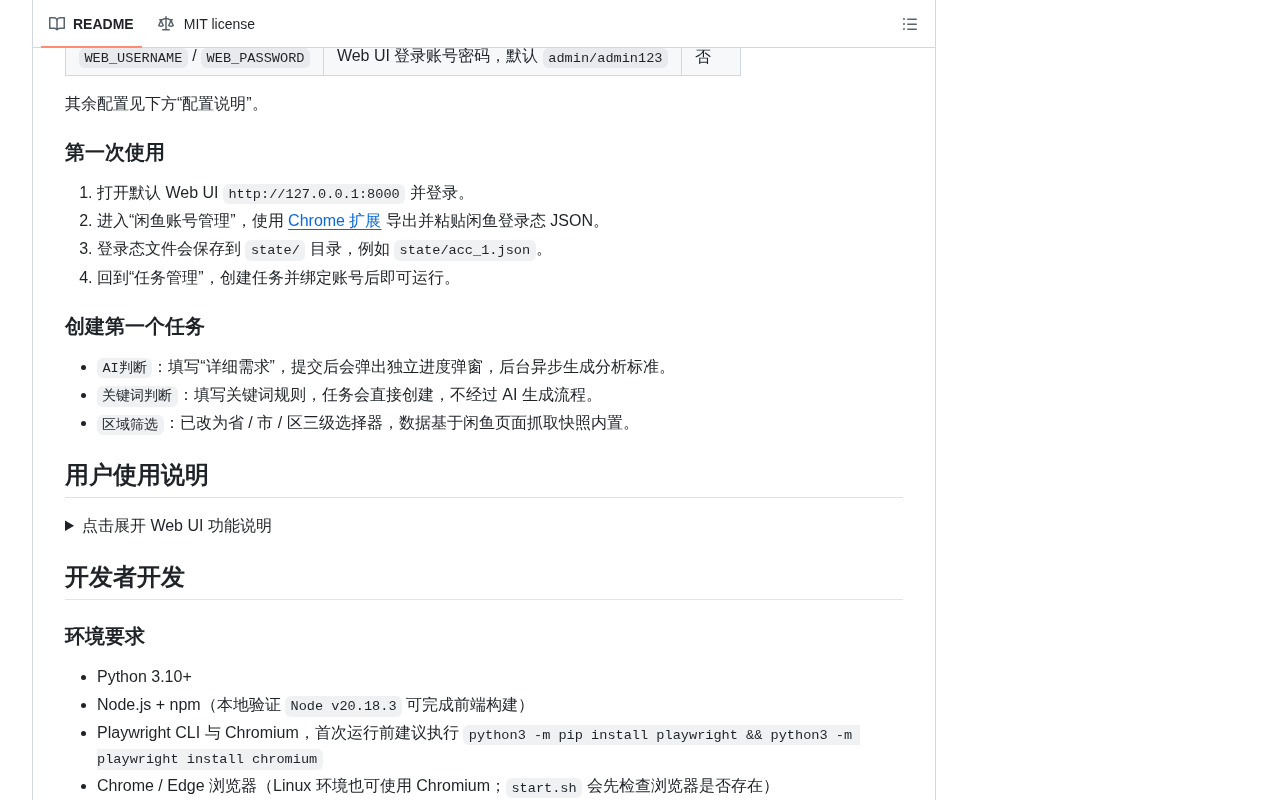
Many similar scripts remain at the command-line level, with configuration done by modifying code and results viewed through logs. A major differentiator of ai-goofish-monitor is its full-featured backend management UI. The visual interface lowers the barrier to entry: adding, starting/stopping tasks, and viewing results can all be done on the web page, making it friendlier for users unfamiliar with the command line. This is also one of the reasons it has gained high attention—turning "usable" into "easy to use."
Use Cases and Usage Reminders
From its functional positioning, the project is suitable for two types of people: buyers with clear needs for specific products who want to know about new listings as soon as possible; and users who need to track market trends over the long term and observe price fluctuations.
It should be noted that automated access to platforms must comply with the target website's terms of service and robots protocol, control request frequency, and avoid putting pressure on the platform. The open-source project itself provides a technical solution; compliance and risk control issues in actual use must be handled by the user. In addition, AI analysis results may still contain misjudgments, and final decisions are recommended to be combined with human judgment.
Summary
ai-goofish-monitor combines Playwright's browser automation capabilities with AI's intelligent filtering capabilities, then encapsulates them in a backend UI, forming a relatively complete Xianyu product monitoring solution. Behind its 16,086 stars is a real efficiency demand in second-hand trading scenarios. For developers who want to build their own monitoring tools or study the combination of browser automation and AI, this project is worth a look.
One-line Summary
Open-source project uses Playwright plus AI to achieve automated Xianyu product monitoring and intelligent filtering.
Paragraph Summary
The GitHub open-source project Usagi-org/ai-goofish-monitor uses Playwright browser automation and AI analysis technology to provide a multi-task real-time/scheduled product monitoring solution for the Xianyu second-hand trading platform. The project chooses Playwright to handle dynamically rendered pages and reliably scrape product information; on top of collection, it introduces an AI analysis layer to intelligently filter and denoise massive listings, helping users transition from "seeing a lot" to "seeing the right ones." The project supports multi-task parallelism and dual real-time/scheduled modes, and comes with a full-featured backend management UI that lowers the barrier to entry. Currently, the project has earned 16,086 stars and 2,817 forks, with 204 new stars in a single day. The article also reminds users to comply with platform terms of service and robots protocol, control request frequency, and maintain human review of AI analysis results.
Related articles

Axion 1.0: A Minimalist Training Recipe for a 35B Open-Source Agent Foundation Model
Axion 1.0 is ByteDance's fully open 35B agent foundation model trained with a minimalist two-stage SFT plus RL recipe—no mid-training, DPO, or OPD—with data construction, validation, and training code released, competing with commercial models on agent benchmarks.

Get SMS Alerts for Codex Quota Resets and Stop Wasting Usage | Reset Alerts
Reset Alerts is a free tool that sends SMS and Telegram reminders when OpenAI Codex usage resets, helping developers use up remaining requests before the reset. No app needed—just text START to subscribe.

Jelly Sheet: Why mrdoob's Physics Simulation Experiment Is Drawing Attention
Jelly Sheet is a browser-based soft body simulation experiment by Three.js founder mrdoob, earning 301 points and 77 comments on Hacker News. This article analyzes its technical challenges, interaction feel, and dissemination path in the creative coding community.