Get SMS Alerts for Codex Quota Resets and Stop Wasting Usage | Reset Alerts

Reset Alerts uses free SMS and Telegram to remind you when Codex quotas reset, helping developers use up remaining requests.
Reset Alerts is a lightweight reminder tool that made it onto Product Hunt, aimed at solving the pain point of OpenAI Codex users often forgetting to use up remaining requests before a quota reset. Users can subscribe simply by texting "START"—no app installation required—with service covering US and Canada SMS plus global Telegram. When the Codex usage limit resets, users receive a free text notification, and a second one when the quota becomes available. Built by Sam Feldman, the tool relies only on OpenAI's public announcements, involves no unofficial API, and carries low compliance risk. The article analyzes the user anxiety behind it and its minimalist design philosophy, and points out the opportunities and limitations of such ancillary services in the age of AI coding.
In today's fiercely competitive AI coding assistant market, OpenAI Codex's usage limits are a mechanism that many developers have a love-hate relationship with. Before each quota reset, someone always forgets to use up their remaining requests, wasting resources for nothing. A small tool that appeared on Product Hunt—Reset Alerts—tries to solve this pain point with the simplest possible SMS reminder.
Why an SMS reminder tool made it onto Product Hunt
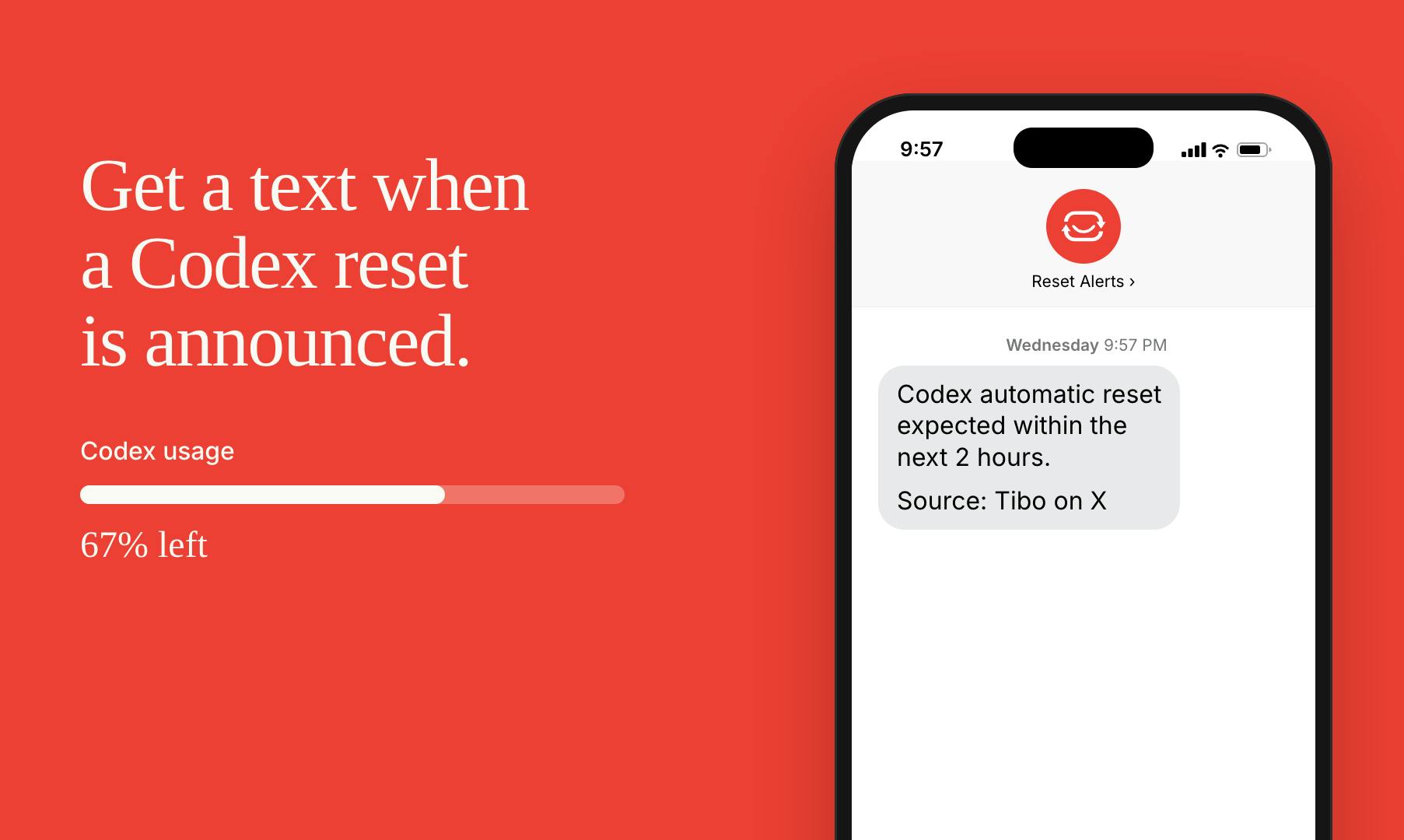
Reset Alerts' core logic is very straightforward: when OpenAI announces that the Codex usage limit has reset, you receive a free text message; when the quota is actually available, you receive a second one. That way you can "squeeze out" your remaining quota before the reset and avoid waste.
The product was built by Sam Feldman and received 79 upvotes on Product Hunt, ranking 20th for the day in the developer tools category. Users simply text "START" to sign up—no app installation required. The service currently covers the US and Canada (SMS) as well as the rest of the world (Telegram).
This seemingly tiny need hits precisely the daily frustration of heavy Codex users. Under the mechanisms of AI coding tools that charge by usage or reset by cycle, quota management itself is an invisible time cost.
Product Hunt is a tech product discovery and launch platform headquartered in San Francisco, founded in 2013 and known in the industry as a "bellwether for tech products." Every day, entrepreneurs and developers can launch their new products on the platform, and community users express support through upvotes; the platform generates a daily ranking based on vote counts (usually displaying the top 20-30). Many early-stage projects—including early versions of Notion and Figma—used Product Hunt to gain their first batch of seed users and media exposure. For small independent developers, appearing on the Product Hunt homepage or even the daily leaderboard means gaining attention from early tech adopters worldwide, so ranking on that list is often seen as a preliminary indicator of a product's popularity.
The user anxiety behind quota resets
Why would a reminder tool attract attention? It starts with how Codex is used. As an AI coding assistant, OpenAI Codex typically provides a certain number of uses per week or per month. When the cycle ends and the quota resets, any unused remaining requests are zeroed out.
For developers who use Codex heavily, missing the "last window" before a reset means a real financial loss. This is especially true in team collaboration scenarios, where multiple members share a quota and "forgetting to use it" becomes even more likely. Reset Alerts turns this passive waiting into an active reminder with a single text message, lowering the user's monitoring cost.
One detail worth noting: the tool does not rely on any unofficial API or hacking method—it simply monitors OpenAI's announcements through public information. This lightweight approach avoids compliance risks while ensuring the service's sustainability.
OpenAI Codex originally referred to the code generation model released in 2021, but the "Codex usage limits" discussed here are more likely related to OpenAI's developer-facing coding assistance products (such as Codex CLI, or the coding features included in ChatGPT subscriptions). Such products typically use a usage quota that resets on a cycle (e.g., weekly or monthly) rather than real-time token-based billing. A quota reset means that requests not consumed within the current cycle do not accumulate into the next cycle but are simply zeroed out. This design is fairly common in subscription-based AI products, aimed at controlling compute resource costs and encouraging continuous usage. For developers, the key to understanding this mechanism is distinguishing between "soft limits" (such as rate limits) and "hard quotas" (periodic allowances)—the latter directly determines how much remaining usage users need to monitor.
Minimalist design: no app, just a text message
Reset Alerts' product philosophy is "zero burden." Users don't need to download an app or register an account—they simply send "START" to a designated number to subscribe. SMS notifications also fit developers' usage habits: no need to open any additional app, because the information reaches the phone directly.
For global users, the Telegram channel offers an alternative. This dual-channel design serves both North American SMS users and international internet users, providing broader coverage. The product's official website is accessed via Product Hunt and currently presents concise information with no complex feature stacking.
From a technical implementation perspective, the barrier to building this kind of reminder service is not high, but its strength lies in its precise use case. It doesn't try to be a comprehensive Codex management dashboard; instead, it focuses on the single action of "reset reminders" and makes the experience as lightweight as possible.
Telegram is a cross-platform instant messaging app known for its open Bot API and channel features. Developers can push messages to subscribers through Telegram Bots without paying SMS fees. For international users, Telegram notifications have a cost advantage over SMS and also support rich text, links, and button interactions. Reset Alerts chose Telegram as its global channel precisely because of its free, reliable nature and high penetration among developer communities. Compared with SMS, Telegram message delivery depends on the user's network connection, but it avoids the complexity and cost of international SMS gateways. This dual-channel strategy effectively segments North American users (with strong SMS habits) and international users (where Telegram is widespread).
The big lesson from a small tool: ancillary services in the age of AI coding
Reset Alerts' emergence reflects a trend: as AI coding tools become widespread, ancillary services around their use are beginning to sprout. From quota monitoring to usage analytics, developers are willing to pay for tools that save them attention.
However, such tools also face inherent limitations. Their value depends entirely on OpenAI's quota policy; once the official rules change or built-in reminders are introduced, the relevance of third-party tools will diminish. In addition, the timeliness of SMS reminders depends on how real-time the announcements are—if OpenAI resets earlier or later, reminders may be off.
For Codex users, Reset Alerts is a low-cost "insurance policy." It doesn't solve programming problems, but it helps you make full use of the quota you're entitled to. In an era where the subscription costs of AI tools are drawing increasing attention, this "waste prevention" mindset may spawn more similar products.
Related articles

DSH + Ollama Local LLM Deployment in Practice: Free Chat with Da Fei Yu
Bilibili creator tests DSH + Ollama local LLM deployment end to end: Ollama install, Xunlei-accelerated downloads, ModelScope GGUF model import, DSH custom API address setup, and a comparison of Qwen 3.5 4B, 8B, Gemma, and other models on 8GB VRAM, with advice on choosing local deployment vs. API calls.

Tested: A $899 Mac Mini vs. a $200/Month AI Subscription
Real-world test of whether an M4 Mac mini can replace a $200 AI subscription: 16GB can't fit large models, and both speed and quality fall short—but privacy, no caps, and near-zero running costs make it an ideal host for an always-on agent. Includes buying advice per configuration and money-saving strategies.

RSTGameTranslation: Real-Time OCR Localization + Offline Translation with Local LLMs
RSTGameTranslation is an open-source real-time Windows game translation tool: OCR for English, Japanese, and Korean with Chinese overlays in place, plus Ollama or LM Studio local LLM offline translation and Whisper speech transcription for games, manga, and visual novels.