AI-Powered Playwright: Building Intelligent Agents for Web and API Test Automation

From Playwright to Claude Code: AI-driven testing shifts from hand-written scripts to intent-driven, agent-executed automation.
This article outlines a three-layer AI test automation roadmap: Layer 1 uses Playwright's semantic locators and cross-browser support for web automation; Layer 2 introduces AI agents to drive API testing via OpenAPI specs, pytest parameterization, and CI/CD integration; Layer 3 uses Claude Code to drive agents with natural language intent, introducing Skills design and LLM evaluation frameworks. AI is positioned as an efficiency multiplier — not a replacement for human judgment — and mastering Playwright combined with AI agents is identified as a clear competitive advantage for test engineers in the AI era.
The fusion of AI and automated testing is fundamentally reshaping how software test engineers work. Tasks that once demanded extensive hand-written scripts, locator maintenance, and assertion debugging can now be dramatically simplified with the help of large language models and intelligent agents. This article outlines a core technical roadmap drawn from an AI + automated testing tutorial designed for both beginners and advanced learners — helping you understand how to build a complete intelligent testing system using Claude Code, Playwright, and AI agents.
Web Automation: Starting with Playwright Browser Control
The first layer of this system is web-side automation, with Playwright as the core tool. As Microsoft's modern browser automation framework, Playwright provides unified control over Chromium, Firefox, and WebKit — one of the key reasons it's become more popular than traditional Selenium.
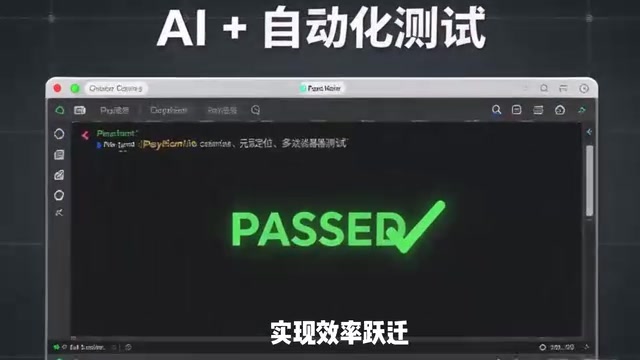
Getting started requires mastering two key areas: first, the fundamental browser automation control flow — page navigation, clicking, typing, waiting, and other common operations; second, element locator techniques. Locators are often the most fragile part of automated testing — the moment a page's structure changes, scripts break. Playwright's semantic locators (such as locating by role or by text) significantly improve script stability. The tutorial emphasizes cross-browser compatibility in practice, meaning the same test suite can be reused across different browser environments — particularly valuable for ensuring consistent behavior across platforms.
It's worth understanding the core differences between Playwright and Selenium. Selenium was born in 2004 and has long relied on the WebDriver protocol to communicate with browsers via HTTP — an architecture that results in slower execution and race conditions when network fluctuations occur. Playwright communicates directly with the browser process using the Chrome DevTools Protocol (CDP), bypassing the intermediary layer for faster execution and more reliable waiting behavior. More importantly, Playwright features built-in auto-wait — it automatically checks whether an element is visible and interactable before performing an action, dramatically reducing flaky tests caused by page load timing issues. On the locator front, Playwright recommends using getByRole, getByText, getByLabel, and similar user-perspective locators that are far less tightly coupled to the underlying DOM structure than XPath or CSS selectors. When developers refactor HTML or adjust styles, test scripts no longer need to be updated — fundamentally lowering maintenance costs.
API Automation: AI Agents Connecting the Full Testing Pipeline
The second layer goes deeper, moving from the UI layer to the API layer. While UI automation is intuitive, it's slow to execute and expensive to maintain. API testing is faster, more stable, and forms the backbone of the automated testing pyramid.

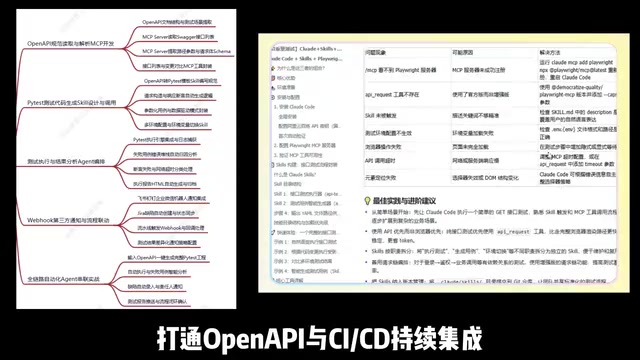
The core of this module is using AI agents to drive API testing, covering the complete pipeline from request construction and assertion validation to continuous integration. The tutorial highlights end-to-end integration with pytest's assertion mechanism — pytest, as the mainstream testing framework in the Python ecosystem, provides the foundational assertion and parameterization capabilities for API testing. Taking it further, by integrating with OpenAPI specifications, AI agents can directly read API documentation and automatically generate corresponding test cases, eliminating repetitive manual authoring.
Connecting these tests to a CI/CD pipeline is the critical step that makes automation genuinely valuable. Only when tests run automatically on every code commit does a fast feedback loop form — catching defects early before they compound.
The OpenAPI specification (formerly known as Swagger) is the standard format for describing RESTful APIs, defining endpoint paths, request parameters, response schemas, and authentication methods in JSON or YAML. Its machine-readable nature makes it a natural fit for AI agents to parse — after reading an OpenAPI document, an agent can automatically extract each endpoint's input types, required fields, and response schemas, then generate test cases covering happy paths, boundary values, and error conditions, without any manual case-by-case authoring. The real value here is that when API documentation is updated, test cases can be automatically regenerated to stay in sync with the backend implementation — solving the long-standing pain point of documentation and test cases falling out of sync. pytest's parameterization feature (@pytest.mark.parametrize) is the key mechanism for batch-executing these auto-generated cases, looping the same test logic over different datasets and further amplifying the coverage advantages of AI-generated cases.
AI + Agent: Advanced Testing with Claude Code
The third layer is the advanced centerpiece of the entire system and the part that most fully embodies the "AI-driven" philosophy. This is where Claude Code is introduced to drive agents that control browsers, enabling a higher level of intelligent testing.
Unlike traditional scripts, agent-driven testing is closer to a "describe your intent, execute automatically" paradigm. Test engineers express testing objectives in natural language, and agents decompose those goals into steps, invoking browser tools to carry them out. This module also introduces two concepts worth paying close attention to:
Skills Design
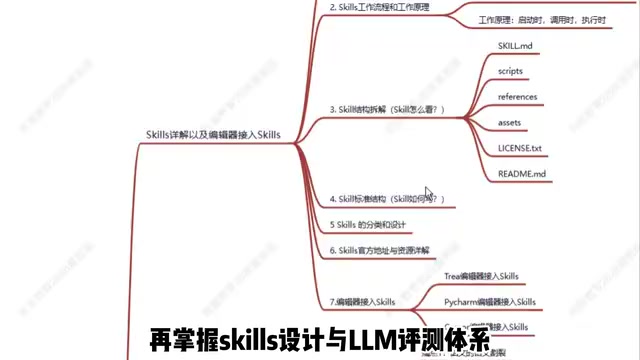
Skills are reusable capability units for agents. Thoughtful Skills design allows agents to flexibly combine and invoke different capabilities across varied testing scenarios, rather than starting from scratch each time. Think of it as building a "testing toolbox" for your intelligent agent.
LLM Evaluation Framework
Once large models are introduced into testing, evaluating the quality of model outputs becomes a new challenge. The tutorial proposes building an LLM evaluation framework — an immediate necessity in today's AI application testing landscape. Whether you're testing AI-powered features or assessing the reliability of agent execution, a quantifiable set of evaluation criteria is essential.
LLM Evaluation is an emerging specialty within AI application engineering. The difficulty lies in the probabilistic and open-ended nature of large model outputs — you can't judge correctness using a simple "expected value equals actual value" check like you would in traditional software. Commonly used evaluation dimensions in the industry include: accuracy (does the output align with facts), relevance (does it address the user's actual intent), consistency (does the same input produce stable outputs), and safety (does it avoid triggering harmful content). Evaluation methods typically combine rule-based judgment (such as regex matching and JSON Schema validation), comparison against human-annotated golden datasets, and the "LLM-as-Judge" pattern (using one model to evaluate another model's outputs). In AI testing agent scenarios, the evaluation framework must also cover whether an agent's action sequence is rational, whether tool calls are correct, and the false positive and false negative rates of the final test conclusions — these metrics collectively determine the trustworthiness of an AI testing system.
The Complete Toolchain: Building Your Own Evaluation System
The three modules build progressively on each other, with the ultimate goal of connecting the complete toolchain from web automation and API automation to AI agent-driven testing.
For learners, the value of this roadmap lies in how it covers both the Playwright fundamentals needed for complete beginners and extends to the AI agent and evaluation capabilities that advanced test engineers need. The direction of the technology stack is clear: automated testing is shifting from "humans write scripts, machines execute" toward "humans define goals, AI executes and self-evaluates."
It's important to maintain a realistic perspective — AI-driven testing does not completely replace human judgment. Cases generated by agents still require human review, and foundational skills in locator strategy, assertion logic, and CI configuration remain critical. AI is more of an efficiency multiplier, and your solid testing engineering foundation determines how deeply you can leverage it.
For testing professionals who want to stay competitive in the age of AI, mastering the combination of Playwright and AI agents is undoubtedly a clear and worthwhile direction to invest in.
Related articles

Felix Rieseberg Personal Homepage
Felix Rieseberg's personal homepage sparks attention on Hacker News. This article covers the Slack engineer's technical background, the rise and fall of nativefier, and the value of a developer homepage as a tech calling card.

@ai-sdk/vue 3.0.306 Patch Release Syncs with [email protected] Update
@ai-sdk/vue 3.0.306 released, synced with [email protected]. A routine patch release for the Vercel AI SDK ecosystem with no public API changes; the Vue adapter layer stays version-aligned with the core package.

Gemini 4 Argon API Launches: The Era of Million-Token Output Begins
Google launches Gemini 4 Argon with sparse MoE architecture, up to 1M output tokens, and a 68.90% Vals Index score, available across API, AI Studio, and the Gemini app.