AI Projects Command 2x the Rates While Traditional IT Struggles to Get Approved: The Real Freelance Market in 2024

AI projects command 2-4x traditional rates—developers should pivot to AI before the window closes.
In today's IT outsourcing market, AI project day rates reach 2-4x those of traditional projects, and enterprise budgets are rapidly shifting toward AI while traditional projects struggle to get approved. Using a seven-figure workflow orchestration system as a case study, this article demonstrates how bidirectional editing between DSL code and visual drag-and-drop solves low-code platform adoption challenges, and shows how small B2B teams can survive among giants by tackling complex scenarios and building open ecosystems. The AI transition window is limited—early movers will build lasting competitive moats.
A 200 RMB Order Sparks a Market Rate Discussion
Recently, an independent developer was criticized as a "race-to-the-bottom price cutter" for accepting a three-day job for just 200 RMB. In reality, it was simply a favor for a follower—far from market rates. But this incident raised a far more important question: What are the real rates in today's IT outsourcing market? And how big is the pricing gap between AI projects and traditional ones?
This article draws from a real independent developer's pricing experiences to analyze the current AI project premium phenomenon, the struggles of traditional projects, and how a workflow orchestration product found its survival niche among industry giants.
AI Project Pricing Revealed: The Premium Is Bigger Than You Think
Independent Developer Day-Rate Ranges
The current market rate for independent developers (sole proprietors) roughly falls between 1,000-3,000 RMB/man-day. Man-day rate is the most common pricing model in IT outsourcing—project fees are calculated based on one person's work output per day. Pricing under this model is influenced by geography, tech stack scarcity, project complexity, and client budget. Senior developers in tier-1 cities (Beijing, Shanghai, Guangzhou, Shenzhen) typically quote 2,000-5,000 RMB per day, while tier-2 and tier-3 cities generally range from 800-2,000 RMB. Due to relatively scarce talent supply and higher technical barriers, AI projects often break through the upper limits of traditional ranges.
Take this developer as an example—his standard rate is 1,500 RMB/day, with AI projects commanding even more.
A real case illustrates the point well: while discussing a manufacturing AI project, he and another developer scoped out over 500 man-days of work for the client. When he quoted 2,000 RMB/day, the client felt it was "too expensive," arguing that a tier-2 city like Changsha should only warrant 1,000-1,200 RMB/day. They eventually compromised at 1,500 RMB/day.
However, a competitor quoted 4,000 RMB/day.
This price gap reveals a key fact: AI projects command a premium far beyond traditional projects. The same technical labor, once tagged with "AI," can command double or even more in the market.
Traditional IT Projects Are Increasingly Hard to Get Approved
An even more alarming trend: Many companies can no longer get traditional projects approved—only AI projects can secure budget sign-off.
There's a deeper macro context behind this. In recent years, from the national "Digital China" strategy to local government subsidies for industrial digitalization, AI projects enjoy natural policy advantages in approval processes. Many enterprises, especially state-owned enterprises and large private companies, set up dedicated "AI/Intelligence" budget lines in their annual IT planning, while traditional informatization projects (like ERP upgrades or OA system renovations) find it increasingly difficult to secure independent budgets. This structural budget shift is the fundamental reason traditional projects struggle to get approved.
What does this mean? For developers still grinding in traditional software development, it's not that you aren't working hard enough—budgets themselves are tilting toward AI. Corporate decision-makers are more willing to allocate funds to AI projects because they align with digital transformation narratives and are easier to report as achievements to leadership.
This developer offered blunt advice: If your current industry and projects are hyper-competitive and exhausting, switch to AI immediately. This window is only open for a few years—once the positions are filled, there won't even be scraps left.
Case Study: Deconstructing a Seven-Figure Workflow Orchestration System
Last year, this developer delivered a workflow orchestration system for a client. The project went through a standard bidding process, with a contract value in the seven-figure range (RMB). Let's break down the product's core capabilities and differentiated design.

Baseline Capabilities: Industry-Standard Features
At the conventional feature level, this platform isn't dramatically different from similar products on the market:
- Multiple triggers: Supporting process initiation from various entry points
- Logic nodes: Boolean conditions, loop iterations, concurrent execution, etc., with drag-and-drop flow generation
- Remote calls: Beyond standard HTTP calls, it supports Dubbo, gRPC, HTTP Cloud, and other protocols. Dubbo is Alibaba's open-source high-performance RPC (Remote Procedure Call) framework, extremely widely used in China's Java ecosystem, particularly excelling in high-concurrency scenarios like e-commerce and finance. gRPC is Google's open-source cross-language RPC framework, built on HTTP/2 and Protocol Buffers serialization, known for efficient binary transmission and strongly-typed interface definitions. Supporting these protocols means the workflow orchestration system can directly invoke an enterprise's existing microservices rather than being limited to simple HTTP REST interfaces—critical for system integration in large enterprises.
- Message middleware: Integration with mainstream message queues
- Third-party app integration: Connecting to applications with open platforms like Vipshop, Tianyancha, Baidu Marketing, etc.
These are "table stakes" capabilities. The real differentiation lies elsewhere.
Core Highlight: Bidirectional Editing Between DSL Code and Visual Design
The product's biggest differentiator is bidirectional editing—full interoperability between DSL code editing and visual drag-and-drop design.
DSL (Domain-Specific Language) is a programming language designed for a specific problem domain. Unlike general-purpose languages like Java or Python, a DSL's syntax and keywords are designed around specific business scenarios, making them more concise and intuitive. In workflow orchestration, DSL is typically used to describe trigger conditions, node logic, data flow, etc. Common workflow DSLs include BPMN's XML descriptions and Temporal's Workflow definitions. Well-designed DSLs allow developers to express complex business logic with minimal code while maintaining readability.
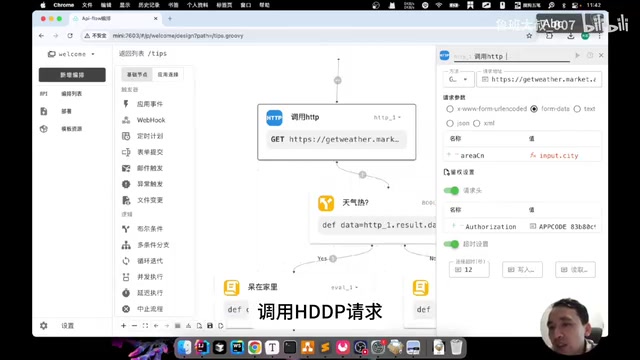
Specifically:
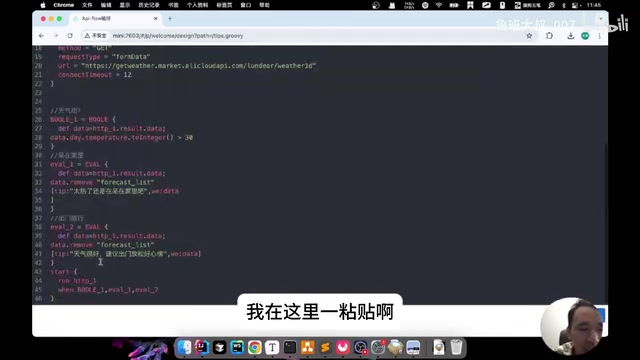
- Professional programmers can directly edit DSL code for higher efficiency and development quality. The DSL is designed to be concise and intuitive—parameters (Premise), request headers, authentication, timeouts are all clear at a glance, and developers can get up to speed quickly with minimal syntax familiarity.
- Non-technical users can generate workflows through drag-and-drop, lowering the entry barrier.
- The two modes switch seamlessly—changes made in code are reflected in real-time on the visual interface, and vice versa.
Even more powerful is the copy-paste capability: you can directly copy a segment of DSL logic (such as a DingTalk message push node) and paste it into another workflow—save and it works. This kind of operation is virtually impossible on pure drag-and-drop platforms.
How Bidirectional Editing Solves the Core Pain Point of Low-Code Platforms
Many enterprises adopt low-code platforms or workflow orchestration tools with the original intention of letting business users build workflows through drag-and-drop. But reality often looks different: Business users can't get it done, so developers end up doing it anyway. And developers working in drag-and-drop platforms are actually less efficient than writing code directly.
This isn't an isolated case—it's a universal challenge facing the low-code industry. Low-code/no-code platforms experienced an investment boom from 2020 to 2022, with Gartner predicting that 70% of new applications would be built on low-code platforms by 2025. In practice, however, many enterprises encountered the "last mile" problem after purchasing low-code platforms: simple forms and approval workflows can indeed be built with drag-and-drop, but once complex business logic, multi-system data integration, or exception handling is involved, business users are out of their depth, and professional developers must step in. Developers working within the constraints of a visual environment are often less efficient than direct coding. This "worst of both worlds" dilemma has led many enterprises to question the ROI of their low-code investments.

Bidirectional editing solves this "have your cake and eat it too" contradiction:
- Simple workflows: business users handle them via drag-and-drop
- Complex logic: developers edit code directly
- Both outputs are fully interoperable—no fragmentation
On the performance front, according to the developer, the engine is 1,000x faster than n8n, and the cost of extending a feature is less than one-tenth of competitors'. n8n is currently one of the most prominent products in the open-source workflow automation space, built on Node.js and known for visual drag-and-drop and rich third-party integrations. Similar products include Apache Airflow (focused on data pipeline orchestration), Temporal (focused on distributed workflows), and domestic options like DingTalk Connector and Feishu Multidimensional Table automation. Each has its strengths: n8n excels in usability and community ecosystem, Airflow in big data scenarios, and Temporal in highly reliable distributed execution. The product discussed here uses DSL-visual bidirectional editing as its differentiating design, attempting to find a unique balance between professional developer efficiency and business user accessibility.
B2B Product Survival Strategy: Finding Your Position Among Giants
B2B Markets Are Not Winner-Take-All Games
People often question: with powerful products from major platforms like Coze already available, why would enterprises use yours?
This developer gave a pragmatic answer: The B2B market absolutely isn't one where only the top three survive—positions 1 through 100 coexist. Unlike C2C markets with their winner-take-all dynamics, B2B (enterprise services) markets are inherently fragmented. This is because different industries and different-sized enterprises have differentiated needs, plus procurement decisions involve compliance reviews, data security, on-premise deployment, after-sales service, and other non-product factors that make it very difficult for any single vendor to serve all customers. Take the CRM market as an example: although Salesforce is the global leader, in China, Fxiaoke, SalesEasy, Cloudcc, and others each dominate specific niches. The workflow orchestration market is the same—large platform products pursue standardization and economies of scale, while small teams can win specific customer segments through deep customization and hands-on service.
B2B products need more than just features:
- Channels: Especially for large enterprises and state-owned companies—without channels, you can't even get in the door
- Differentiation: Unique advantages in specific scenarios
- Service: Customization and personalized responsiveness
- Depth: Ability to handle complex scenarios
As long as your product isn't terrible, you won't starve. Of course, making big money isn't easy either.
Specific Differentiation Tactics
First, do what the giants won't do. Don't compete head-on with Coze or n8n—go after the complex scenarios they can't satisfy. Large platforms pursue universality and scale, and those deeply customized "dirty jobs" that require heavy lifting are precisely where small teams find opportunity. Do enough of them, and you earn your permanent seat.
Second, build an open ecosystem and profit together. Leave specialized work to specialists—channel partners handle sales and client relationships while the product team focuses on technology and delivery.
User Profiles: Who's Paying Attention to Workflow Orchestration Products
Based on current ecosystem member data:
| Purpose | Percentage |
|---|---|
| Learning the technology and source code | 80% |
| Using it in their own enterprise | 48% |
| Starting a business in this space | 45% |
| Building similar development tools | 34% |
| Selling the product through channels | 22% |
80% of people are most interested in learning the technology and source code, indicating that in the current market environment, mastering workflow engine core technology is itself a valuable capability investment. Workflow engines involve a rich technology stack, including DAG (Directed Acyclic Graph) scheduling algorithms, distributed task execution, state machine management, event-driven architecture, and more. These underlying capabilities have broad applications across microservice orchestration, data pipelines, DevOps pipelines, and many other domains—their learning value extends far beyond workflow itself.
Conclusion: The AI Transition Window Won't Wait
The current IT market is undergoing a clear value reassessment: AI projects enjoy premiums while traditional projects face budget contraction. For independent developers and small teams, this is both a challenge and an opportunity.
The key is timing. The high premium on AI projects won't last forever—as more people flood into this track, prices will inevitably rationalize. This mirrors patterns from previous technology waves: in the early mobile internet era, iOS developers' daily rates similarly far exceeded traditional web developers', but as training programs mass-produced talent, the premium disappeared within 3-5 years. The AI field will most likely repeat this cycle, with the specific time window depending on the speed of technology adoption and the growth curve of talent supply.
But before that happens, those who enter early will have accumulated project experience, client resources, and industry knowledge—these are the real moats.
Whether you're transitioning to AI projects or going deep on infrastructure products like workflow orchestration, the core logic is the same: Find a direction the market is willing to pay for, build barriers with differentiated capabilities, and accumulate rapidly during the window of opportunity.
Key Takeaways
- AI project day rates can reach 4,000 RMB, far exceeding the 1,000-1,500 RMB for traditional projects—a clear premium
- Traditional IT projects are increasingly hard to get approved, with budgets concentrating toward AI
- Bidirectional editing (DSL code + visual drag-and-drop) in workflow orchestration systems is the key differentiator solving the enterprise low-code platform adoption challenge
- B2B markets are not winner-take-all—small teams can survive by tackling complex scenarios giants won't touch and building open ecosystems
- The AI transition window is limited—early movers' accumulated project experience and client resources will become long-term moats
Related articles
Meta Muse Hits 900K Downloads in Six D…
Meta Muse Hits 900K Downloads in Six Days: The AI Agent Era Has Officially Arrived
Meta's AI agent Muse hit 902K downloads in 6 days, topping US App Store and Google Play charts above ChatGPT and Claude. A deep dive into Muse's capabilities and the AI Agent race.
 Industry Insights
IRS Fully Embraces Claude AI, Accelerating Federal Government's AI Adoption
The IRS is recruiting staff with 24/7 Claude AI access, marking Anthropic's breakthrough into the federal government. Explore the strategic implications and tax use cases.
 Industry Insights
The IRS Mobile App Debate: A Trust Crisis in Government Digital Transformation
The IRS's proposed mobile app has sparked heated debate. This article analyzes the core arguments, exploring data security, privacy, and the trust crisis in government digital transformation.