AI Proves the Riemann Hypothesis? The Mathematical Revolution and Controversy Behind 170,000 Lines of Code
Anthropic mathematician uses AI to complete a machine-verifiable Riemann Hypothesis proof, sparking questions about human understanding and commercial motives.
Anthropic number theorist Levent Alpoge collaborated for six weeks with a more powerful version of Claude to produce 17 million lines of Lean code, independently verified by the Lean community and MIT, with all five core theorems passing. But the proof's scale far exceeds human readability; although compressed to 76,000 lines and tested, a complete human-readable version has yet to appear, fueling the debate over whether machine verification equals a mathematical proof. A Stanford team released an all-human proof the same day, creating a race between AI-assisted and purely human proofs. The Clay Institute's $1 million prize requires publication, two years of review, and academic acceptance; the Riemann Hypothesis is currently in an intermediate state: machine verification passed, human understanding pending. The incident also involves questions about commercial timing, but the Wall Street Journal clarified that Claude did not solve it autonomously—the mathematician led throughout.
A "Code Proof" That Rewrites Mathematical History
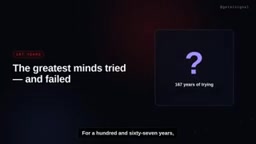
For 167 years, the Riemann Hypothesis has been the most famous unsolved problem in mathematics. It concerns the ultimate law governing the distribution of prime numbers and is one of the seven Millennium Prize Problems for which the Clay Mathematics Institute offers a million-dollar reward. Recently, news from Anthropic broke the calm: a mathematician, assisted by AI, completed a machine-verifiable proof of the Riemann Hypothesis.
According to a breakdown by the YouTube tech channel "AI Signal," Anthropic number theorist Levent Alpoge, while on leave, collaborated for six weeks with an unreleased, more powerful version of Claude, ultimately producing 17 million lines of computer code. This is not a traditional mathematics paper but a formal proof written in the Lean programming language—Lean acts like a spell-checker, verifying every logical step line by line.
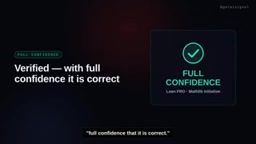
Shortly afterward, the Lean community and the MathLib project announced with "complete confidence" that the proof was correct. Andrew Sutherland of MIT independently checked five core theorems, all of which passed. The news quickly ignited discussion in both the mathematics community and the tech world.
The Riemann Hypothesis was proposed by Bernhard Riemann in 1859, asserting that all non-trivial zeros of the Riemann zeta function lie on the line in the complex plane with real part 1/2. It is closely tied to the distribution of primes: if the conjecture holds, the error term in the prime number theorem would be precisely controlled. It is one of the seven Millennium Prize Problems announced by the Clay Mathematics Institute in 2000, with a $1 million reward. For 167 years, countless mathematicians have tried and failed to conquer it, and it is regarded as a touchstone for testing the limits of mathematical tools.
Lean is an interactive theorem prover and also a programming language based on dependent type theory. Mathematical proofs are written as code in Lean, and every logical deduction is strictly checked by the kernel, so "machine verification" means the proof is impeccable at the level of formal logic. MathLib is the Lean community's mathematics library project, aiming to formalize all undergraduate and graduate mathematics; it currently contains hundreds of thousands of theorems.
Machine Verification ≠ Human Understanding: Controversy Ensues
Although machine verification gave a positive answer, the scale of 17 million lines of code means that almost no human mathematician can read the entire text. Scholars are now working to compress the proof: from the original 17 million lines, some have reduced it to 300,000 lines, and even to a 76,000-line version, and Sutherland has also tested these shortened versions and confirmed they are equally correct. However, a complete, human-readable proof has yet to appear.
This is the core of the controversy. Some mathematicians point out: does a proof that no one can understand count as a genuine "proof"? Andrew Granville bluntly criticized the public materials as "a mess" and questioned the timing of their release.
There is an essential difference between formal proofs and human-readable proofs: a formal proof is a sequence of symbols for machine checking, potentially extremely long and unintuitive; a human-readable proof relies on high-level mathematical concepts and natural-language exposition, making it easy to understand and communicate. Even if a formal proof is completely correct, if its structure is too large or relies on extensive computer-assisted computation, it may fail to provide mathematical insight to humans. Historically, the machine proof of the Four Color Theorem sparked similar controversy, but the scale of the Riemann Hypothesis proof (17 million lines) far exceeds the former, making the "understandability" problem even more acute.
Same-Day Race: The Human Team's "All-Human" Counterattack
Just one day after the AI proof was announced, Ravi Vakil of Stanford University released a preprint by Alessandro Masullo—a proof written entirely by humans, also targeting the Riemann Hypothesis. Vakil called it a "rushed announcement," originally planned to be polished for a year but released early due to the impact of the AI proof.
Two proofs in one day—one AI-assisted, one rushed out to prove human capability. This dramatic race has been interpreted by outsiders as a collective response by human mathematicians to AI's "invasion."
The Subtle Interweaving of Commerce and Academia
The incident also involves commercial-level skepticism. Alpoge's announcement came shortly after Anthropic's IPO, when the company's valuation reached $1.5 trillion, while the day before the announcement the valuation had fallen. Granville implied that the timing was no coincidence and was intended to stabilize the stock price. Alpoge responded directly, saying such cynical speculation is wrong. Anthropic officially did not respond to Nature's request for comment.
The Wall Street Journal report also clarified a key fact: Claude did not solve it autonomously; Alpoge guided it step by step throughout, and the mathematician always held the reins. This was more a deep exploration of human-machine collaboration than an independent AI victory.
Cautious Affirmation from Scholars Such as Terence Tao
Several top mathematicians gave preliminary affirmation to the mathematical content of the proof. After an early review, Terence Tao said the proof appeared to use the full power of modern number theory, including the Langlands program and arithmetic geometry. Fields Medalist James Maynard gave a concise assessment: "If fully verified, this is obviously a milestone."
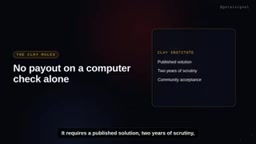
But the Clay Mathematics Institute's million-dollar prize will not be awarded on the basis of machine verification. According to the rules, formal publication, two years of rigorous review, and broad acceptance by the mathematics community are required. Therefore, the current status of the Riemann Hypothesis is: machine verification passed, human understanding not yet complete.
The Langlands program is a vast network of conjectures in mathematics, proposed by Robert Langlands in 1967, linking number theory, representation theory, and algebraic geometry. It predicts a deep correspondence between Galois representations and automorphic forms, and has been hailed as a "grand unified theory of mathematics." Arithmetic geometry is the discipline that studies number-theoretic problems using algebraic geometry methods, such as elliptic curves and modular forms. What Tao meant by "the full power of modern number theory" refers precisely to these advanced tools—they are usually far removed from elementary proofs, and if the Riemann Hypothesis proof indeed relies on them, its verification and simplification will be extremely difficult.
A Broader Signal: AI Is Becoming a Subject of Scientific Discovery
The Riemann Hypothesis is not an isolated case. In the same week, DeepMind announced that its AI agent could autonomously design experiments, decide what to test, and allocate computational resources without prior human approval. Another Millennium Prize Problem, the Navier-Stokes equations, has also seen attempts at AI-assisted proofs.
These events point to a clear trend: AI is shifting from "answering questions" to "conducting scientific research." The role of mathematicians is being redefined—from lone prover tackling problems alone to architect designing verification frameworks and guiding AI exploration.
Three things worth watching next: progress on translating the proof into human-readable form, the final fate of Masullo's all-human proof, and the Clay Institute's lengthy review. Regardless of the outcome, this November has already proven one thing: the way mathematics is researched can never go back to how it was.
Related articles
AI Proved the Riemann Hypothesis, Yet No One Understands It: The Gap Between Machine Verification and Human Understanding
An AI and a mathematician produced a 17-million-line Riemann Hypothesis proof that passes computer verification yet no one understands. This article explores the gap between machine verification and human understanding, and the division of knowledge work in the AI era.
Can AI Crack the Riemann Hypothesis? New Hope for the Million-Dollar Math Puzzle
The Riemann Hypothesis carries a million-dollar bounty. Can AI help crack this math puzzle? This article examines the conjecture's origins, the difference between verification and proof, and AI's real role and limits in mathematical research.
AI Cracks the Riemann Hypothesis? 17 Million Lines of Code Send Shockwaves Through Mathematics
In November 2026, Anthropic mathematicians and Claude complete a machine-verified proof of the Riemann Hypothesis — 17 million lines of code pass five independent theorem checks. Yet the mathematics community falls silent: does a proof no human can read through count as a solution?