AI Public Benchmarks: Why Free Access to Information Matters
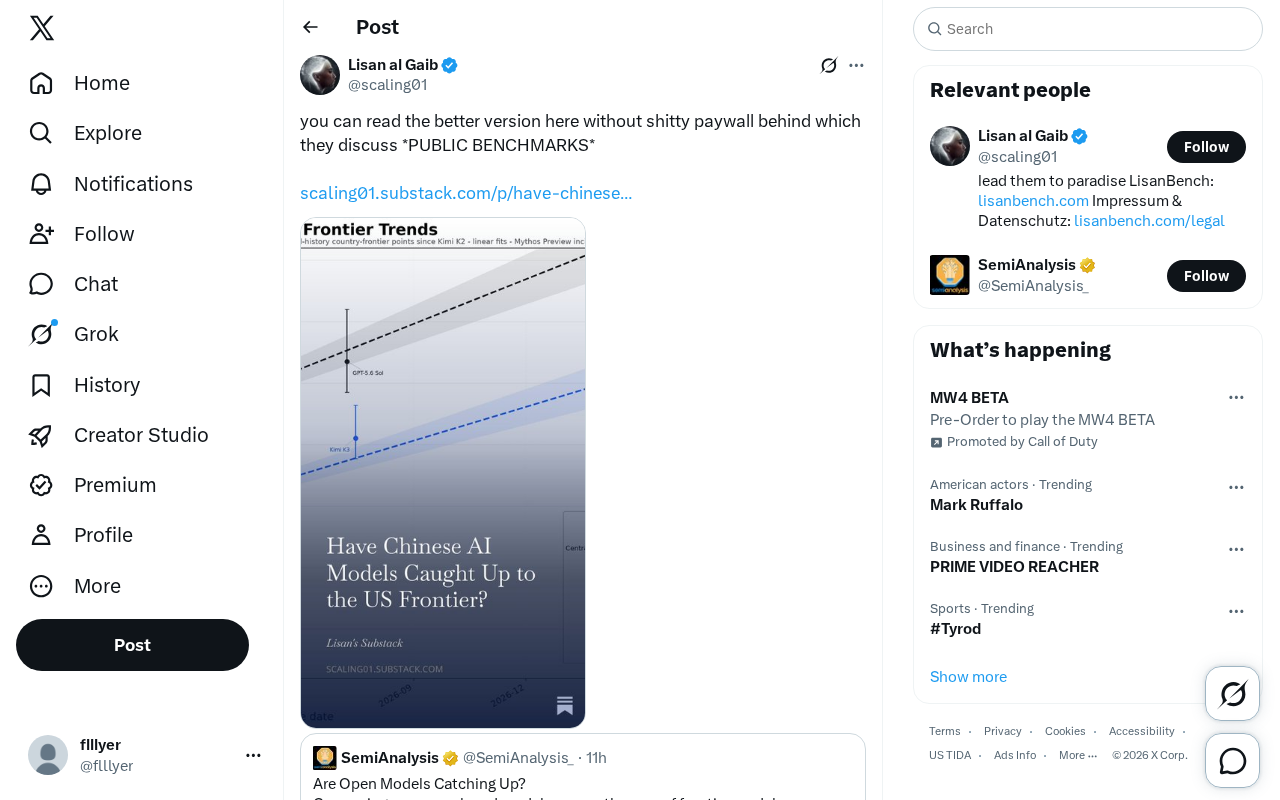
Why AI public benchmark analyses should remain freely accessible and what paywalls mean for the industry.
This article examines the growing debate around paywalling analyses of AI public benchmarks, exploring the tension between content monetization and knowledge sharing. It covers what public benchmarks are, the data contamination challenge, the open-source community's self-organizing response to information barriers, and practical advice for AI practitioners on evaluating benchmark results from diverse, accessible sources.
Introduction: The Value of Public Benchmarks
As AI technology iterates at breakneck speed, how we evaluate model performance has become increasingly important. A recent discussion on social media zeroed in on the accessibility of public benchmarks — specifically, why some high-quality technical analyses are locked behind paywalls when they arguably should be freely available as public knowledge.
This debate touches on a long-standing tension in the AI industry: the conflict between technical transparency and content monetization. When it comes to information with public value like public benchmarks, the presence of paywalls often triggers strong pushback from the community.
What Are AI Public Benchmarks?
Definition and Core Purpose
Public benchmarks are standardized tools for evaluating AI model capabilities. Through a unified set of tasks, scoring criteria, and testing procedures, they allow different models to demonstrate their performance under comparable conditions. Common benchmarks span dimensions including language understanding, reasoning, code generation, math problem-solving, and more.
The most influential public benchmarks in the AI field today include MMLU (Massive Multitask Language Understanding, covering 57 subjects), HumanEval (for evaluating code generation), GSM8K (elementary math reasoning), HellaSwag (commonsense reasoning), and more recently GPQA (graduate-level science Q&A) and SWE-bench (real-world software engineering tasks). These benchmarks are typically maintained by academic institutions or open-source communities, with test sets, scoring scripts, and leaderboards all publicly accessible. Notably, as large model capabilities have rapidly improved, many early benchmarks have become saturated — for instance, the score differences among frontier models on MMLU have narrowed to fractions of a percentage point, driving the emergence of harder benchmarks like MMLU-Pro and ARC-AGI.
Unlike proprietary internal tests run by vendors, the core value of public benchmarks lies in their reproducibility and transparency. Any researcher or developer can verify results using the same test sets, providing the entire industry with a relatively objective frame of reference.
Why the Emphasis on "Public"
The original discussion deliberately emphasized "PUBLIC BENCHMARKS" with asterisks, and the message behind it is clear: if the tests themselves are public in nature, then the analyses and discussions surrounding them should also remain openly accessible. Locking information that belongs in the public domain behind a paywall, to some extent, betrays the very purpose of public benchmarks.
However, a core challenge facing public benchmarks is the issue of "data contamination": since test sets are publicly visible, model training data may include benchmark questions and answers, inflating scores without reflecting true capabilities. To combat this, some organizations have adopted "closed evaluation" strategies — for example, Scale AI's SEAL Leaderboard and LMSYS's Chatbot Arena use a real-time Elo rating mechanism, where the latter evaluates model performance through blind-test voting by real users, effectively avoiding data leakage. Yet this raises another layer of discussion: as more high-quality evaluations shift toward closed or semi-closed models, is the "public" nature of public benchmarks being eroded? This is the deeper reason why the community is so sensitive about information accessibility.
The Deeper Logic Behind the Paywall Controversy
The Conflict Between Content Monetization and Knowledge Sharing
The original discussion bluntly criticized the paywall approach. This sentiment reflects a fairly widespread stance within the tech community: technical knowledge — especially analyses built on public resources — should circulate as freely as possible.
From the content creator's perspective, paywalls are one business model for sustaining high-quality content production. In-depth benchmark analyses require significant time investment in data organization, reproduction verification, and result interpretation — labor that genuinely deserves compensation. However, when the subject of analysis is public data, readers often find it hard to accept paying for "secondarily processed" public information.
The content monetization dilemma in AI is not an isolated phenomenon — it's a microcosm of the broader transformation in tech media ecosystems. From early advertising models to today's subscription models driven by platforms like Substack and Patreon, the business model for deep technical analysis has undergone dramatic changes. Outlets like The Information and Semafor put AI industry analyses behind paywalls, while community-driven platforms like Hugging Face's Open LLM Leaderboard and Papers With Code remain fully open. This divergence reflects a fundamental economic question: high-quality technical analysis has the characteristics of a "quasi-public good" — its marginal consumption cost is near zero, but its production cost is quite high. How to balance incentivizing creators to keep producing with ensuring community knowledge sharing remains an unsolved puzzle.
The Tech Community's Self-Organizing Response
Interestingly, the core action in the original post was sharing a free alternative version. This exemplifies a typical self-organizing behavior in the tech community — when valuable information is artificially gated, community members proactively seek out and distribute free alternatives.
This phenomenon is especially common in the AI field. The deep roots of open-source culture predispose practitioners toward free information sharing, making paywalls feel out of place in such a cultural context. The tech community's resistance to paywalls is deeply rooted in the broader open-source movement tradition. From Richard Stallman launching the GNU Project in 1983, to the collaborative development of the Linux kernel, to Meta's recent open-sourcing of the LLaMA model series and Stability AI's release of Stable Diffusion, the open-source ethos has consistently been a vital driver of technological innovation. The prevalence of the arXiv preprint platform ensures that AI research papers become freely accessible to researchers worldwide almost as soon as they're published — a stark contrast to the steep subscription fees of traditional academic publishing. In this cultural atmosphere, community members not only expect free access to information but actively participate in its reproduction — from Reddit's r/LocalLLaMA community to various Discord tech channels, volunteer-driven knowledge-sharing networks form an indispensable part of the AI ecosystem's infrastructure.
Practical Takeaways for AI Practitioners
How to Properly Interpret Benchmark Results
For practitioners focused on AI model evaluation, accessing raw public benchmark data and multi-source analyses is crucial. Interpretations from a single source may carry bias or selective framing, while cross-validation from multiple channels helps us understand a model's true capabilities more comprehensively.
When accessing benchmark information, prioritize the following:
- Source of the raw test data: Confirm the benchmark's openness and credibility
- Analytical methodology: Understand the evaluation dimensions and criteria used by the analyst
- Comparison of multiple perspectives: Avoid being swayed by a single viewpoint
- Completeness of test conditions: Pay attention to performance differences under various parameter settings
How Information Accessibility Impacts Industry Development
This debate about paywalls reminds us that information accessibility is a critical issue in the democratization of AI technology. When core technical evaluation information is monopolized by a few paid channels, it can exacerbate inequality in knowledge access and undermine the healthy development of the entire ecosystem.
Inequality in information accessibility produces concrete, far-reaching consequences in the AI field. For resource-constrained startups, research institutions in developing countries, and independent developers, if key model evaluation information is locked behind paid channels, they face a clear disadvantage in technology selection, model deployment, and R&D direction decisions. Take large language model selection as an example: an accurate benchmark comparison analysis can directly influence whether a company chooses GPT-4o, Claude, Gemini, or an open-source model — a decision with implications for hundreds of thousands of dollars in API costs and product performance. When such information becomes paid content, it effectively uses economic barriers to filter who gets to make more informed technical decisions. This is precisely why platforms like Hugging Face insist on keeping model evaluation tools and leaderboards fully open-source — they consider it a foundational condition for maintaining fair competition in the AI ecosystem.
Conclusion
As a critical evaluation tool for the AI industry, the value of public benchmarks lies not only in the test results themselves but also in the open discussions that unfold around them. What appears to be a simple act of "bypassing a paywall" actually reflects the tech community's deep-seated demand for the free flow of information.
For every AI practitioner, maintaining awareness of diverse information sources and developing the ability to independently evaluate benchmarks may be more important than chasing any single "authoritative analysis." In the ongoing tug-of-war between information barriers and open sharing, the power of the community remains a crucial force driving transparency.
Related articles

GPT-6 Astra Voice Mode Hands-On: A Voice-Driven Personal Automation Operating System
In-depth analysis of GPT-6 Astra voice mode demo, showing how voice commands complete video-to-article conversion, landing page building, calendar management, and more. Codex-powered multi-threaded collaboration is redefining AI automation workflows.

A Complete Guide to AI OCR for Large PDF Documents with 1000+ Pages
How to handle OCR for 1000+ page scanned PDFs using AI: covers Gemini batch calls, Tesseract, PaddleOCR, and cloud OCR services with accuracy, cost, and speed comparisons.

DeepSeek Harness Open Source Explosion: Deep Dive into Plugin Hot-Swapping Architecture
DeepSeek Harness open-source coding framework hits 150K GitHub stars with "everything is a plugin" architecture rivaling Claude Code. Deep dive into dynamic hot-swapping, trace tracking, and critical security gaps.