AI Reads Through Theoretical Astrophysics: A Discipline-Scale Knowledge Scanning Experiment
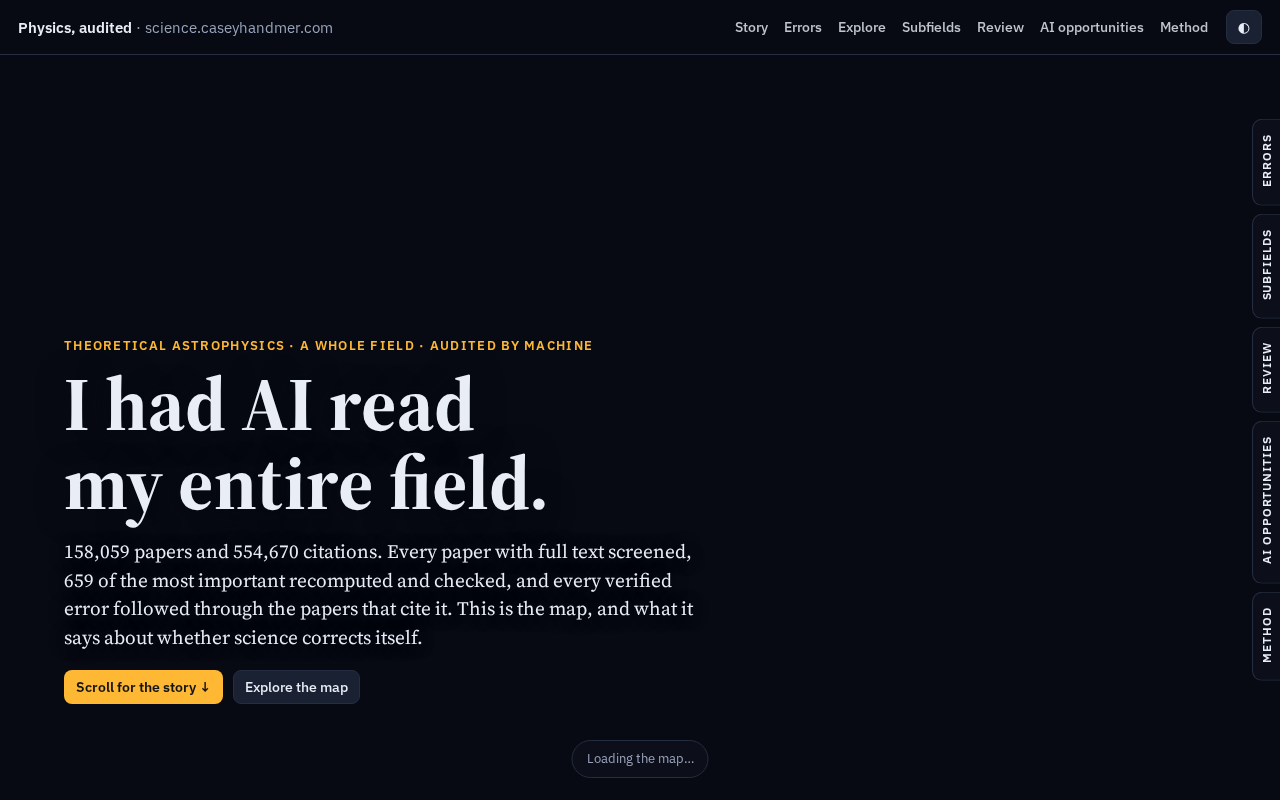
AI reading all of theoretical astrophysics: hard due to corpus aggregation and formula loss, valuable for shifting cognitive burden—not replacing close reading.
The article examines an experiment having AI read the whole theoretical astrophysics literature. The real bottleneck is not model reading ability but information loss of formulas, figures, and citations during corpus aggregation. Output value depends on synthesis granularity. Such tools shift researchers' cognitive burden from information collection to judgment and verification, but can't replace close reading or physical intuition. Pitfalls include confusing reading with understanding, citation networks with knowledge structures, and formula derivations hard to reconstruct from text. Machine-readability of disciplinary knowledge is becoming hidden research infrastructure.
When AI Is Asked to Read an Entire Field of Theoretical Astrophysics
A researcher did something nearly impossible in a traditional academic workflow: had AI read the entire literature of theoretical astrophysics. The experiment was posted on HackerNews with the straightforward title "I had AI read my entire field, Theoretical Astrophysics." The post itself didn't generate much discussion, but it points to a weighty question: when all the public knowledge of a discipline can be consumed by a machine in one pass, what happens to the relationship between researchers and knowledge?
Theoretical astrophysics is a broad field, spanning stellar structure, compact objects, cosmology, and gravitational theory, with literature scattered across preprint platforms, journals, and conference proceedings. Having AI "read through" this field actually involves three layers: aggregating scattered literature into processable corpora, having the model understand and synthesize over the corpus, and then distilling from the synthesis something human researchers can directly use. Each of these three layers has concrete engineering and cognitive challenges.
What "Letting AI Read an Entire Field" Really Means
Corpus Aggregation Is Trickier Than Model Capability
Accessing public literature is not without barriers. Preprints can be downloaded in bulk, but journal papers have copyright and access restrictions, early literature varies in digitization level, and formulas, figures, and citation networks are hard to fully preserve in plain text format. Theoretical astrophysics papers especially rely on mathematical derivation—a key argument is often written between formulas rather than in paragraphs. Feeding such content to a language model incurs structural information loss.
So the first problem这类 experiments must solve is not "can the model understand it" but "how much is left of what's fed in." If the input itself is truncated text with formulas dropped and figures removed, then what the AI reads is only a shadow of the paper.
Preprint platforms like arXiv provide bulk download interfaces, but the structuredness between metadata (authors, categories, citations) and full-text PDFs varies. When converting PDFs to plain text, two-column layouts, LaTeX source versus rendered results of mathematical formulas, and mixed figure captions with body text can all cause information misalignment. More critically, core arguments in theoretical astrophysics papers are often presented as inline formulas or display equation blocks, and most text extraction tools convert formulas into unreadable symbol strings or discard them entirely. This means even if the corpus is complete in quantity, its fidelity to physical semantics may be greatly reduced. Therefore, when building discipline-level corpora, dedicated formula preservation strategies (such as retaining LaTeX source) and layout parsing pipelines are needed; otherwise the model receives only the "textual skeleton" of papers, not complete scientific arguments.
The Granularity of Synthesis Determines the Value of Output
After reading an entire field, AI can produce outputs at different granularities. The coarsest is a topic map: what major directions the field roughly divides into and what questions each cares about. Medium granularity is a method genealogy: what mainstream technical routes exist for a specific problem and how they inherit from and compete with each other. The finest is contradiction identification: which conclusions are in tension across different papers, which assumptions are repeatedly used but rarely tested.
The finer the granularity, the higher the value—but also the higher the demands on corpus completeness and model reasoning capability. Many debates in theoretical astrophysics hide precisely at the level of assumptions. Whether the model can recognize that "two papers use the same word but refer to different physical pictures" is key to judging the success of such experiments.
Contradiction identification in theoretical astrophysics especially depends on sensitivity to physical assumptions. For example, two papers might both discuss "the density profile of dark matter halos," but one assumes an NFW profile and focuses on the inner slope, while the other adopts an Einasto profile and emphasizes outer truncation. If the model matches only by keywords, it will misjudge them as different conclusions on the same problem, when in fact they point to different physical pictures and applicable scales. To identify such deep tensions, the model needs the ability to map textual descriptions onto the parameter space of physical models, not just semantic similarity computation. Current large language models remain weak in cross-paper assumption alignment, often requiring manually constructed domain ontologies or prompt engineering to guide reasoning.
Practical Impact on Researcher Workflows
The Starting Point of Literature Review Moves Earlier
Traditionally, the first step into a new direction is to read review articles, then expand outward along references. This process is time-consuming and easily constrained by the review author's selection bias. If AI can provide a thematic structure covering the entire field, the researcher's starting point shifts from "which review to read" to "verify whether the structure AI provided holds up." The latter still requires extensive reading, but the sense of direction comes faster.
According to the experiment record on HackerNews, its core action is to have AI undertake this panoramic scanning. It doesn't replace close reading, but it can compress "what this field roughly looks like" from weeks of groping into the starting point of a single conversation.
Hypothesis Testing and Gap Identification
Progress in theoretical astrophysics often comes from re-examining existing assumptions. A model that has read through a field's literature can theoretically point out under which observational conditions a class of models is repeatedly cited but lacks independent verification, or which approximations may fail outside small-parameter regimes. Such prompts cannot be taken directly as conclusions, but can serve as a checklist for researchers.
The nuance here is important: the "research gaps" AI identifies often reflect uneven literature distribution rather than judgments of physical importance. Conflating the two is where such tools are most easily misused.
Three Pitfalls to Watch For
Reading Through Is Not Understanding
Language models experience attention dilution when processing long texts—content further back is more easily compressed into a vague impression. The volume of thousands of papers in a field far exceeds what a single context can process in detail. Even with retrieval augmentation or segmented summarization engineering solutions, deep cross-paper associations may still be lost at the aggregation stage.
The "attention dilution" phenomenon of long context windows is especially prominent in discipline-level reading. Even if the model supports contexts of hundreds of thousands of tokens, when the input contains abstracts or full texts of hundreds of papers, the model's ability to extract information located in the middle or end drops significantly—known as the "lost in the middle" effect. Moreover, the engineering approach of segmented summarization followed by aggregation introduces information loss: each segment summary is a lossy compression of the original text, and after multiple compressions, subtle cross-paper associations (such as an approximation condition mentioned in one paper's appendix being cited in another paper's main text) are easily lost. Therefore, outputs from discipline-level reading are better suited as indexes and leads rather than directly citable knowledge conclusions.
The Gap Between Formulas and Physical Intuition
Judgment in theoretical astrophysics is largely built on physical intuition—knowing which approximation is reasonable at a certain order of magnitude and which effect can be neglected. This intuition comes from long-term derivation training and is very difficult to fully reconstruct from text. Models can recite derivation steps but may not be able to judge in new situations which step can be skipped.
Citation Networks Are Not Knowledge Structures
If AI's synthesis relies mainly on citation relationships, what it learns is closer to academic sociology than physics. Highly cited papers are not necessarily the most conceptually critical ones, and key work in niche directions may be systematically undervalued due to sparse citations.
The Real Significance of Such Experiments
Having AI read an entire discipline through is more likely in the short term to produce a "field map" rather than "new physics." Its value lies in shifting researchers' cognitive burden from information collection to judgment and verification, letting people spend time on what only humans can do: what questions are worth answering, and whether a conclusion holds up physically.
Such experiments also expose a reality: the machine-readability of disciplinary knowledge is becoming hidden infrastructure affecting research efficiency. Whichever field has more open literature, more regular formats, and higher structuredness of formulas and data is more easily and effectively scanned by AI. Theoretical astrophysics is not badly positioned in this regard, but it is far from seamless.
For individual researchers, a more pragmatic approach is not to wait for a model that has read an entire field, but to first use AI to complete a structured overview of the subfield they care about, then gradually expand outward. Discipline-level reading is a direction worth watching, but it currently looks more like a research problem than a mature product capability.
One-line Summary
Having AI read through theoretical astrophysics is hard because of corpus aggregation and formula loss; its value is shifting cognitive burden, not replacing close reading.
Paragraph Summary
The article explores an experiment having AI read the entire field of theoretical astrophysics and its implications. The core point: the real bottleneck is not model reading ability but information loss of formulas, figures, and citation networks during corpus aggregation. The value of AI output depends on synthesis granularity—from topic maps to contradiction identification, finer granularity demands higher corpus completeness. For researchers, such tools shift cognitive burden from information collection to judgment and verification, but cannot replace close reading and physical intuition. The article also warns of three pitfalls: reading through is not understanding, citation networks are not knowledge structures, and formula derivations are hard to fully reconstruct from text. Ultimately, it notes that the machine-readability of disciplinary knowledge is becoming hidden infrastructure affecting research efficiency.
Related articles

Convex Skill Allegedly Uploads User App Ideas to Remote Servers Without Consent
Convex backend skill allegedly sends user app ideas to remote servers without disclosure, sparking Hacker News debate. We analyze the privacy risks and transparency issues.

The Coding Data Market Booms: How Frontier Labs Buy Training Data
The coding data market is rapidly expanding, with frontier labs as major buyers. This article analyzes the types of data traded, labs' procurement logic, and concerns such as licensing compliance and data contamination.

M5 MacBook Air Drops $300 for Black Friday — $999 Is the Best Time to Buy
Black Friday deal: 13-inch M5 MacBook Air (16GB+512GB) drops $300 to $999 at Amazon and Best Buy — the lowest price since Apple's June hike. Details and buying advice inside.