AI Reference Links: The Strange Backlinks Showing Up in Search Console

A site owner found blog backlinks mostly coming from AI-style "References" sections — all nofollow, with no search gains.
While tracing backlinks in Google Search Console, a site owner found that links to his blog posts largely came from the "References" sections of articles by unfamiliar authors on platforms like note. Of 31 linking note articles, 29 were from 2026 and 20 used an academic-style citation format resembling AI web research output. But the links were almost all nofollow, produced zero visitors over six months, and the cited posts showed no visible search improvement — they were already ranking between positions 4 and 8 before being cited.
A website owner found something odd in the external links report in Google Search Console: backlinks pointing to his blog posts were pouring in from the "References" sections at the end of articles by a group of authors he had never heard of.
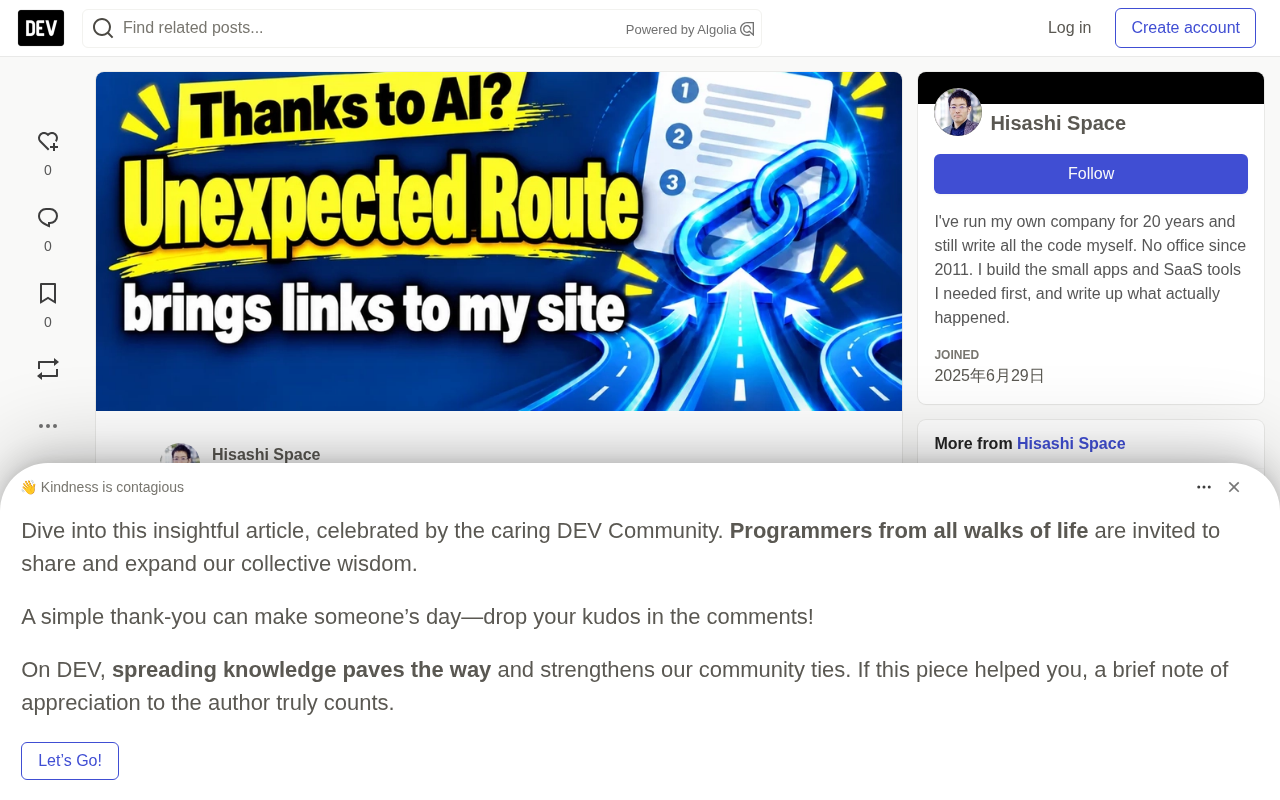
A manual backlink-tracing experiment
The site this owner runs has a total of 799 backlinks in Search Console, the vast majority pointing to the homepage, sourced from established Japanese platforms like Hatena and Yahoo! Japan — nothing out of the ordinary. But when he looked only at the links pointing to blog posts, the pattern suddenly changed: his articles were being listed in the "References" sections at the end of articles by unfamiliar authors.
His tracing process was quite methodical: first he listed all pages with backlinks under "Top linked pages" (98 of them), then filtered out the blog posts (68), then listed the linking sites one by one. For links from note (a major Japanese blogging platform), he had to go one level deeper and pull the specific URL of each linking article. Search Console only shows 25 rows per page, so he paged through to the very end. For the note articles, he pulled the publication date and body text via the public API and read the context around each link article by article.
Where the backlinks actually came from
The 68 blog posts received a total of 125 backlinks from 36 sites. Of these, note accounted for 19, Hatena Blog 5, Yahoo! Japan 3, and the remaining 33 sites each contributed 1 to 6 articles.
The sources of homepage links and blog post links were almost two entirely different groups: the former were still the old links from Hatena and Yahoo! Japan, while the latter came mainly from note and personal blogs. Tracing the note links further down, they ultimately landed on 31 articles. By publication date, 2020 and 2022 had only 2 each, while 2026 had 29 — that number alone is telling.
Those 2 older articles were genuinely about the author's own experiences and mentioned his site in passing. The 29 from 2026 were something else entirely.
The reference format exposed the writing method
Of the 29 articles from 2026, 20 had a section after the main text called "References," "Sources," "情報源," or "引用元," and his articles were listed within them. The format looked roughly like this: number, site name, date, and title arranged in sequence, e.g., [2] Cabinet Office. (2023). Annual Report on the Ageing Society 2023. Some articles also had superscript markers like [1, 2] in the body text.
This style of writing is the citation convention of academic papers, and note articles written by individuals rarely list sources this carefully. Conversely, when you ask an AI to research a topic, the text it returns often looks exactly like this — with a source list attached. Whether an article was written by AI cannot be confirmed from the outside, but the similarity in format is hard to ignore. Some authors even linked to his site from 8 different articles.
Breaking down the 29 by month: 2 in March, 1 in April, 1 in May, 2 in June, 9 in July, 5 in August, 9 in September. July was a clear jump point, after which it stayed at a high level.
The "References" section works as a clue because it corresponds to a typical output form of large language models in web-search mode. When a user asks an AI to "research a topic for me" with web search or retrieval enabled, the model first searches several web pages, then attaches the sources it used as a list at the end when generating the body text.
Different products call this section by different names — common ones include References, Sources, Citations, and in Japanese contexts, 情報源 or 引用元. The format typically follows "number + site name/author + date + title," with superscript markers like [1], [2], or [1, 2] in the body text pointing back to them.
This style originally belongs to academic writing conventions, and individual bloggers rarely follow it strictly. So when a note-style article suddenly features a properly numbered source list, it looks more like an AI research result that was copied and pasted directly, rather than citations an author verified one by one and wrote by hand. Of course, format is only indirect evidence — it's not enough on its own to conclude that an article was AI-generated.
Corporate sites are auto-injecting references
Beyond note, an IT company's owned-media site provided even clearer clues. That site had 11 links pointing to 6 of his articles, with a row of "References" cards at the end of each article. In the page data, these cards carried a "source":"injected" marker — in other words, the article-building system automatically selects related external articles and inserts them afterward.
The total number of reference cards on this site was as high as 65,176. His site wasn't treated specially — other sites writing about similar topics were included too. This looks more like a large-scale automated process than citations handwritten by any individual.
Having the link doesn't mean having traffic
A few easily overlooked counting details: the links in note articles carry rel="nofollow", and all 11 card links on the corporate site are also nofollow, yet Search Console still counts nofollow links as backlinks. In other words, some of the numbers in the backlinks report don't represent real authority transfer.
The author also checked Google Analytics: over more than six months, the number of visitors from that corporate site was zero. Having a link and having visitors are two different things.
nofollow is an attribute value for HTML links, written as rel="nofollow", proposed by Google in 2005 to mark "this link is not one I'm actively recommending." Its core purpose is to tell search engines: don't treat this link as a vote for the target site — that is, don't pass PageRank or other authority signals.
However, Google adjusted the rules in 2019, grouping nofollow together with sponsored and ugc as "hints," meaning search engines may still theoretically use them as one reference signal, just without promising to completely withhold authority transfer. This is also why Search Console's backlinks report still includes nofollow links in its statistics — it's counting "all links discovered," not "links that pass authority."
So there's a gap between the numbers in the backlinks report and actual SEO gains. When a large number of backlinks are nofollow, seeing the number grow doesn't mean authority is growing, much less that rankings or traffic will improve directly.
Did search performance actually change?
The most critical verification is here. For the 19 blog posts cited by note articles, he compared Search Console data for the 21 days before and after they were first cited, using whole-site impression growth as a baseline to filter out site-wide fluctuations.
The result: only 2 posts grew impressions faster than the whole site (and those 2 had fewer than 60 impressions in 21 days), while 17 grew slower than the whole site; average rankings rose for some and fell for others, with no clear direction. Not a single one showed visible search improvement after being cited.
Even more intriguing is another set of numbers: in the 21 days before being cited, the average ranking of all 19 posts fell between positions 4 and 8. In other words, they were already on the first page of search results before being cited. It wasn't that they rose because they were cited — it's that they were cited because they were already ranking well.
Summary
- Backlinks pointing to blog posts came mainly from note and personal blogs, while backlinks to the homepage were still the old links from Hatena and Yahoo! Japan
- Of the 31 linking note articles, 29 were from 2026, and 20 of them linked from a "Sources" section at the end
- The source sections used an academic-style format of number plus site name, date, and title
- These articles increased noticeably starting in July
- The corporate site automatically injects reference cards through its article-building system
- The cited articles showed no visible improvement in search performance, because most links are
nofollow - The articles cited were precisely the ones already ranking on the first page
So far, this whole thing has produced no visible results. But the fact that AI picked out his site as a source when researching a topic gave him a glimpse of some kind of possibility.
Has your site also been listed in the source sections of other people's articles? It might be worth tracing it once in Search Console's backlinks report.
One-line Summary
A site owner traced his blog backlinks and found they mostly came from AI-style "References" sections — all nofollow, with no search gains.
Paragraph Summary
While tracing backlinks in Google Search Console, a site owner discovered that links pointing to his blog posts largely came from the "References" sections at the end of articles by unfamiliar authors on platforms like note. He manually sorted out 125 backlinks across 68 blog posts, sourced mainly from note and personal blogs, clearly different from the old homepage links. Of the 31 linking note articles, 29 were published in 2026, and 20 used an academic-style citation format of number plus site name, date, and title — highly similar to the output of AI web research; one corporate site even auto-injects reference cards through its build system, with a source:"injected" marker in the data. But verification found that these links were almost entirely nofollow, with zero visitors over six months, and the cited blog posts showed no visible improvement in search performance in the 21 days before and after citation — their average ranking was already between 4 and 8 before they were cited.
Related articles

JobRunner MCP Server: AI Agents Can Now Fix Failed Java Jobs
JobRunner launches an open-source MCP server enabling AI agents to view cluster status, diagnose failures, and recover Java jobs—incident response from any cloud coding environment or existing agent.

MLAI Digital Launches 9 Security Agents: MCP Server Safeguards the Full Lifecycle of Agentic AI
MLAI Digital launches Security MCP Server with nine built-in specialized security agents covering vulnerability discovery, attack simulation, prompt injection detection, API and infrastructure assessment, and accelerated remediation—embedding security validation across the full Agentic AI lifecycle from development to production.

Running Isaac Lab on H100 GPUs: Exploring Better Approaches
Exploring optimization methods for running Isaac Lab on NVIDIA H100 GPUs, including MIG configuration, mixed precision, TensorRT acceleration, and community experience to improve robotics simulation and reinforcement learning efficiency.