AI Reshaping Amazon Product Research: From Giving Commands to Socratic Dialogue

Rebuild Amazon product research with AI Agents: MCP data layer, first-principles back-questioning, and reusable Skills for automation.
This article summarizes a live session on using large model Agents to systematically rebuild Amazon product selection workflows. The methodology has three layers: first, MCP must be configured as the data foundation or the model will guess from stale training data; second, the collaboration paradigm must shift from issuing commands to having AI proactively surface hidden constraints via first-principles questioning; third, category viability requires quantifying six dimensions — tiered market size, three monopoly coefficients all below 40%, new product opportunity, $30+ price points, and a return rate/margin trade-off. Once validated, the entire criteria set is packaged into a reusable Skill for daily automated product pushes, with human review retained as the final checkpoint.
In Episode 464 of the Amazon Seller Spirit Master Class live stream, Reagan — an official Amazon content creator — shared a practical methodology for using large model Agents to reimagine product selection and category analysis. The core idea isn't about having AI do the work for you; it's about changing the underlying logic of human-AI collaboration — shifting from passively issuing commands to actively prompting the AI to ask questions back. The following summarizes the key methodology and practical insights from the session.
Note: Due to live platform restrictions, the presenter used tools such as Workbody as substitutes for Codex/GPT-class models in the demo, but the overall approach is consistent — the tool differences do not affect the methodology.
The Biggest Bottleneck in AI-Driven Operations: The Data Foundation
The presenter opened with a pointed question: given the exact same product selection prompt and identical criteria, why do two different people get wildly different results from AI?
The answer is the data foundation. He demonstrated what happens when AI is used for product research without MCP integration — the model's reasoning is riddled with guesswork: "probably under 100K," "maybe around 150K," and it even pulls from year-old product selection articles to recommend categories like TV stands that are already saturated. "When you haven't configured a database for it, AI will just guess its way to an output."
His first iron rule: before using any Skill or prompt as an Amazon seller, configure MCP first. MCP itself doesn't include a workflow — it's purely a database layer. "How to make use of all that data is every operator's own skill." And configuring MCP itself can now be delegated to AI — he demonstrated live how the AI reads a reference link and auto-completes the MCP configuration. "You don't need to do it yourself anymore. Just give AI a conversation."

What impressed him even more was the model's multimodal capability and long-chain reasoning. During competitive research, without anyone manually uploading a single image, the AI directly read competitor listing images and even videos via MCP — assessing whether part numbers were legible, whether installation steps skipped ahead, whether images obscured key areas — and then outputted optimization suggestions. "All of this is prep work that should be done before a new listing goes live."
MCP (Model Context Protocol) is an open protocol introduced by Anthropic in late 2024, designed to standardize how large language models connect to external data sources and tools. Think of it as the "USB port" of the AI world — databases, APIs, and file systems from different vendors can all plug into any MCP-compatible model or Agent as long as they follow the same protocol. For Amazon sellers, configuring MCP means mounting real-time category data, sales estimates, and competitor listing information from tools like Seller Spirit directly into the model's context window, allowing it to query live data rather than relying on static knowledge from training. Without MCP, the model can only "guess" at market size based on outdated parameter memory — which is exactly why, in the demo, AI recommended stale categories like TV stands.
The Paradigm Shift: From "Answering Questions" to "Asking Them"
This was the most critical insight of the entire session. The presenter candidly described his old approach: just throwing a prompt at the AI like "I'm a US marketplace seller looking to sell X category, help me screen products by the following criteria." The problem? Any list of criteria a human writes will have gaps. "Did you include product dimensions? No. Certifications required? Also no." When the output doesn't meet expectations, you patch it, rerun it, burning through tokens and compute in an endless loop.
The new logic is to have AI use first principles to continuously question you. In the conversation he demonstrated, the AI didn't rush to find categories — it first asked: "What's your budget for the new product? What results do you want after launch? What's the maximum loss you're willing to absorb per unit?" Then it drilled deeper round by round into supply chain constraints, sourcing regions, whether the product is fragile or battery-powered, and whether multiple variations are mandatory.
"AI can help a seller who already understands operations make their thinking concrete, but it won't turn someone who knows nothing about operations into an expert overnight." This line captures the tool's real limits — the value of the back-questioning mechanism is to help experienced operators plug gaps, not to replace operational expertise itself.
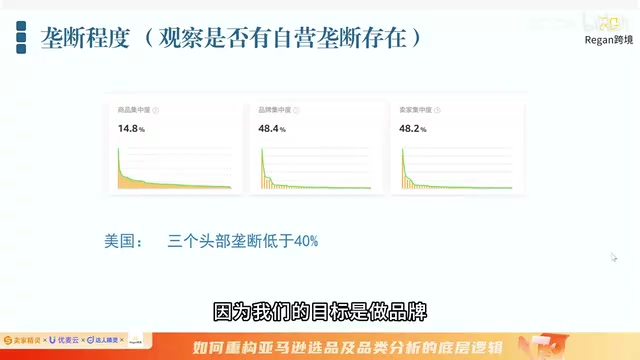
He added two prerequisites for effective collaboration: metrics must be quantified (don't say "a home category with low competition" — say a specific monthly sales range, a monopoly coefficient range, a new product opportunity range); and tools must be standardized (different crawlers estimate sales for the same category differently — Seller Spirit might show 160K, another tool 180K or even 200K; results are only comparable if the measurement standard is unified). He also acknowledged that all third-party data is never 100% accurate — even Seller Spirit's sales estimates run 5 to 10 points high compared to sellers' actual figures. "You can only get as close to the truth as possible."
First Principles Thinking means breaking a problem down to its most fundamental, irreducible assumptions and rebuilding conclusions from scratch, rather than reasoning by analogy from existing experience. In the context of AI collaboration, having the model "question with first principles" means it doesn't accept the user's stated framing — instead, it traces back to the real decision-making constraints behind the request: what's the budget ceiling, what's the maximum acceptable loss, where are the supply chain geographic boundaries? The value here is that humans describing requirements tend to omit constraints they treat as "common sense," while the model's structured questioning systematically surfaces these hidden premises — effectively functioning as a dynamic decision checklist. This explains why the presenter positions "having AI proactively ask questions" as a more fundamental upgrade than optimizing prompts — it changes the direction of information flow, not just the wording of instructions.
The Six-Dimension Model + Nine-Criteria Category Evaluation Framework
Finding a category isn't the finish line — determining whether you can actually compete in it is. The presenter laid out a quantifiable set of category evaluation dimensions:
Market Size Tiers (Amazon US as reference)
- Under 30K: niche market — suitable for sellers with no capital, no supply chain, and no operational experience who just need to survive
- Under 50K: small market
- 50K–150K: small-to-medium market
- 150K–300K: medium market — requires supply chain advantage + operational experience + capital
- 300K–500K: medium-to-large market
- 500K–800K: large market
- 800K+: red ocean — only suitable for teams who deeply dissect subcategories before entering
Core Evaluation Criteria
- Trend: annual growth rate above 5%, in an upward trajectory
- Monopoly level: all three monopoly coefficients (brand, seller, Amazon private label) below 40%
- New product opportunity: 3–5 listings under six months old in the top 100, with new product market share above 3% but below 40%
- Price point: median above $30 — only then is running ads viable
- Pain points: average star rating above 4.2, return rate ideally below 5%
- Profit margin: gross margin above 35% after deducting COGS, freight in, freight out, and commission
He particularly emphasized the trade-off between return rate and profit margin: "The higher the return rate — say it goes from 5% to 10% — the more you pad your margin from 30% to 35%, using profit to absorb the extra losses from returns."
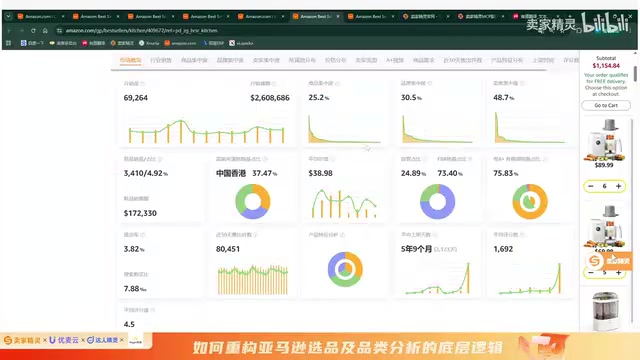
At a more advanced level, he had AI identify categories that Seller Spirit's own filters can't surface — non-complex assembly products, products with supply chains in and around Guangdong, products that don't require multiple mandatory variations. These soft conditions can't simply be checked in a tool — and that's exactly where AI fills the gap.
Case Studies: Drilling Down from the Overall Market to Subcategories
Several live examples reinforced the point that "a healthy overall market doesn't mean you can win in it."
Take the full-length floor mirror (Folios Mirror) category: the overall market is 160K in size, monopoly coefficients below 40%, decent new product opportunity — looks viable on paper. But break it down: rectangular metal-frame mirrors are the largest and most saturated mainstream style; round metal-frame mirrors dominate customer satisfaction; arch mirrors are in growth phase (20K volume, 12 SKUs in the mix); irregular freeform mirrors hold only 5% of the market with about 5K monthly sales — a niche segment. Within the same category, the opportunity varies dramatically by subcategory.
Compare Western flatware sets vs. steak knife and fork sets: standard flatware sets have high barriers to entry (you need 1,000 reviews just to crack the top 100) and low price points — not recommended for small-to-medium sellers. The steak cutlery set subcategory, however, shows 69K in size, new product opportunity of 4.9, average price of $38, return rate of just 3.8%: "worth a closer look."

He was equally blunt about the bad examples. Yoga mats: without filtering criteria, AI returns a result showing a 250K mid-size market, but brand monopoly is 54%, seller monopoly 77%, and Amazon private label over 50%. "What are you going to compete with against those players?" Ultrasonic pest repellers are an even more textbook case — all three monopoly coefficients exceed 60%, and new product market share hits 80%. These are typically built on patents or "black-hat tactics." "Not applicable to most sellers."
Packaging the Workflow into a Skill for an Automated Closed Loop
Once the methodology was validated, the presenter packaged the entire product selection criteria into a reusable Skill — named something like "Amazon US Home Category Small-to-Medium Product Research" — and saved it locally. From that point on, no more typing out long prompt strings. One sentence triggers the whole thing.
He shared how automated his own team has become: in a Feishu (Lark) online spreadsheet, the Skill has been auto-pushing products that meet the filtering criteria every day since August 18th, automatically matching 1688 cost data (requiring a human second-pass judgment). In theory, the full chain — from product research, scheduled product pushes, category analysis, subcategory breakdown, to auto-generating listings — can all be handed off to an Agent. The listing upload step hasn't been fully connected yet due to API integration gaps, and human review remains the final decision checkpoint. "AI can do the screening for you, but AI won't be accountable when you lose money."
The real value of this approach isn't showing off — it's about balancing compute efficiency. The presenter repeatedly mentioned that Codex compute is scarce. The back-questioning approach is precisely a way to reduce token waste from repeated revisions by clarifying information upfront. For Amazon sellers with a solid operational foundation, this is a directly applicable reference for AI collaboration.
Agent in this context refers to an AI system capable of autonomously planning steps, calling external tools, and executing tasks in a loop — distinct from single-turn conversational models. A standard LLM treats each interaction as an isolated Q&A; an Agent can orchestrate multi-step tasks like "screen qualifying categories daily → query 1688 pricing → write to Feishu spreadsheet" as a workflow, without requiring human intervention at each node. Skill is a mechanism for packaging a validated set of instructions and tool-calling logic into a reusable unit — analogous to a function in programming. Once product selection criteria are packaged as a Skill, subsequent invocations need only a single natural-language trigger, and the model automatically expands the full reasoning chain and tool call sequence behind it. This pattern of "package → reuse → auto-schedule" is the core mechanism through which today's AI productivity tools are evolving from single-point assistants into systemic production capabilities.
Related articles

Felix Rieseberg Personal Homepage
Felix Rieseberg's personal homepage sparks attention on Hacker News. This article covers the Slack engineer's technical background, the rise and fall of nativefier, and the value of a developer homepage as a tech calling card.

@ai-sdk/vue 3.0.306 Patch Release Syncs with [email protected] Update
@ai-sdk/vue 3.0.306 released, synced with [email protected]. A routine patch release for the Vercel AI SDK ecosystem with no public API changes; the Vue adapter layer stays version-aligned with the core package.

Gemini 4 Argon API Launches: The Era of Million-Token Output Begins
Google launches Gemini 4 Argon with sparse MoE architecture, up to 1M output tokens, and a 68.90% Vals Index score, available across API, AI Studio, and the Gemini app.